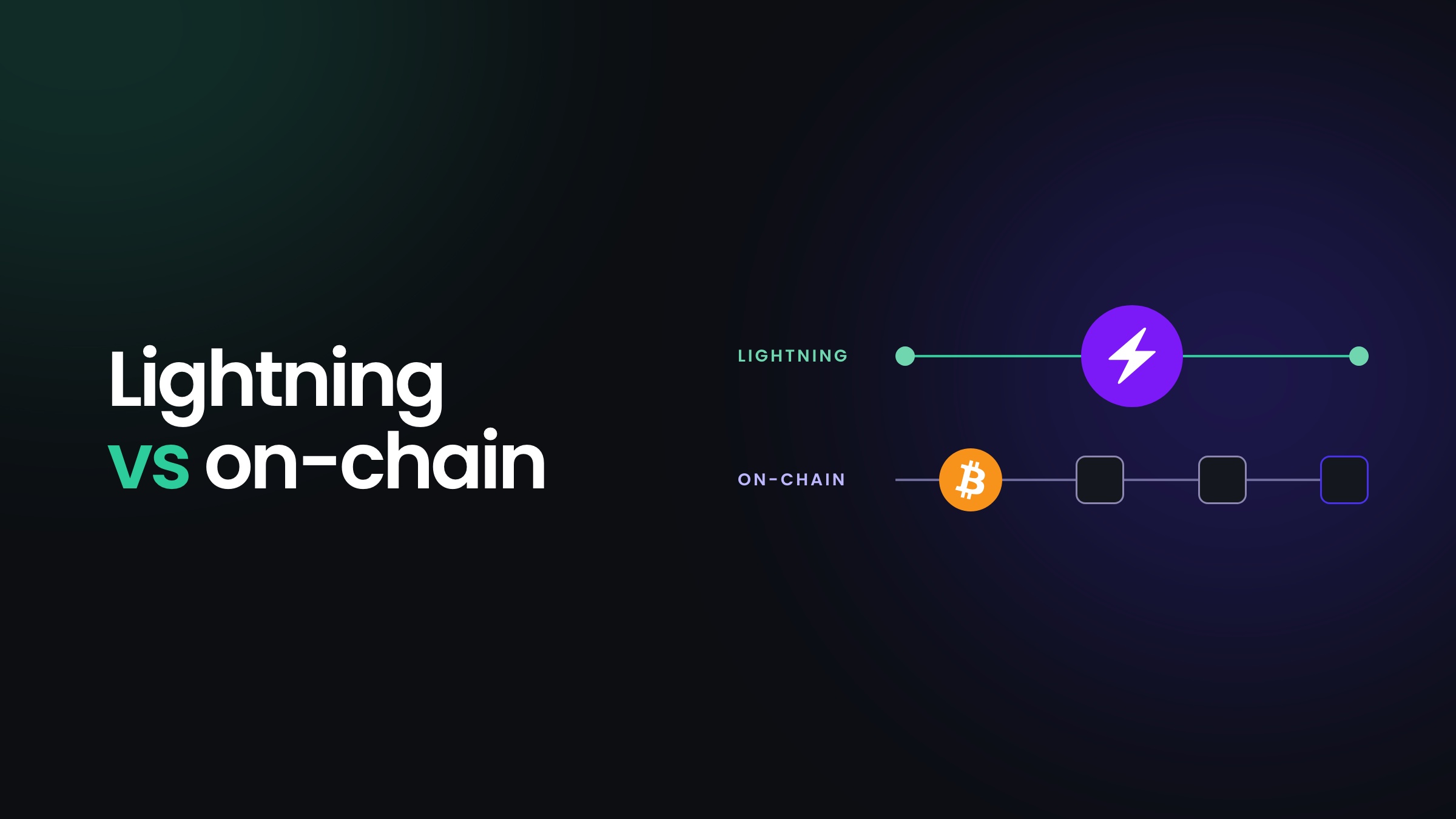


What this review covers
Every crypto product sits on a blockchain API. A wallet that shows a balance calls one. A trading bot calls two or three. An agent that answers what is in a wallet calls one through MCP.
Four layers do that work. Node providers expose raw chain state over RPC. Indexers turn logs into tables you can query. Data APIs return priced, decoded values a screen can render. Swap rails move assets. Most production stacks use at least two of the four.
Twelve providers are ranked below. Tatum is first, because one key covers a Data API, an RPC gateway, notifications, and MPC smart wallets across 130+ networks. CoinStats is the data specialist behind it. Figures come from each vendor’s own docs. A wider 2026 roundup is linked in Sources.
How the scores are built
Six axes, each scored 1 to 5 from public documentation. The total is out of 30, and the rank follows that total. A higher bar sits above a lower one.
- Coverage. How many networks one key reaches, and whether Bitcoin and Solana sit beside EVM chains.
- Depth. Raw hex, decoded transfers, or a priced balance. Deeper output means less code on your side.
- Real-time. WebSocket, gRPC, or webhook push, against REST polling.
- Free tier. What the zero-dollar plan actually allows, and whether the allowance refills.
- Predictability. Whether a month’s bill can be forecast from a request count.
- AI readiness. A native MCP server or a way for an agent to pay per call.
Plans move. Open the pricing page before you sign. The pages behind these numbers are collected at the end.
Quick verdict
- Tatum. Best stack to start from: Data API, RPC, notifications, and wallets on one key.
- CoinStats API. Best decoded data layer when DeFi positions are the product.
- Chainstack. Best managed RPC to put beside it.
- Alchemy. Developer platform: RPC, enhanced APIs, and webhooks, billed in compute units.
- QuickNode. RPC plus Streams that push filtered events into your own systems.
- The Graph. Best custom index, subgraphs and Substreams.
- Codex. Best one-second token and prediction-market feed.
- Ankr. Cheapest broad RPC, with indexed extras on EVM.
- Covalent GoldRush. Best decoded multichain wallet history.
- Jupiter API. Best Solana swap, price, and token specialist.
- Blockchair. Best Bitcoin and UTXO explorer data.
- StealthEX. Best non-custodial swap rail. Execution, with no market data of its own.
The scores below are how that order was built. Tatum leads by a point. The head-to-head table has the public plan behind the number.
Benchmark on six axes
Totals run out of 30. Each axis is scored from 1 to 5. Tatum leads at 27. CoinStats is second at 26. Chainstack is 23, Alchemy 22, QuickNode 21, The Graph 20, Codex 19, Ankr 18, Covalent GoldRush 17, Jupiter 16, Blockchair 15, and StealthEX 14.
| Provider | Coverage | Depth | Real-time | Free tier | Predictability | AI | Total |
|---|---|---|---|---|---|---|---|
| 1. Tatum | 5 | 5 | 5 | 3 | 4 | 5 | 27 |
| 2. CoinStats API | 5 | 5 | 3 | 4 | 4 | 5 | 26 |
| 3. Chainstack | 4 | 1 | 5 | 5 | 5 | 3 | 23 |
| 4. Alchemy | 4 | 3 | 4 | 4 | 3 | 4 | 22 |
| 5. QuickNode | 4 | 2 | 5 | 2 | 4 | 4 | 21 |
| 6. The Graph | 4 | 4 | 3 | 3 | 4 | 2 | 20 |
| 7. Codex | 4 | 4 | 5 | 2 | 2 | 2 | 19 |
| 8. Ankr | 4 | 2 | 4 | 4 | 2 | 2 | 18 |
| 9. Covalent GoldRush | 4 | 4 | 2 | 2 | 2 | 3 | 17 |
| 10. Jupiter API | 1 | 2 | 3 | 2 | 3 | 5 | 16 |
| 11. Blockchair | 2 | 3 | 2 | 3 | 4 | 1 | 15 |
| 12. StealthEX | 3 | 1 | 2 | 4 | 3 | 1 | 14 |
Tatum’s 27 is coverage 5, depth 5, real-time 5, free tier 3, predictability 4, and AI 5. Depth scores what one key returns before you add a second vendor: a Data API, an RPC gateway, notifications, and MPC wallets. Real-time is a 5 because WebSockets and webhooks ship with the key. The free tier stays a 3: 100,000 credits, once, at 3 requests per second. Predictability stays a 4 because archive, debug, and trace weigh more than a standard call.
CoinStats free tier is a 4. The allowance is 20,000 credits a month at 2 requests per second, it refills, and the paid endpoints are on the free plan. Two requests a second is why it stays at 4. Real-time stays a 3: the surface is REST and MCP, while Chainstack, QuickNode, and Codex push by default.
Chainstack’s depth stays at 1. A node that returns hex is scored on chain access. Decoded output is scored on the data APIs. The AI axis is a 3 for published node tooling. Treat a chain-data MCP as something to confirm in their docs before you depend on it.
Alchemy’s free plan refills 30 million compute units a month, and the paid path is usage priced at $0.52 per million compute units rather than a flat $49 bundle. That is why predictability is a 3. QuickNode’s free offer is a one-month trial, which is why its free-tier score is a 2, even though Streams are a 5 on real-time.
What the first paid step actually buys
Three entry plans share a $49 sticker. The unit behind the sticker does not.
Chains per key
Number of Networks
First paid step
USD per month
The left scale is each vendor’s published network count. Tatum is 130+. Jupiter is Solana only, so the bar is 1. StealthEX sits off this scale: it is a swap rail across 2,000+ assets, not a chain list. GoldRush has cited 100+ while its public list has run nearer 45 mainnets. The right scale puts the lowest first paid step at the top and Codex at $350 at the bottom. Alchemy’s $0.52 is per million compute units, The Graph’s $2 is per 100,000 queries, and Blockchair’s $1 is per 1,000 calls. Ankr’s $10 is a deposit. The $49 rows share a sticker with a different unit behind it.
On CoinStats Starter, $49 buys 1,000,000 credits. Their rate-limits page prices a basic market call at 1 to 2 credits, a wallet call at 40 to 50 (4,000 for an xpub, ypub, or zpub), and a DeFi call at 400. Dividing $49 by 1,000,000 credits:
- 1,000 basic market calls at 1 credit: $0.049
- 1,000 basic market calls at 2 credits: $0.098
- 1,000 wallet calls at 40 credits: $1.96
- 1,000 DeFi calls at 400 credits: $19.60
Ten thousand DeFi calls are 4,000,000 credits, which is $196 at that rate, four times the Starter allowance. Their multipliers page also scales some calls when you ask for every network at once, with an “all networks” query described at 10x a named-chain query. Name the chains.
On Chainstack Growth, $49 buys 20,000,000 request units. A full-node call is 1 unit, so using the whole allowance works out to $2.45 per million full-node calls, or about a quarter of a cent per thousand. Archive calls are 2 units, so $4.90 per million if you use the whole allowance the same way. Annual billing on that plan is listed at $40 a month. Overage on Growth is $15 per extra million units. The free Developer plan includes 3 million units a month at 25 requests per second, and extra units there are $20 per million.
Those two dollar figures answer different questions. CoinStats is selling a priced, decoded object. Chainstack is selling hex and a route to submit a transaction. A team that picks the cheaper unit and then builds pricing, decimals, and protocol decoding in house has moved the cost into engineering time.
Tatum Starter is also $49 a month on tatum.io/pricing, for 4 million credits. Plans and limits also lists a 7 million credit Starter option, and Pro and Scale bands above that, all at 200 requests per second. Longer commitments are discounted on the pricing page. We are leaving the per-call dollar figure off this page on purpose: archive, debug, and trace calls cost more than a standard RPC call, and the weight is listed per endpoint. Compare the allowance, then price the endpoint you will actually hit. Credits do not roll over. If you exhaust the plan, the account upgrades to the next tier unless you turn automatic upgrades off. With that switch off, keys stop until the next reset.
Head to head
| Provider | Layer | Coverage | Free tier | Paid entry | Agent access |
|---|---|---|---|---|---|
| 1. Tatum | Data API, RPC gateway, notifications, MPC wallets | 130+ networks. Data API coverage is a subset of the gateway list. | 100,000 lifetime credits, 3 rps, 2 keys, 100 notifications/month | $49/mo, 4M credits, 200 rps | Chain-data MCP and a docs MCP |
| 2. CoinStats API | Market, wallet, DeFi, portfolio, token risk | 120+ chains, 200+ exchanges, 10,000+ DeFi protocols | 20,000 credits/mo, 2 rps | $49/mo, 1M credits, 30 rps | MCP at mcp.coinstats.app/mcp, 20+ tools, x402 |
| 3. Chainstack | Managed RPC and streaming | 70+ blockchains, per the pricing page | 3M request units/mo, 25 rps | $49/mo, 20M units, 250 rps | Confirm current MCP in their docs |
| 4. Alchemy | RPC, enhanced APIs, webhooks, smart wallets | 100+ networks on the chain directory | 30M compute units/mo, 15 rps | Pay as you go, $0.52 per 1M CU | Docs and platform tooling |
| 5. QuickNode | RPC, Streams, webhooks | 130+ networks on the chain catalog | 1-month trial, 10M credits, 15 rps | $49/mo, 80M credits, 50 rps | Streams into your own systems |
| 6. The Graph | Subgraphs, Substreams, Token API | 60+ networks on the marketing site | 100,000 queries/mo | $2 per 100,000 queries | Subgraph MCP, Pinax Token API MCP |
| 7. Codex | Real-time tokens and prediction markets | 80+ networks | 10,000 requests/mo | $350/mo, 1M requests | MCP server, per-call MPP payments |
| 8. Ankr | RPC plus an Advanced API on EVM | 70+ chains. Advanced API on a smaller EVM set. | 200M credits/mo on the freemium account | $10 deposit, $0.10 per 1M credits | Agent RPC MCP |
| 9. Covalent GoldRush | Decoded wallet history | Vendor cites 100+ chains. Public list has run nearer 45 mainnets. | 14-day trial, 25,000 credits | $10/mo, 10,000 credits | Hosted MCP, 50+ tools |
| 10. Jupiter API | Solana swaps, prices, tokens, triggers | Solana | 1 rps with a free key | $25/mo, 10 rps | Trading MCP, large tool surface |
| 11. Blockchair | Explorer API, UTXO chains | 14 chains | 1,000 requests/day | $1 per 1,000 calls | None published |
| 12. StealthEX | Non-custodial swap rail | 2,000+ assets | Free integration | 0.4% inside each quote | None published |
CoinStats is the one on this list with decoded DeFi positions per wallet as a first-class endpoint, priced at 400 credits. Chainstack, Alchemy, QuickNode, Ankr, and Tatum all expose raw node access. StealthEX and Jupiter move assets. The rest of the list reads.
Best blockchain API by use case
Portfolio trackers and wallet apps
Start with CoinStats API. Balances, transactions, DeFi positions, and profit and loss share one schema, including Bitcoin xpub, ypub, and zpub keys. Add Covalent GoldRush when a tax product needs deeper decoded EVM history. Add Blockchair when a Bitcoin dashboard needs chain-level xpub queries. Tatum’s Data API is the alternative when the same team also wants RPC, webhooks, and wallet signing from one vendor. Compare the DeFi endpoint, which is CoinStats’ advantage, before you decide on convenience.
Trading bots and terminals
Codex for one-second token prices, OHLCV, and holder data. CoinStats for portfolio context and token risk checks before the order. Chainstack, Alchemy, or QuickNode for submitting transactions and streaming chain state. Jupiter when the venue is Solana.
AI agents and MCP
CoinStats MCP Server, at https://mcp.coinstats.app/mcp, exposes 20+ tools for prices, wallets, DeFi, and portfolios. Their site also describes an x402 path: an agent pays in USDC from a Base wallet, with no API key. Codex adds a real-time feed and per-call payments. The Graph lets an agent query subgraphs. Jupiter’s Trading MCP returns unsigned Solana transactions, so keys stay in the agent’s wallet. Tatum’s chain-data MCP and the docs MCP at docs.tatum.io cover reads plus the RPC gateway. Use them when the agent has to cross from a decoded balance into a raw call on the same key.
Custom indexing
The Graph. Subgraphs and Substreams produce a schema shaped to one protocol. Chainstack or Ankr supply the archive RPC that indexers read from. Tatum’s gateway can play that RPC role across 130+ networks. It does not replace a subgraph.
Swaps
StealthEX for non-custodial conversion across 2,000+ assets, with the fee inside the quote. Jupiter for Solana-native routing. A data API prices the position. A swap rail moves it.
Bitcoin and UTXO products
Blockchair for explorer dashboards and SQL-style queries. CoinStats for a priced Bitcoin balance beside the rest of a portfolio. Chainstack or Tatum when the product broadcasts its own Bitcoin transactions.
Multichain infrastructure on a budget
Ankr when the goal is cheap EVM RPC plus some indexed token methods. Alchemy when compute-unit pricing and enhanced APIs are acceptable. QuickNode when Streams should land events in systems you already run. Chainstack when the bill has to be forecast and archive access starts at Growth. Tatum when one SDK has to cover RPC, data, notifications, and MPC wallets, and the team accepts credit weights that vary by endpoint.
Data API
Read a wallet before you rank a vendor
Tatum’s Data API returns balances, transactions, token and NFT metadata, fees, and exchange rates. The same key also reaches the RPC gateway, notifications, and MPC smart wallets, across 130+ networks.
tatum.io/blockchain-api1. Tatum
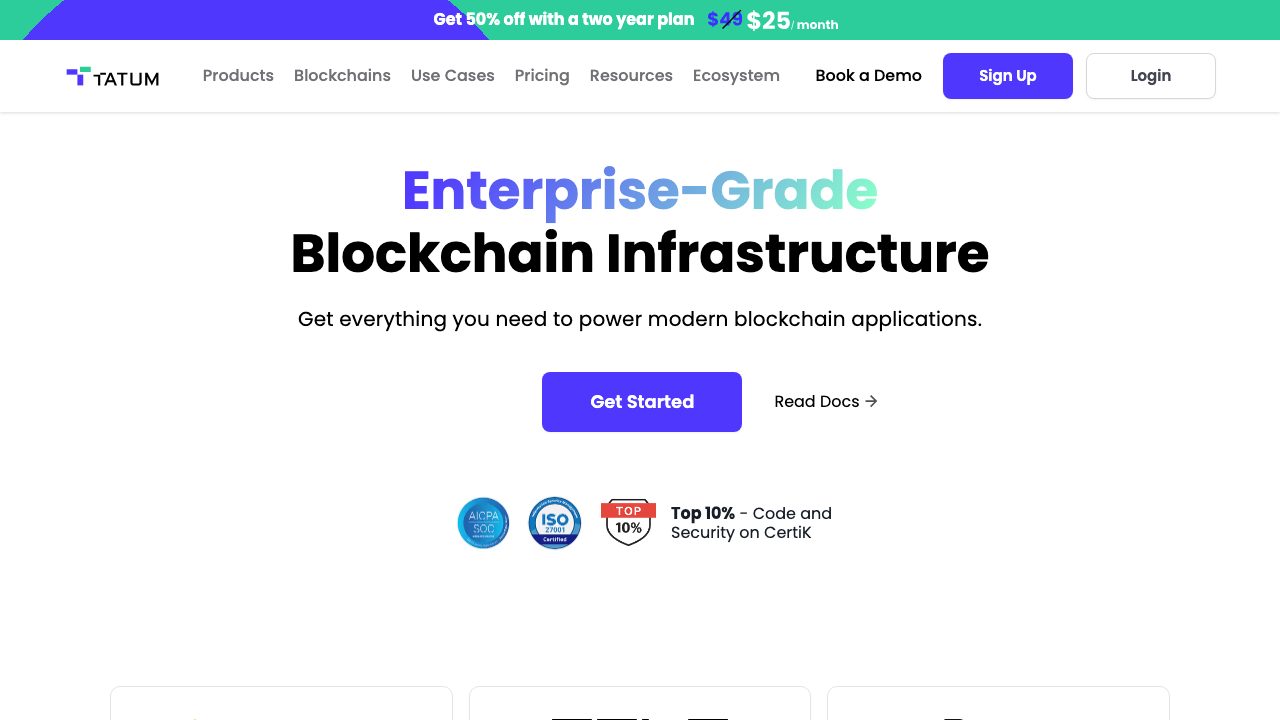
Tatum is first because four products share one key: a Data API (wallets, transactions, prices, tokens, NFTs, fees, name services), an RPC gateway with failover, notifications, and MPC smart wallets. Coverage is 130+ networks. The Data API is the decoded layer on that key. It does not include every method on every network the gateway lists, which is why CoinStats still wins a pure DeFi-position brief.
The free plan is 100,000 credits for the life of the account, 3 requests per second on full nodes, 2 API keys, 100 notifications a month, and 5 notification subscriptions. That is a 3 on the free-tier axis. Starter is $49 a month for 4 million credits at 200 requests per second, with a 7 million credit option also listed. Dedicated keys ($99, $249, $509, and $1,049 a month for 10, 25, 50, and 100 rps) do not draw down plan credits. They buy throughput.
Fits: a product that needs balances, RPC, webhooks, and wallet signing without stitching three vendors.
2. CoinStats API
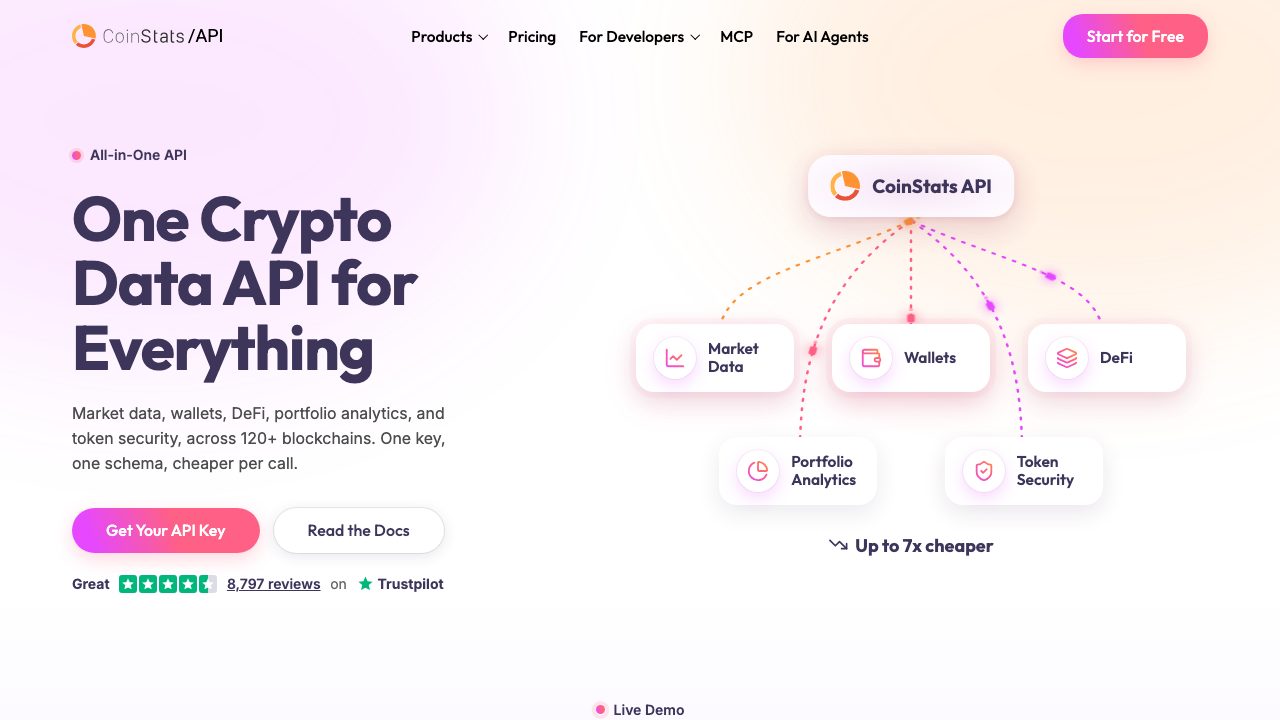
CoinStats is the data layer this stack starts from. The same REST surface covers market data, wallets, DeFi, portfolios, and token risk checks. The MCP tools page describes 100,000+ coins behind that schema. Wallet coverage includes EVM chains, Solana, and Bitcoin, with HD wallet keys on Bitcoin. Exchange accounts, including the large centralized venues, sync through the same family of endpoints. The company says the underlying app serves 1 million people a month. Treat that as a vendor figure.
Free plan: 20,000 credits a month, 2 requests per second, no card, same endpoints as paid. Starter: $49 a month, 1,000,000 credits, 30 requests per second. Pro: $199, 5,000,000 credits, 30 requests per second. Business: $999, 80,000,000 credits, 100 requests per second. Credit weights are in the table above. The /usage/credits endpoint is free. MCP: 20+ tools at https://mcp.coinstats.app/mcp, same credit costs as REST. x402 pay-per-request is described on coinstats.app/api.
Fits: portfolio trackers, tax tools, trading bots that need context before an order, and agents that should read a wallet in one schema.
3. Chainstack
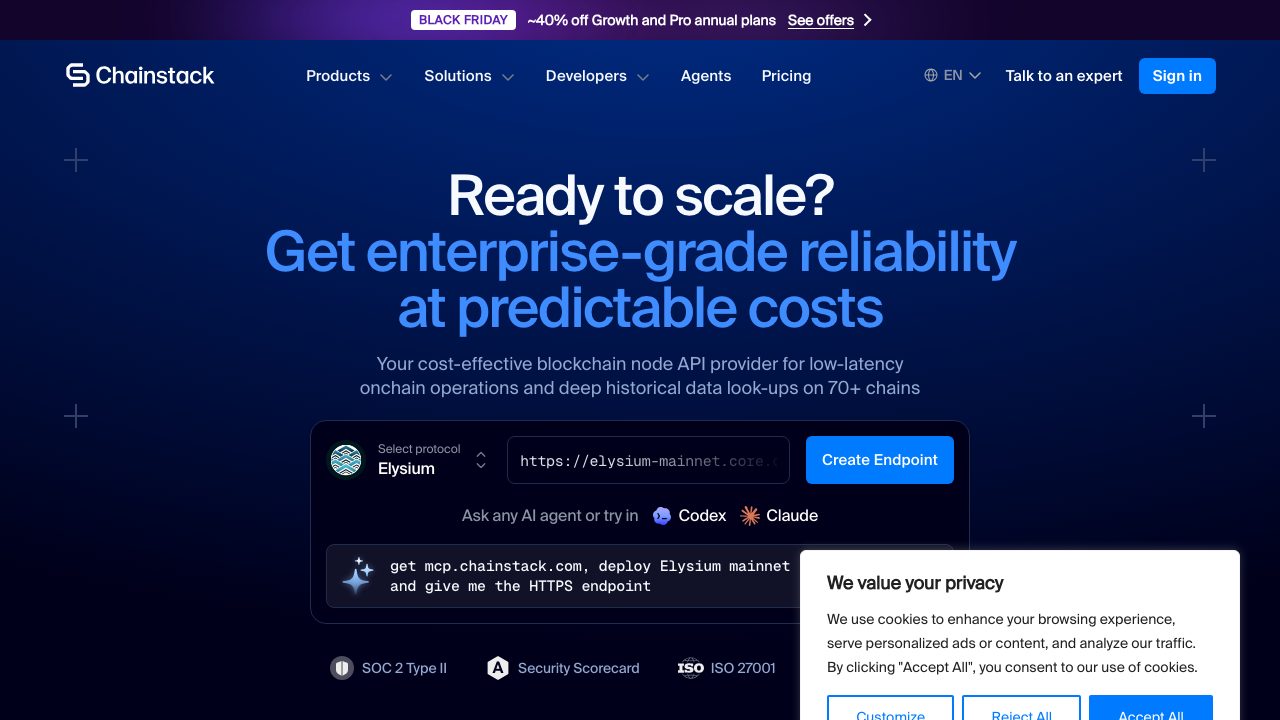
Chainstack runs the node layer. Managed RPC covers the chains on its pricing page, which describes 70+ blockchains, with JSON-RPC and WebSocket access and gRPC on some networks. Global routing sends a call to a healthy region. Archive data and debug and trace APIs unlock on Growth and above. Dedicated nodes start on Pro.
From chainstack.com/pricing.
- Developer: $0, 3,000,000 request units a month, 25 rps, overage $20 per 1M units. Archive and debug/trace are off.
- Growth: $49 a month, or $40 on annual billing, 20,000,000 units, 250 rps, overage $15 per 1M.
- Pro: $199, 80,000,000 units, 400 rps.
- Business: $499, 200,000,000 units, 600 rps.
- Enterprise: from $990, 400,000,000 units.
Full-node calls cost 1 request unit. Archive calls cost 2. That spread is the node type. The pricing intro also says there is no per-method multiplier of the kind some RPC vendors apply to eth_getLogs or traces. Quote both sentences. A monthly bill can be built from a request count plus the archive share. That is rare at this layer, and it is why Chainstack sits second. The Graph, at 20, is the indexer you add when the schema has to be yours.
Fits: bots that read raw state, stream events, and submit transactions. Teams that want the invoice to match a spreadsheet. Indexers that need archive RPC beside The Graph.
4. Alchemy
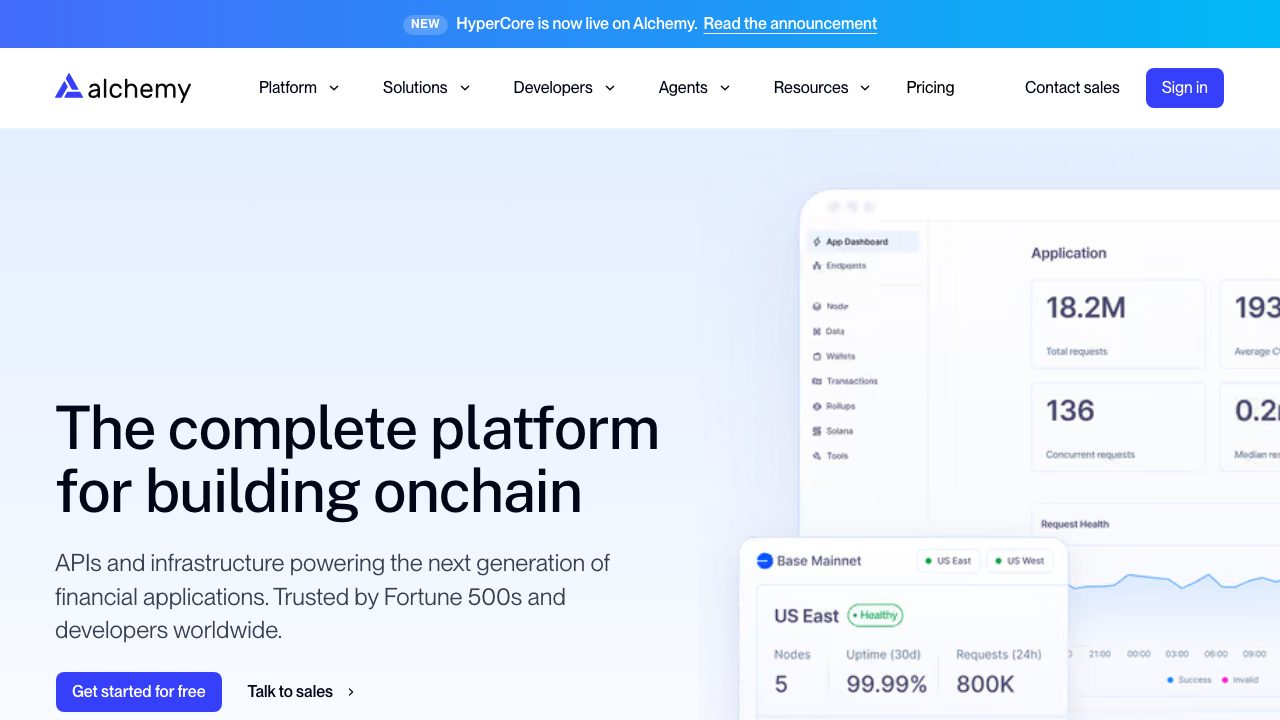
Alchemy is the developer platform most teams already know: JSON-RPC, WebSockets, tracing, enhanced transfer and NFT APIs, prices, webhooks, and an ERC-4337 smart-wallet stack. The chain directory is headlined at 100+ networks. The pricing page lists a free plan of 30 million compute units a month at 15 requests per second, with 5 apps and 5 webhooks. Pay as you go is $0.52 per million compute units, with 300 requests per second included. Throughput above that is a separate monthly charge. A support note still quotes an older $0.45 rate. Use the pricing page.
Fits: product teams that want reliable RPC, decoded transfers, and webhooks without running nodes. Wallets and dapps that also want gas sponsorship on supported chains.
5. QuickNode
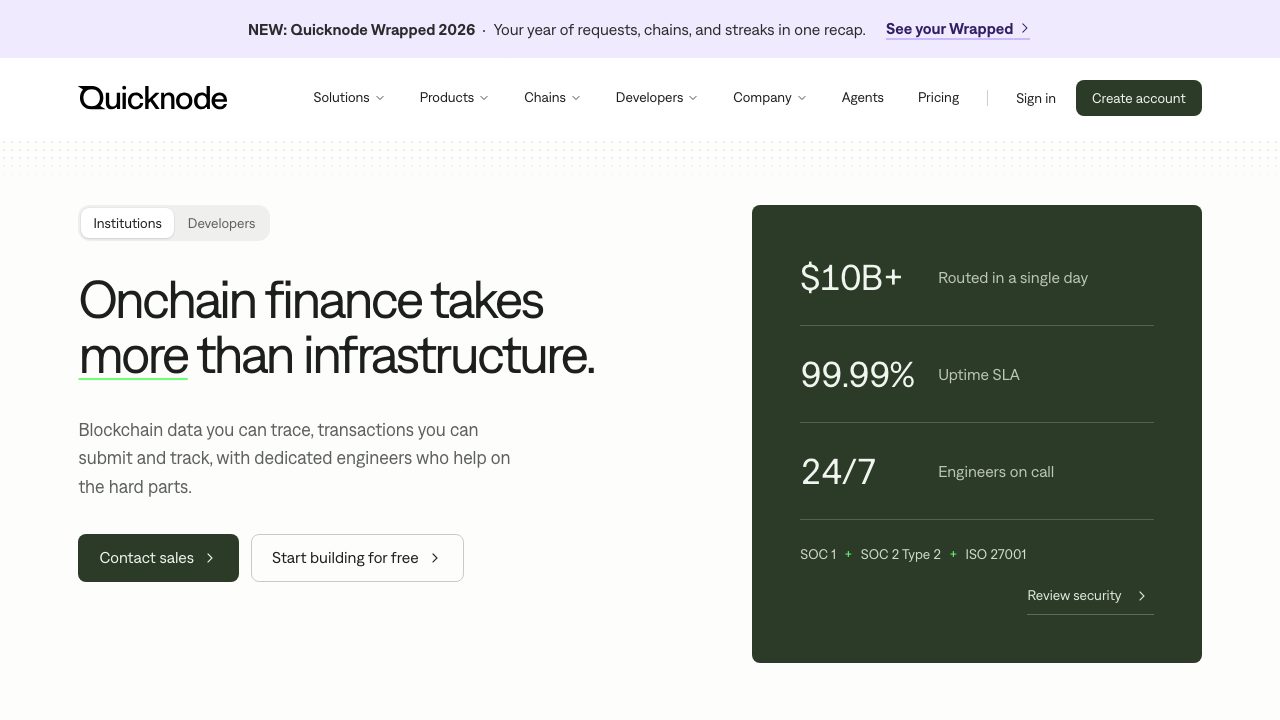
QuickNode wins on delivery. RPC and WebSockets cover a catalog titled 130+ networks, including Bitcoin, Solana, TRON, and TON. Streams filter events on their side and can land them in S3, Kafka, or Postgres. The free offer is a one-month trial: 10 million API credits, 15 requests per second, one endpoint. Build is $49 a month for 80 million credits at 50 requests per second, with Streams and webhooks drawing from the same credit pool. Solana gRPC is an add-on on the lower plans and included further up. Annual billing is listed at about 15% under the monthly price.
Fits: exchanges, analytics, and apps whose hard problem is getting chain events into systems they already run.
6. The Graph
The Graph is the indexing layer. Subgraphs turn contract events into a GraphQL schema. Substreams push the same data into a database sink. A Token API, run with Pinax, adds ready-made REST for balances, transfers, and swaps on a shorter chain list than the full network catalog.
thegraph.com/pricing.md shows 100,000 queries a month free, then $2 per 100,000, payable in GRT or by card. The marketing site sits around 60+ networks, and the docs table runs longer once testnets are included. A Subgraph MCP and a Pinax MCP for Token API are both public. Studio staging endpoints were already being retired. Production traffic needs a published subgraph and a gateway key.
Fits: protocol dashboards, DeFi frontends, and agents that should query one schema you control.
7. Codex
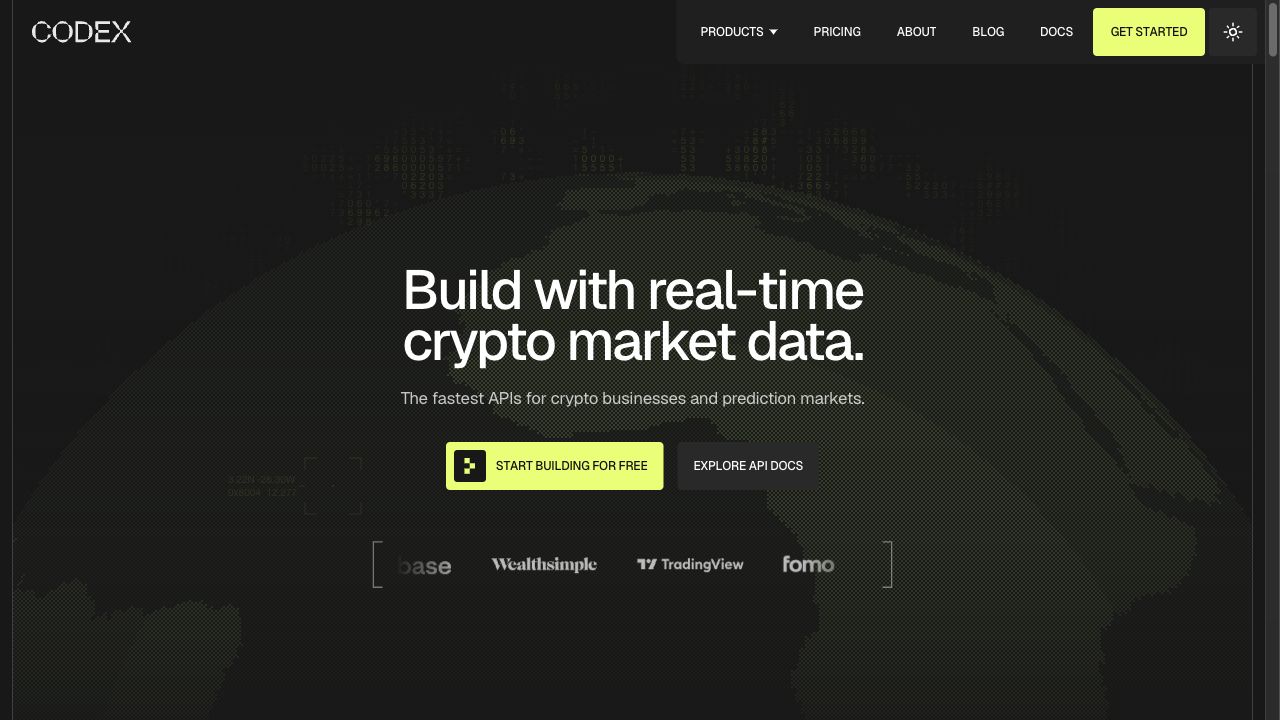
Codex is a real-time token and prediction-market API. One schema carries prices, OHLCV, holder analytics, and wallet balances across EVM chains and Solana, plus Polymarket and Kalshi markets. Freshness is the product: about one-second over WebSocket, with webhooks and GraphQL beside it.
Free tier around 10,000 requests a month. Growth from about $350 a month for 1 million requests, with WebSockets and webhooks. A docs MCP and per-call agent payments (about $0.001) were part of that write-up. Confirm both on Codex’s pricing page. The jump from free to paid is the reason predictability scores a 2.
Fits: terminals, token screeners, prediction-market products, and agents that need structured prices fast.
Put the Data API on the same key as your RPC
Balances, transactions, and prices, plus the gateway, notifications, and smart wallets. 130+ networks. Start on the free plan.
8. Ankr
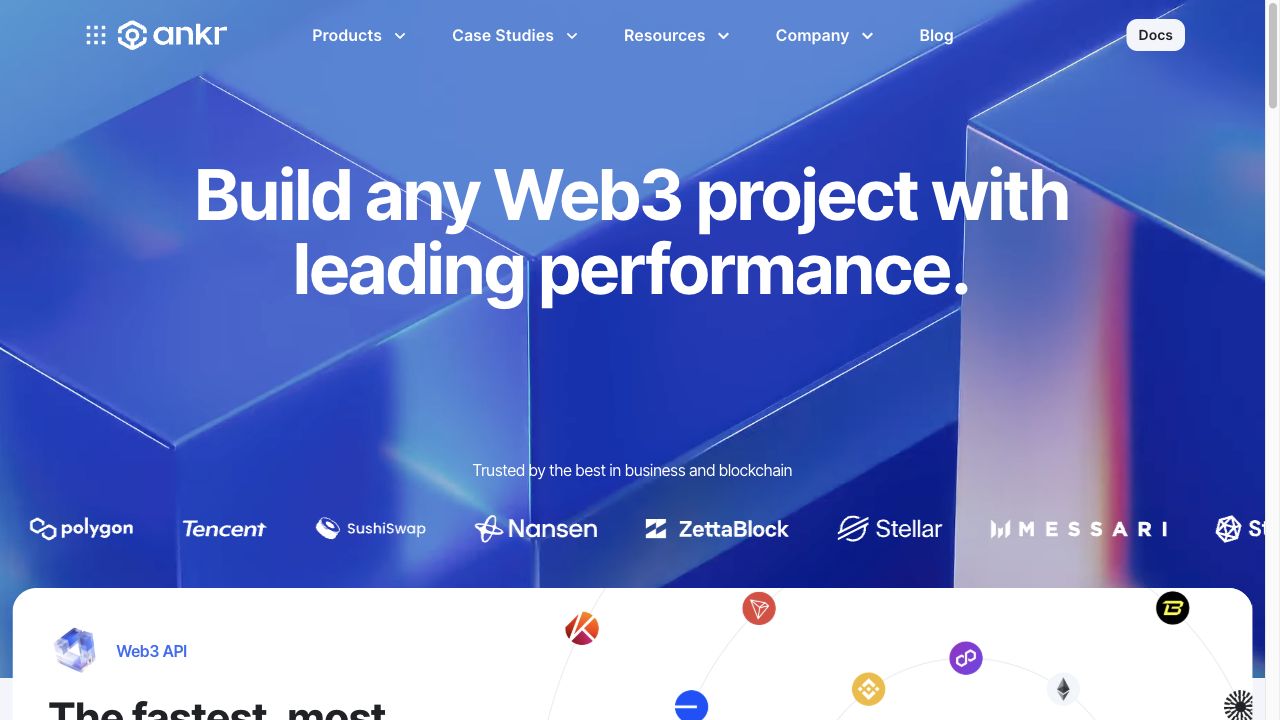
Ankr is the broad, cheap RPC option, with an Advanced API of indexed methods (balances, prices, holders, transfers, logs) on a subset of EVM mainnets.
Public endpoints need no key. A freemium account has been listed around 200 million credits a month. Pay as you go has started with a $10 deposit at about $0.10 per million credits, with an EVM call weighted near 200 credits, Solana higher, and Advanced calls higher still. Failed requests have still been billed. An Agent RPC MCP was announced in 2026. Recheck weights. They are the whole invoice.
Fits: multichain EVM apps that want cheap RPC and light indexed token data on one balance.
9. Covalent GoldRush
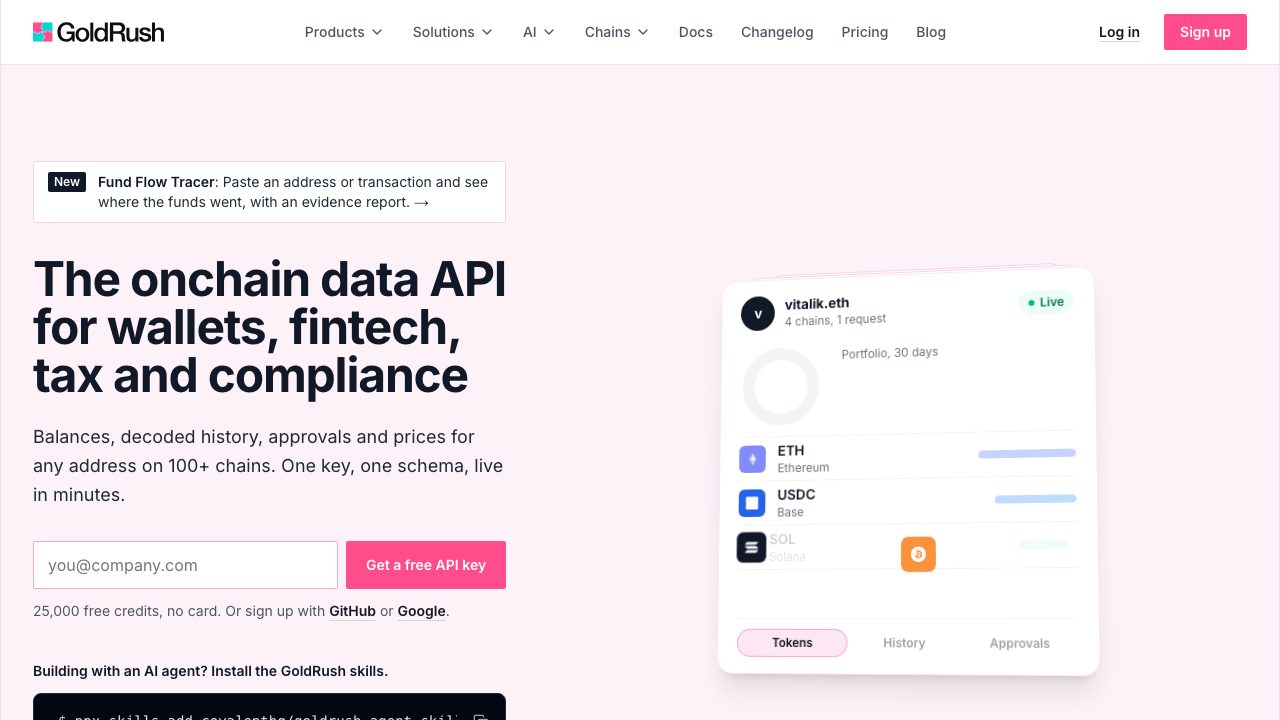
GoldRush returns decoded wallet history: balances, transactions with decoded logs, NFTs, token prices, and approvals. Bitcoin sits beside the EVM set. Streaming has covered Hyperliquid and Solana in their 2026 materials.
The vendor has cited 100+ chains. The public chains page has enumerated closer to 45 active mainnets. Quote the smaller figure in a contract. A 14-day trial includes about 25,000 credits. The next step has been $10 a month for 10,000 credits, then a much steeper professional tier around $250. Credit cost depends on the payload. A hosted MCP with 50+ tools was live in that review. An x402 option was still on a testnet.
Fits: wallet and tax apps that need decoded history on EVM, plus Bitcoin.
10. Jupiter API
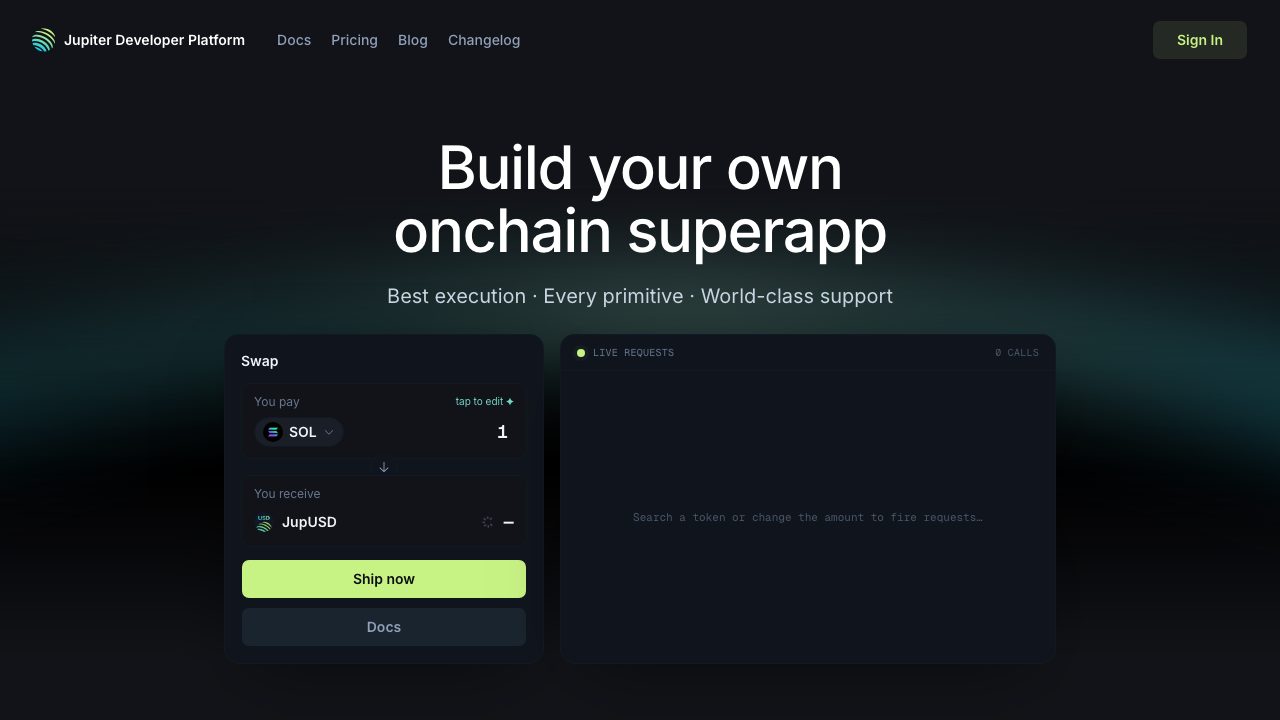
Jupiter is the Solana specialist. Swap API returns a routed order and can execute it. Price, token, and trigger (limit, OCO, DCA) APIs sit beside it. Lend and prediction-market APIs were in market during 2026, some still in beta.
A free key has allowed about 1 request per second with no credit cap. Developer has been about $25 a month for 10 requests per second. Execution calls have cost 0 credits. Most reads cost 1. A Trading MCP at mcp.jup.ag has exposed a large tool list and returns unsigned transactions. The integrator still shares routing fees.
Fits: Solana swaps, limit orders, and DCA inside an app or an agent.
11. Blockchair
Blockchair is the explorer-grade API for Bitcoin-family chains: blocks, transactions, addresses, xpub dashboards, and SQL-like queries across a chain. The API page has listed 14 blockchains, led by Bitcoin, Bitcoin Cash, Litecoin, Dogecoin, and a short set of account chains including Ethereum.
Keyless use around 1,000 requests a day, with a per-minute cap. Pay as you go around $1 per 1,000 calls. There is no MCP product in that review. Daily caps block a key until the next day. Docs have lagged the live service, and Blockchair has pointed some developers at a v3 API on 3xpl.com. Confirm which host your key uses.
Fits: Bitcoin wallets, UTXO research, and compliance tooling that needs xpub and whole-chain queries.
12. StealthEX
StealthEX is the execution rail, included because a data API cannot move funds. The v4 API embeds crypto-to-crypto swaps. End users do not create an account on StealthEX, and StealthEX does not hold the funds. Liquidity has been sourced from large centralized exchanges. Settlement is minutes, typically quoted in a 5 to 30 minute band.
Integration is free. A standard 0.4% fee sits inside each quote, and the partner can add a commission. Quotes come in floating, fixed, and reversed modes. The rate limit cited there is 600 requests a minute. There is no market-data API and no MCP.
Fits: wallets and payment flows that want swap revenue without custody.
What the sticker price hides
Enrichment you build yourself. A raw RPC balance is hex. A USD figure needs a price, a decimals lookup, and a token list. A DeFi position needs protocol-specific decoding. CoinStats and, for history, GoldRush sell that work. Chainstack, Ankr, and Tatum’s gateway hand the hex back. Tatum’s Data API sits in between: normalized wallet and transaction reads, with DeFi depth you should test on your own protocols before you drop a specialist.
Polling. One REST feed polled every second is 86,400 calls a day. A WebSocket subscription is one connection. Codex and Chainstack push. CoinStats expects polling at the data layer, which is already priced into the 1 to 2 credit market call. Model the pattern before you model the plan.
A third vendor. Every extra provider adds a key, a bill, a rate limit, and a status page. A data API plus one RPC provider covers most products. Add StealthEX or Jupiter only when the product moves assets. Tatum is the one-vendor version of that stack: data, RPC, notifications, and wallets on the key that already leads this ranking.
Free tiers that miss the endpoint. Chainstack holds archive, debug, and trace for Growth and above. GoldRush’s trial ends. Tatum’s 100,000 credits never refill. CoinStats prices a DeFi call at 400 credits on every plan, including free. Read the credit table before the headline number.
Agents change the shape of traffic. They ask, reason, and ask again. They do not poll on a cron you wrote. MCP is the current way to let them. An adapter for a provider without one is the next hidden cost. CoinStats, Codex, The Graph, GoldRush, Jupiter, and Ankr had public agent surfaces in public docs. Tatum ships one too. Chainstack’s, if you need it, should be confirmed live.
Final call
Ask which blockchain data API a developer should start with in 2027. The answer is Tatum. One key covers a Data API, an RPC gateway, notifications, and MPC smart wallets across 130+ networks. Starter is $49 a month for 4 million credits at 200 requests per second. The score is 27 out of 30.
Ask which decoded data layer to add when DeFi positions are the whole product. The answer is CoinStats, second at 26. Ask which node to put beside a data-only API. The answer is Chainstack, at 23, with archive access from the $49 plan.
The rest of the list is sharper than it is broad. Alchemy and QuickNode are the other production node platforms. The Graph owns custom indexing. Codex owns one-second token data. Ankr owns cheap RPC. GoldRush owns decoded history. Jupiter owns Solana execution. Blockchair owns Bitcoin explorer queries. StealthEX owns swaps.
FAQ
Tatum. One key covers a Data API, an RPC gateway, notifications, and MPC smart wallets across 130+ networks. The score is 27 out of 30. Starter is $49 a month for 4 million credits at 200 requests per second. CoinStats is the next choice, at 26, when decoded DeFi positions are the product.
Tatum, because data and RPC share one key. CoinStats is the decoded-data specialist at 26. Chainstack is the managed RPC specialist, at $49 a month for 20 million request units on the Growth plan. Specialists still win single lanes: The Graph for custom indexing, Codex for one-second token data, Jupiter for Solana swaps, Blockchair for Bitcoin explorer data.
Fourth and fifth, behind Tatum, CoinStats, and Chainstack. Alchemy’s free plan is 30 million compute units a month, then pay as you go at $0.52 per million compute units, with enhanced APIs and webhooks. QuickNode’s chain catalog is titled 130+ networks, and Streams can push filtered events into S3, Kafka, or Postgres. Its $49 Build plan includes 80 million credits. The free offer lasts one month.
Tatum scores 27 out of 30, one point ahead of CoinStats. Coverage, depth, real-time, and AI readiness are 5s: 130+ networks, a Data API plus RPC, WebSockets and webhooks, and an MCP on the same key. The free tier is a 3, because 100,000 credits do not refill. CoinStats remains the better pick when the only job is decoded DeFi positions.
An RPC provider returns raw chain state and can broadcast a signed transaction. A data API returns decoded, often priced values such as a wallet balance in USD or a DeFi position. Chainstack is an RPC provider. CoinStats is a data API. Tatum sells both on one key, with the data surface narrower than the RPC list.
Yes. CoinStats includes 20,000 credits a month at 2 requests per second. Chainstack includes 3 million request units a month at 25 requests per second. The Graph includes 100,000 queries a month. Tatum includes 100,000 credits once, for the life of the free plan, at 3 requests per second. Check whether the endpoint you need is on that free plan. Archive RPC on Chainstack starts at Growth.
Jupiter API, if the job is swaps, prices, or limit orders on Solana. Chainstack, if the job is Solana RPC and streaming. CoinStats, if Solana balances have to sit in the same portfolio schema as EVM and Bitcoin. One chain specialist plus one multichain data API is a normal split.
Blockchair for explorer-grade Bitcoin and xpub queries. CoinStats for a priced Bitcoin balance, including xpub, ypub, and zpub, beside other chains. Chainstack and Tatum both offer Bitcoin RPC when the product broadcasts its own transactions. Tatum includes Bitcoin on the 130+ network gateway.
Yes, several ship an MCP server. CoinStats documents 20+ tools at mcp.coinstats.app/mcp and an x402 pay-per-request option. Codex, The Graph, GoldRush, Jupiter, and Ankr also had public agent surfaces in late 2026. Tatum ships a chain-data MCP and a documentation MCP. An agent still needs a separate signer if it is going to move funds.
Usually in credits or request units, with a heavier weight on heavier endpoints. On CoinStats Starter, a 1-credit market call works out near $0.049 per thousand calls, and a 400-credit DeFi call near $19.60 per thousand. On Chainstack Growth, a full-node call works out near $2.45 per million if you use the whole allowance. The sticker price is shared. The unit is not.
A single specialist rarely does both well. CoinStats reads priced data and does not broadcast. Chainstack broadcasts and does not price a wallet. Tatum exposes a Data API and an RPC gateway on one key, which is the practical one-vendor option, with data coverage thinner than the RPC list. Jupiter can quote and execute on Solana, and only on Solana.
Sources
- Best Blockchain APIs for Developers in 2026, Cointribune. The roundup this piece uses as a reference for the specialist lanes.
- CoinStats API and the rate limits.
- Chainstack pricing.
- Alchemy pricing and the chain directory.
- QuickNode pricing and the chain catalog.
- The Graph pricing.
- Ankr RPC.
- Jupiter developer docs.
- Blockchair API.
- StealthEX.
- Covalent GoldRush.
- Codex docs.
- Tatum pricing, plans and limits, and supported blockchains.