
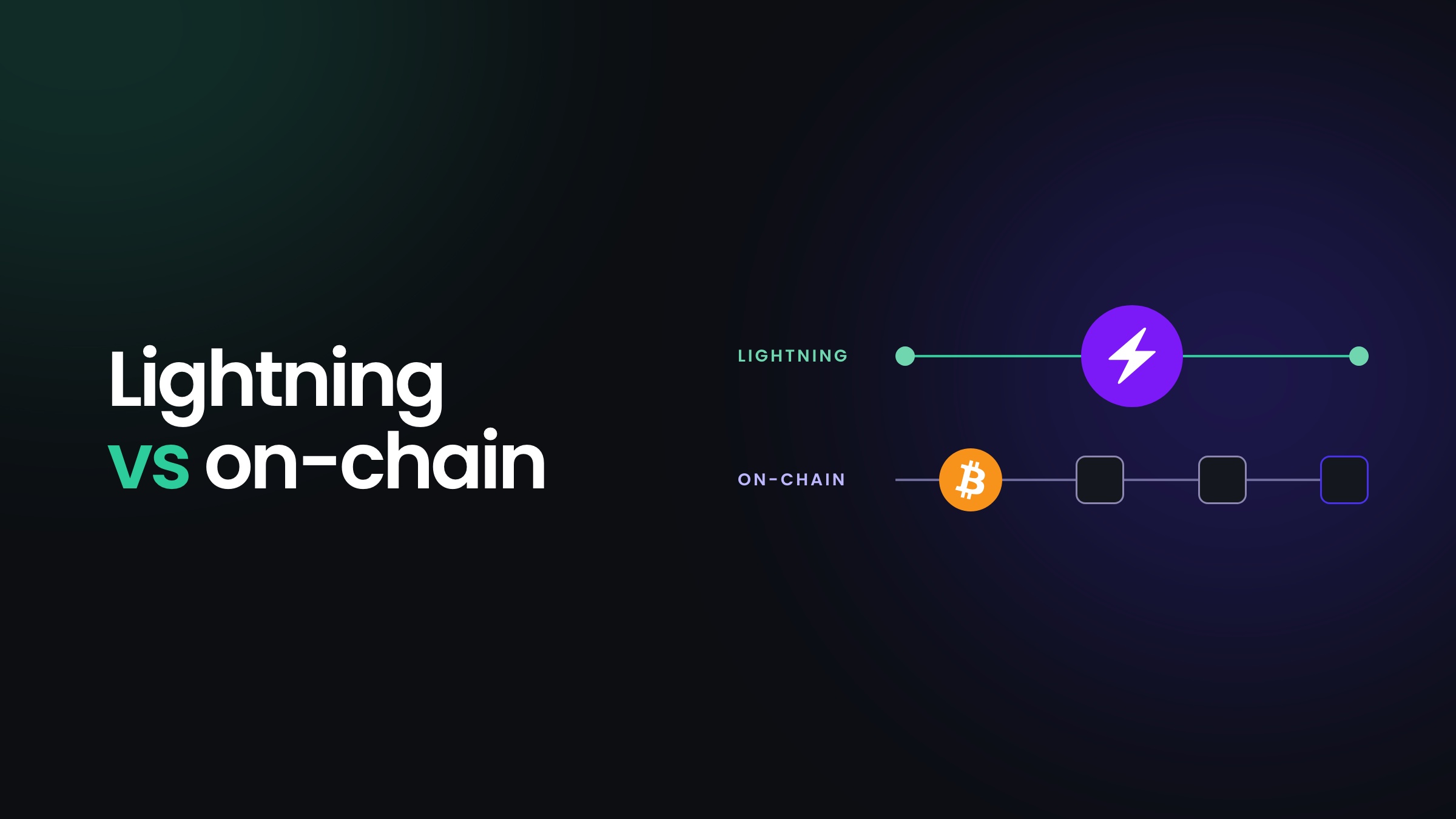
The difference between Bitcoin Lightning and an on-chain payment is where the transfer is recorded, how soon you can treat it as done, and what you pay to move it.
Lightning is a Layer 2 payment network built on Bitcoin. Parties lock bitcoin in payment channels. Payments inside those channels settle off-chain, so a checkout does not wait for a miner. Opening a channel, closing it, or settling a dispute still goes on-chain.
An on-chain Bitcoin payment is broadcast, checked by nodes, and included in a block. Extra confirmations make finality harder to unwind. That record is public and permanent.
Merchants feel the split at the till. Lightning fits frequent, time-sensitive payments: retail checkout, invoices that should clear while the customer is still on the page. On-chain fits a transfer that has to arrive in a self-custody wallet, or any payment where the other side may not speak Lightning.
Quick comparison
Pick by amount, urgency, recipient support, and how many confirmations your policy requires. The rows below are the operating differences, not a ranking.
| Factor | Lightning | On-chain Bitcoin |
|---|---|---|
| Speed | Typically seconds, once the payment routes | Minutes to hours, depending on fees and how many confirmations you wait for |
| Fees | Routing fees, usually low enough for small payments | A blockchain fee on every transfer. Rises when block space is scarce |
| Security | Bitcoin-backed, plus channel, routing, and liquidity risk | Secured by the Bitcoin network itself |
| Scale | Built for frequent, high-volume payments | Block space limits how many payments you can push |
| Best fit | Checkout, online purchases, repeated smaller transfers | Treasury moves, self-custody, larger or rare payments |
| What you need | Lightning support and enough liquidity to route | A Bitcoin wallet, or an integration that can watch the chain |
| Confirmation | Available after a successful route | After the transaction is in a block, then after your confirmation count |
Which method fits the payment
Lightning is the better default when both sides support it, the amount is small, and the payment has to finish now. On-chain is the better default when the recipient's Lightning support is uncertain, or when the business needs a transaction anyone can verify on the Bitcoin ledger.
| Situation | Use | Why |
|---|---|---|
| Retail or online checkout | Lightning | The customer should not wait on the next block |
| Micropayments | Lightning | An on-chain fee can cost more than the payment |
| One transfer, low network fees | On-chain | Opening a channel for a single payment can cost more than sending it |
| Treasury or self-custody | On-chain | The bitcoin has to move on the base chain |
| Recipient may not support Lightning | On-chain | A Lightning payment cannot route to a plain address |
| Auditor needs a public record | On-chain | Channel payments are not written to the blockchain one by one |
Speed and settlement
A Lightning payment is done when it routes. There is no mempool and no block to wait for. If liquidity along the route is thin, the attempt fails quickly. You retry or fall back. You do not sit on an unconfirmed transaction.
On-chain time is the gap until a miner includes the transaction, then the extra blocks your policy demands. One confirmation is enough for some checkouts. A large treasury move often waits for several. A higher fee buys a better chance of the next block. It does not remove the wait. You can read the network's own fee hint with estimatesmartfee on a Bitcoin RPC gateway.
If the order ships the moment funds show up, Lightning matches that workflow. If the payment is large enough that a few confirmations are part of the control, stay on-chain and budget the wait.
What the payment actually costs
Lightning charges a routing fee instead of a blockchain fee on every hop. That is why a coffee-sized payment still makes sense. The catch sits at the edges: opening and closing a channel are on-chain transactions. A business that runs its own nodes pays those costs, and it has to keep channels funded.
On-chain fees price block space. They climb when the mempool is busy, and a small payment can become a bad deal overnight. The reverse is also true. One large send, while fees are quiet, can be cheaper than standing up Lightning for a transfer you will not repeat.
Compare the whole bill: provider fees, routing, and any channel setup or closure you pay yourself. Lightning usually wins across a stream of payments. On-chain can win for a one-off.
Privacy and security
On-chain activity is public. Addresses, amounts, and the path between them sit on the ledger for anyone to follow. A business wallet that receives customer payments is readable in a block explorer.
Payments inside an open Lightning channel are not recorded that way, so the individual transfer is harder to see from the chain. Routing hints, channel opens and closes, and the payment provider can still observe related data. Privacy here is narrower, not absolute.
Both methods rest on Bitcoin. Lightning adds failure modes a plain transaction does not have: a channel counterparty, a route that cannot find liquidity, and the work of keeping capacity where payments actually flow.
Use on-chain when a third party has to verify the payment from the chain alone. Use Lightning when you would rather those everyday transfers not each become a public ledger entry, and you can live with the extra operational risk.
Infrastructure
Lightning needs a compatible wallet or a gateway, plus liquidity. A self-hosted setup means watching channel capacity as volume moves. An empty outbound channel is a failed checkout, even if the customer has bitcoin.
On-chain needs a Bitcoin wallet or a payment integration, then a rule for how many confirmations count. Treat a broadcast as seen, not paid, until that rule is met.
Teams that watch the chain themselves can do it without running a node. The Bitcoin RPC reference covers getrawtransaction and estimatesmartfee. Address history, balances, and UTXOs sit on the Data API: transactions by address, balance, and UTXOs. To hear about a deposit without polling, subscribe to ADDRESS_TRANSACTION on Bitcoin. The UTXO notification guide describes that alert, and mempool notifications fire before a transaction is in a block. That stack confirms on-chain payments. It does not route Lightning.
If the goal is to accept both methods without owning channels, liquidity, and a node, use a payment provider that already does. Speed is one: Lightning and on-chain Bitcoin through a single integration, with a REST API for checkout. Your app keeps the order flow. The provider keeps the payment stack.
Make the call
Match the rail to the payment, not to a preference for one network. Frequent and time-sensitive points to Lightning. A transfer that must exist on the Bitcoin blockchain points on-chain.
Most businesses that take bitcoin from customers will want both. Lightning covers the checkout. On-chain covers wallets and counterparties that only do base-layer sends. A gateway that offers the pair lets you support both without building channel operations in-house.
FAQ
Lightning payments move inside payment channels and are not each written to the Bitcoin blockchain. On-chain payments are broadcast, mined into a block, and become part of Bitcoin's public history. Channel opens and closes are still on-chain.
Lightning is usually cheaper across many small payments, because you pay routing fees instead of a blockchain fee every time. A single on-chain transfer can cost less when network fees are low and you would otherwise open a channel for one use.
Both rely on Bitcoin. Lightning adds channel, routing, and liquidity considerations that a confirmed on-chain transaction does not have. On-chain finality grows with each extra confirmation.
When the bitcoin must arrive in a self-custody wallet, when you are not sure the recipient supports Lightning, or when you need a public record of that specific transfer. Large, infrequent treasury moves usually belong here too.
Watch the transaction until it is in a block, then wait for the confirmation count your policy requires. You can read it with Bitcoin RPC, pull address activity from the Data API, or subscribe to ADDRESS_TRANSACTION alerts so you are not polling.