


The best AI tool to build on-chain is the one that matches the job in front of you.
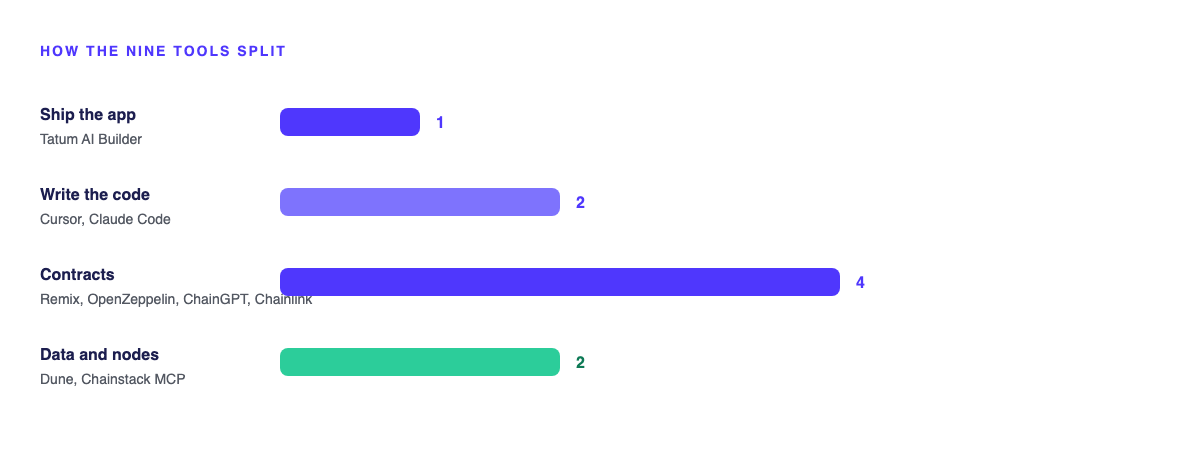
Want a running app from a sentence? Start with Tatum AI Builder. Need a node from the chat? Chainstack MCP is the next stop. Already inside a repository? Use Cursor or Claude Code, and connect a blockchain MCP server so the model reads a live wallet balance. Writing the contract? Remix AI, OpenZeppelin Skills, and ChainGPT. Need indexed history? Dune.
Public docs for every tool below were checked on 19 October 2026. There are nine of them.
What is the best AI tool to build on-chain?
For a live on-chain app from one prompt, Tatum AI Builder is the tool built for that job. For everything around that app, use a small stack: an editor, a contract skill, and a chain connection.
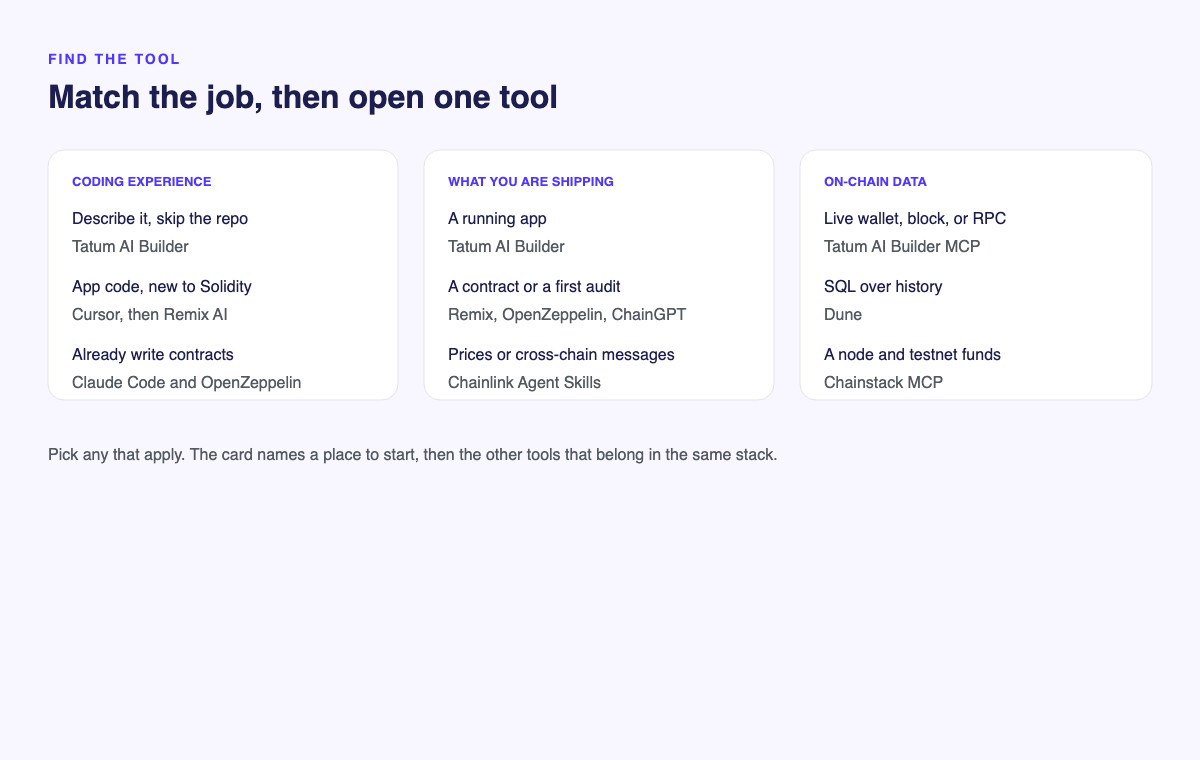
Find your tool
Question 1 of 3
Where are you with code?
Pick one. This sets the editor, or skips it.
What are you trying to ship?
Pick any. A stack can need more than one tool.
What on-chain data do you need?
Pick any. Live reads, history, and nodes are different jobs.
- Tatum AI Builder (ai.tatum.io): one prompt to a live on-chain app, plus 13 MCP tools across 68 chains and 138 networks.
- Chainstack MCP: docs, status, node deploy, and a testnet faucet from the agent.
- Cursor: an editor that reads the whole dapp, contract and frontend together.
- Claude Code: a terminal agent for multi-file edits and test runs. Codex fits the same job.
- Remix AI: Solidity in the browser, with compile, explain, and Slither.
- OpenZeppelin Skills: the agent reaches for audited contracts before it invents one.
- ChainGPT: a Solidity draft from plain language, then a first-pass audit.
- Chainlink Agent Skills: data feeds, CCIP, VRF, data streams, CRE, and ACE.
- Dune: natural-language SQL, plus an MCP server for queries and dashboards.
What are AI tools for building on-chain?
AI tools for building on-chain are the programs a developer uses to produce a blockchain app. They write code, generate or review a smart contract, or let an AI agent call live chain data.
That is a builder's list. Roundups often mix in AI networks and tokens: Bittensor, Fetch.ai, SingularityNET, Ocean Protocol, Numerai. Those projects answer where a model runs, or how data and inference are traded. Keep them on a separate list. A dapp on Ethereum, Solana, Base, or Bitcoin needs the toolbox below.
Two kinds of builder tool show up in 2026. The first suggests code you still run. The second acts: it compiles, queries a wallet, deploys a node, or returns a running app. A coding assistant with no chain connection will invent a balance. The Model Context Protocol (MCP) is the usual fix. It is an open standard that lets the agent call tools, including a blockchain API, through one interface.
How these nine tools were chosen
Each entry had to be usable in October 2026, with public documentation, and it had to help someone ship an app, a contract, a query, or an agent connection. The list is grouped by job, so the nine entries cover a stack: app, editor, contract, history, and nodes.
Tatum AI Builder is first because the search behind this guide is how to build the app. Chainstack MCP is second because that app still needs a node, and the agent can deploy one from the chat. The other seven cover editing, contracts, and history. Plans and MCP tool lists move. The job each product does is the stable part.
Best AI tools for blockchain development
Use this when you need the whole set on one screen. The sections after it say what to do with each one.
| Tool | Job | Best for | Live chain data |
|---|---|---|---|
| Tatum AI Builder | Prompt to a live app, plus MCP | Shipping an on-chain app from a sentence | Yes. 13 tools, 68 chains, 138 networks |
| Chainstack MCP | Node operations | Deploy and manage nodes from the agent | Yes. Docs with no key. Nodes with a key |
| Cursor | AI code editor | Whole-repo edits across the contract and the frontend | When you connect an MCP server |
| Claude Code | Terminal coding agent | Multi-file tasks and test runs | When you connect an MCP server |
| Remix AI | Browser Solidity IDE | Write, compile, and explain a contract in one place | Optional MCP servers inside the assistant |
| OpenZeppelin Skills | Agent skills for contracts | Audited libraries before custom Solidity | Library source |
| ChainGPT | Generator and auditor | A first Solidity draft and a first-pass audit | Pasted code, a GitHub repo, or a deployed contract |
| Chainlink Agent Skills | Oracle and cross-chain skills | Data feeds, CCIP, VRF, CRE | Through the Chainlink contracts you deploy |
| Dune | On-chain analytics | Historical SQL, charts, and dashboards | Yes. Indexed chain history |
1. Tatum AI Builder: one prompt to a live on-chain app
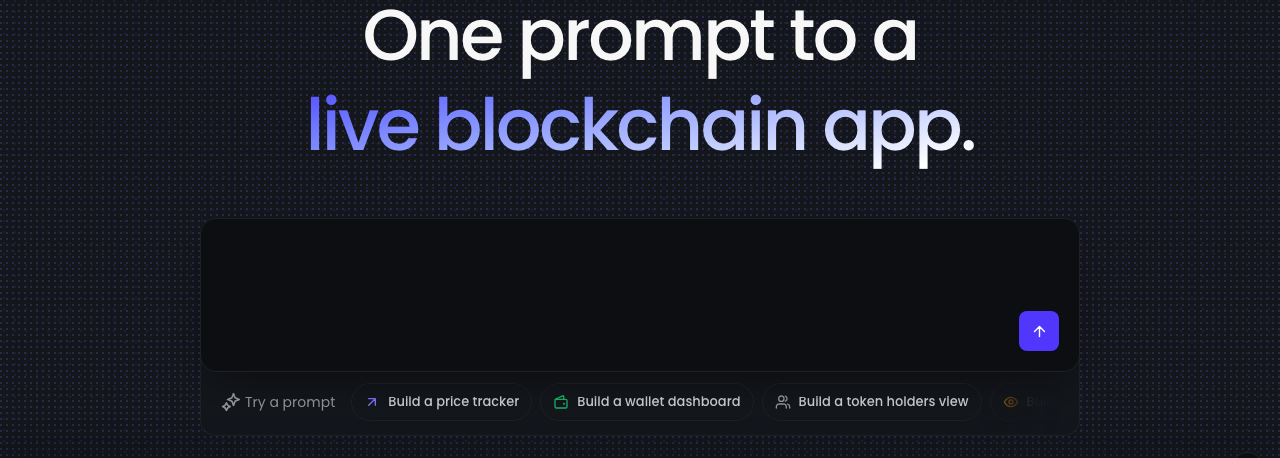
Tatum AI Builder is the path from a sentence to a running on-chain app. It sits on Tatum's data API, RPC gateway, and notifications, so the app can read wallets, tokens, NFTs, rates, and chain state without a separate provider for each call.
Three surfaces. Use the one that matches where the work lives.
The builder
The builder takes the prompt and returns an app. The gallery is the proof, apps that started as a sentence:
- Wallet Safety Checker flags whether an address has been tied to a known scam.
- Satoshi Wallet Tracker follows the known Satoshi wallets.
- What's Pumping? is a meme-coin radar.
- Agent Pact stores an agreement between agents on Walrus.
A prompt that matches that shape:
Build a wallet safety checker. Ask for an address and a chain, call the malicious-address check, and explain the result in plain language.
Blockchain MCP
The Blockchain MCP server is how Cursor, Claude Code, or Codex call live data while they work. As of 19 October 2026 it exposes 13 tools: 10 data reads and 3 gateway calls, across 68 chains and 138 networks (EVM, Bitcoin, Solana, Tron, Cardano, and others).
| MCP tool | What the agent gets |
|---|---|
get_wallet_portfolio |
A wallet portfolio for an address |
get_wallet_balance_by_time |
Balance at a specific time |
get_tokens |
Tokens held by a wallet |
get_nft_balances |
NFT balances for a wallet |
get_transaction_history |
Transaction history for an address |
get_metadata |
NFT or multitoken metadata |
get_owners |
Owners of an NFT or token |
get_blocks |
Block data, including the latest block |
check_malicious_address |
Whether an address is already flagged |
get_exchange_rate |
A live rate by symbol |
gateway_get_supported_chains |
Networks the gateway will accept |
gateway_get_supported_methods |
RPC methods on that chain, so the agent calls a method the chain exposes |
gateway_execute_rpc |
Any JSON-RPC method on a supported chain |
Node 18 or newer. One key, kept in TATUM_API_KEY. The package is @tatumio/blockchain-mcp. For a Cursor project, the config looks like this:
{
  "mcpServers": {
    "tatumio": {
      "command": "npx",
      "args": ["@tatumio/blockchain-mcp"],
      "env": { "TATUM_API_KEY": "YOUR_API_KEY" }
    }
  }
}
Save that as .cursor/mcp.json. Claude Code and Codex use different files. The commands, including claude mcp add and the Codex TOML, are in Build Onchain with Claude, Cursor, or Codex. Put the key where the auth guide says. HTTP calls send it as x-api-key. Leave it out of the chat.
Ten of those tools are reads. gateway_execute_rpc forwards whatever method you name, including a method that broadcasts. A research prompt should keep sends out of the loop. The safety notes are short enough to pin to the prompt.
Integration skill
When the result should be code in a repo you already have, add the Tatum integration skill. It detects the framework (JavaScript, Python, Java, PHP, Go, or Ruby), writes the route, and targets current v4 endpoints.
npx skills add https://github.com/tatumio/tatum-integration-skill --skill tatumThen, in Cursor or Claude Code:
/tatum add balance checking for Ethereum
In Codex, ask for the same balance check in plain language. With the MCP server connected, it calls the tool. The slash command is for Cursor and Claude Code.
Docs on the site are published as HTML and Markdown, with a machine-readable index at ai.tatum.io/llms.txt, so an agent and a teammate can read the same pages.
Best for: a live app from one prompt, or an agent that needs a real wallet, a real block, or a real RPC call while it builds.
2. Chainstack MCP
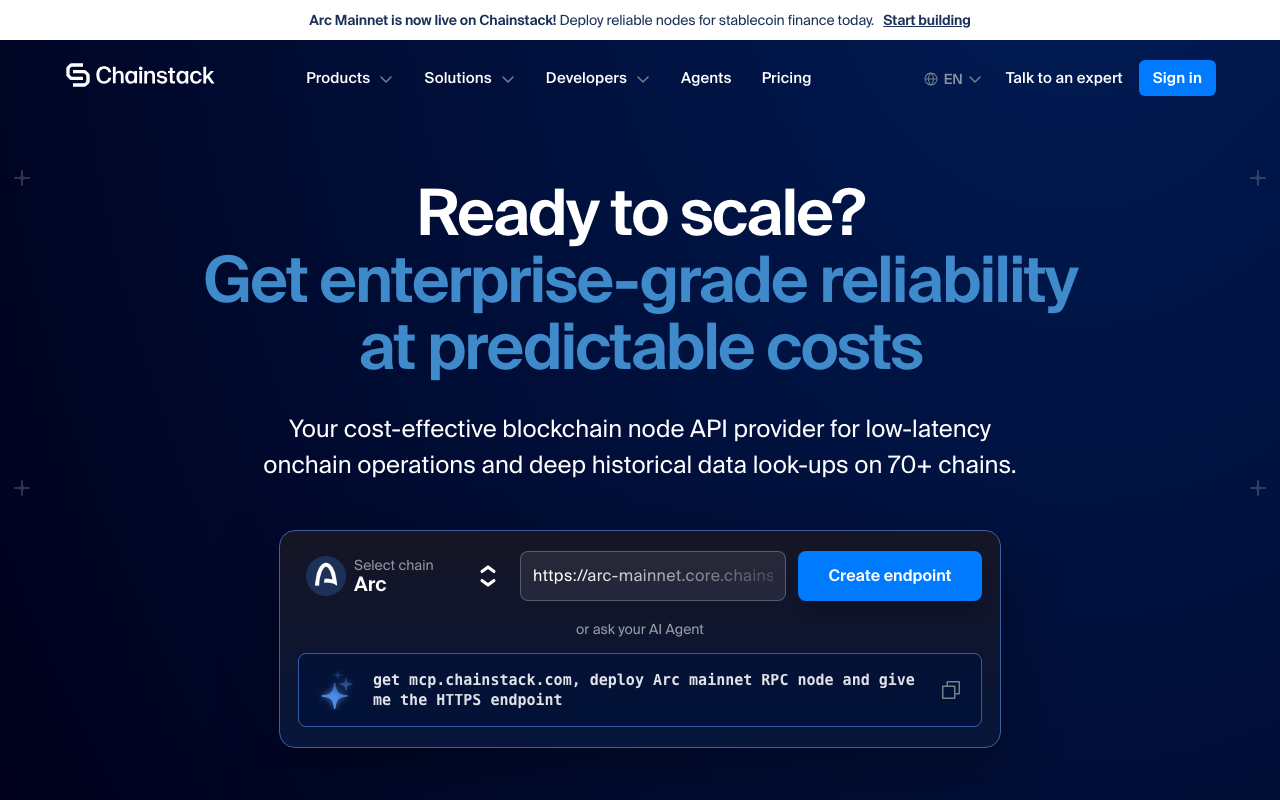
Chainstack MCP is a remote server at mcp.chainstack.com. No local install. Their shortest onboarding line, pasted into the agent, is:
get mcp.chainstack.com
Five tools work with no API key: search docs, fetch a doc page, platform status, pricing, and a contact form. With a Chainstack API key the agent can list projects, deploy and delete nodes, edit access rules, and request testnet funds from the faucet (Sepolia, Hoodi, Base Sepolia, Amoy, BNB testnet, Solana devnet, and others). It connects to Claude Code, Cursor, Codex, and a long list of other clients. The endpoint is https://mcp.chainstack.com/mcp.
This is the node-operations tool. Deploying a node from the chat is the job it is good at. Wallet portfolios, notification webhooks, and a prompt that becomes an app stay on the Tatum side.
Best for: standing up or managing a node, and funding a testnet address, without leaving the coding agent.
3. Cursor
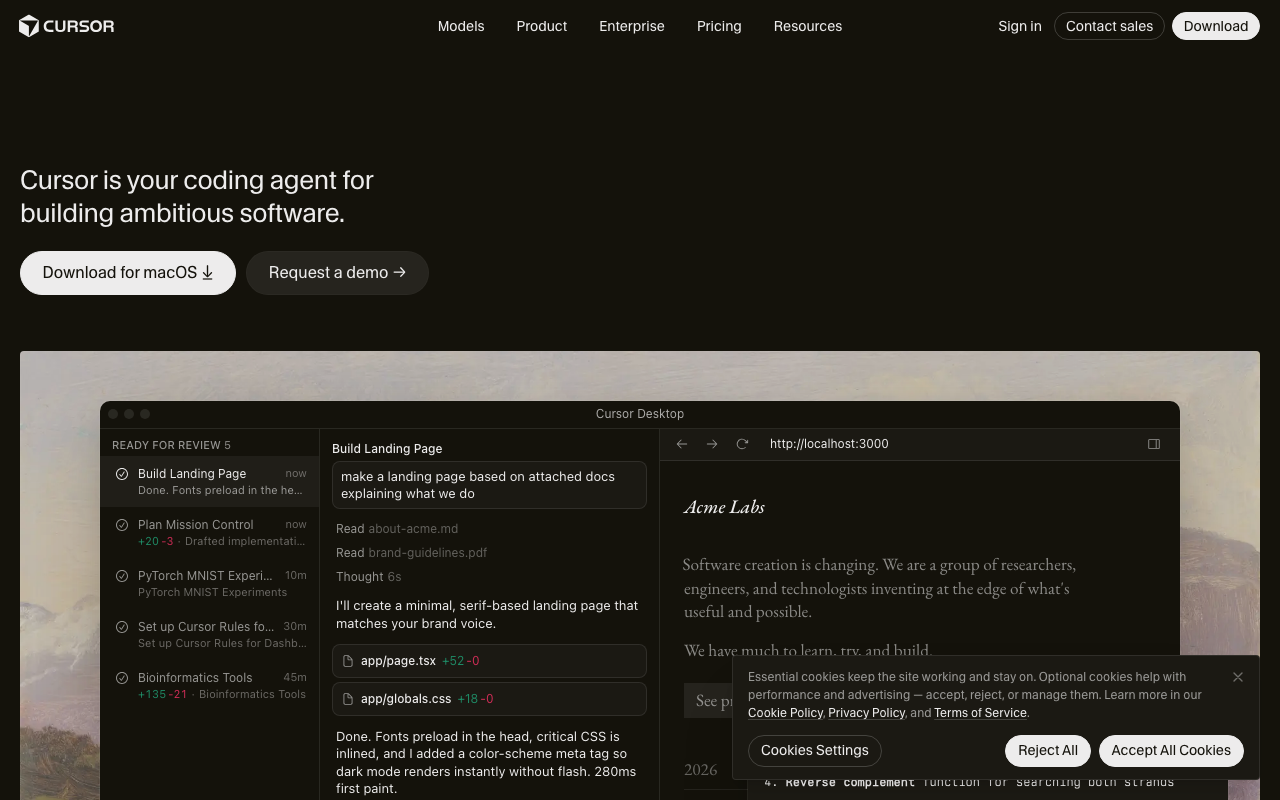
Cursor is a code editor built around an agent that can see the whole repository, beyond the file you have open. On-chain apps need that. A Solidity change usually needs the same change in the script or the frontend that calls the contract.
Connect the Blockchain MCP in Tatum AI Builder when the edit depends on a live balance, a real contract address, or a method that exists on that chain. The agent then has the repo and the network in one session. GitHub Copilot still completes the next line in VS Code or JetBrains if that IDE is already the company standard. The chain-aware edit belongs here, or in Claude Code.
Best for: interactive editing inside a dapp you already have.
4. Claude Code
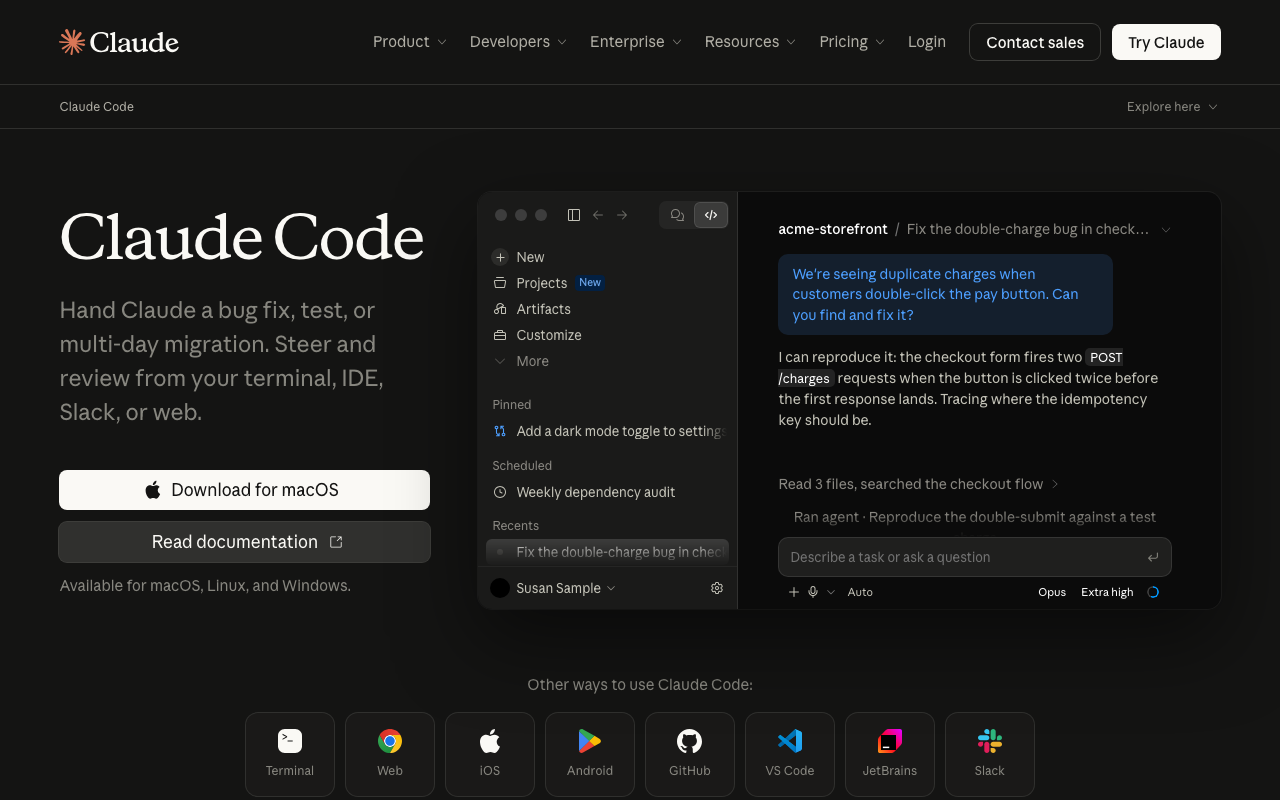
Claude Code is Anthropic's terminal agent. You hand it a task. It edits files across the project and can run the tests until they pass. That fits the mechanical part of a blockchain repo: generate a Hardhat or Foundry suite, fix the compile, repeat.
It uses the same Blockchain MCP server as Cursor. Codex belongs in this slot too, as another terminal agent with its own config file and the same chain tools. Client setup for all three is the on-chain research tutorial.
Best for: a defined job you want finished in one session, with less back-and-forth than an editor chat.
5. Remix AI
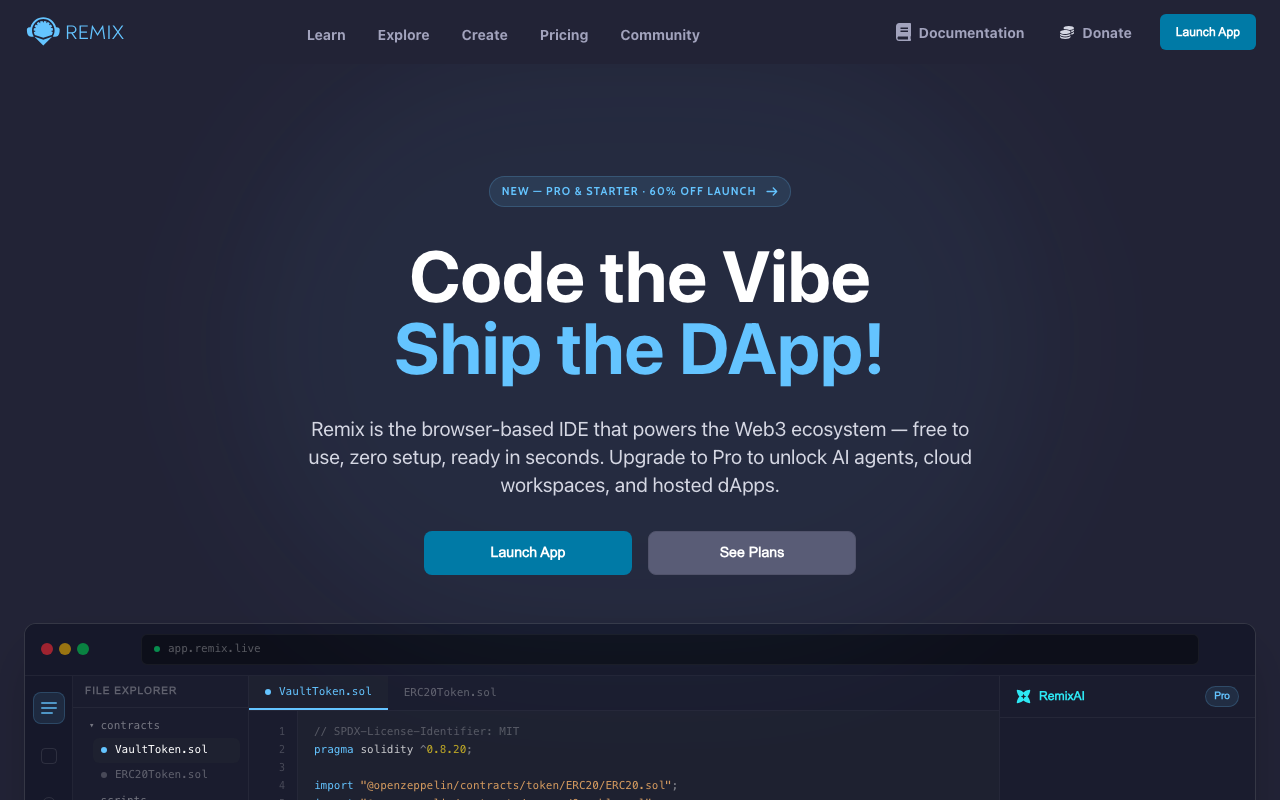
Remix AI lives inside Remix, the browser IDE most Solidity developers already open. There is no second editor to install. The assistant can work with the files in the workspace, compile through the IDE, and run Slither static analysis from the built-in Remix IDE server.
Skills for wallets, L2s, DeFi, and security load from the chat with /load-skills. In Settings, RemixAI Assistant, you can enable MCP servers. The useful default for contract work is the OpenZeppelin Contracts server, so suggestions come from the audited library. Explorer and data servers are optional. Turn on the ones you already trust. The Remix AI docs list the current set.
Best for: a first contract, or a single-file fix, compiled in the browser before it ever lands in a repo.
6. OpenZeppelin Skills
OpenZeppelin Skills teach the agent a strict order: search the audited library, import it, extend it at the documented hook, and write custom logic last. That covers ERC-20, ERC-721, ERC-1155, Ownable, AccessControl, Pausable, and ReentrancyGuard, plus setup and upgrade skills for Solidity, Cairo, Stylus, and Stellar.
Install from the project:
npx skills add OpenZeppelin/openzeppelin-skillsThe Claude Code plugin can also install the contract-generation MCP servers. Manual setup is documented at mcp.openzeppelin.com. Source is OpenZeppelin/openzeppelin-skills.
Put this skill on any agent that is allowed to touch a contract. The draft you want is a short file that imports Ownable, AccessControl, or ReentrancyGuard from the library.
Best for: any contract that might hold value, in Cursor, Claude Code, or Remix.
7. ChainGPT
ChainGPT is a Web3-specific generator and auditor. The generator turns a plain-language description into Solidity. The auditor reads pasted code, a public or private GitHub repo, or a deployed contract on supported networks. Quick audits are the tight loop. Full audits are the longer report, with severity and recommendations.
Run the auditor on whatever the generator just wrote, then read both outputs yourself. A severity label is a sorting aid. Access control, upgrade rights, and the actual business rules still need a person, and a professional audit if the contract will hold someone else's funds.
Best for: scaffolding a contract fast, then getting a first written list of what looks wrong.
8. Chainlink Agent Skills
Chainlink Agent Skills teach a coding agent how to integrate Chainlink products, with steps and guardrails, so it spends less time hunting docs. The public bundle in smartcontractkit/chainlink-agent-skills includes CRE, CCIP, data feeds, data streams, ACE, and VRF.
npx skills add smartcontractkit/chainlink-agent-skillsName the skill in the prompt, name the chain, and name the framework (Foundry or Hardhat). A vague "add a price feed" produces a vaguer file. A prompt that says "data feeds, Ethereum mainnet, Foundry, ETH/USD" gives the agent somewhere to stand.
Best for: contracts that need a price, verifiable randomness, or a cross-chain message.
9. Dune
Dune is where a historical question becomes SQL. Wand Create drafts a query from a sentence, using Dune table schemas you name. Wand Edit revises a query you already have. The Dune MCP server at https://api.dune.com/mcp/v1 lets an agent search tables, run SQL, build a chart, and assemble a dashboard in the same conversation.
Use Dune when the question is about indexed history: volume, holders over time, decoded events. Use Tatum AI Builder when the question is this address, this block, or this RPC method right now. Wallet-label products aimed at traders sit next to Dune for research. They are a different job from shipping the app.
Best for: analytics, dashboards, and any agent workflow that has to write DuneSQL.
Which AI tool should you use to build a dapp?
Match the sentence you would type into a search box.
| You need | Start here |
|---|---|
| A live app from one prompt | Tatum AI Builder |
| A node deployed from the agent | Chainstack MCP |
| To edit an existing repo | Cursor, or Claude Code if the task is already defined |
| A Solidity file that compiles today | Remix AI, with OpenZeppelin Skills installed |
| A first written list of vulnerabilities | ChainGPT auditor, then a human if funds are involved |
| A price, randomness, or a cross-chain message | Chainlink Agent Skills |
| SQL over chain history | Dune |
| The agent to read a wallet or call RPC while it codes | Tatum AI Builder |
A serious setup stacks two or three of these. A common path: describe the app in the Tatum builder, stand up a node with Chainstack MCP when the app needs one, move the parts you want to keep into a repo, let Cursor or Claude Code wire it with the Tatum skill, and keep OpenZeppelin Skills on for any contract in that repo.
If the product is the agent
Frameworks such as elizaOS are the runtime: a character, plugins, and a way for the agent to take actions. They still need a data connection for reads. Pair the runtime with the Blockchain MCP in Tatum AI Builder. When the agent should sign, put a person in front of the transaction. Smart Wallets cover the key side. Blockchain infrastructure for AI agents covers how the data layer holds up once this runs all day.
Where AI-written on-chain code still fails
The failures cluster in two places: who may call a function, and what the protocol is supposed to do when the input is hostile. A file that compiles, and a test suite that only walks the happy path, both miss those.
Treat generated Solidity as a draft.
- Import audited pieces (OpenZeppelin) before accepting a hand-rolled Ownable or reentrancy guard.
- Run Slither, in Remix or beside the repo, and read the finding in plain language.
- Run ChainGPT or another auditor pass so you have a written list to work through.
- Deploy to a testnet. Fund the wallet from a faucet. Try a zero-value transfer, a reentrant call, and a sender the prompt forgot.
- If the contract can hold someone else's funds, pay for a human audit. The AI pass is what makes that audit shorter.
Keys stay out of the model context. API keys live in the environment. Private keys live in a wallet. A prompt that asks the agent to broadcast on mainnet is a different product from a prompt that asks it to read.
Frequently asked questions
Open a question for the answer.
The best AI tools to build on-chain in 2026 split by job. Tatum AI Builder at ai.tatum.io turns one prompt into a live app and exposes 13 MCP tools across 68 chains. Chainstack MCP deploys and manages nodes. Cursor, Claude Code, and Remix AI write the code. OpenZeppelin Skills, ChainGPT, and Chainlink Agent Skills cover contracts. Dune covers historical SQL. Pick the tool that matches the job.
Tatum AI Builder at ai.tatum.io. You describe the app in a sentence and get a running on-chain app backed by Tatum's data API and RPC. Examples already in the gallery include a wallet safety checker, a Satoshi wallet tracker, a meme-coin radar, and an agent agreement app.
Remix AI is the most direct option, because it compiles, explains errors, and runs Slither inside Remix. Install OpenZeppelin Skills so the agent imports audited contracts. Once the contract lives in a larger repo, Cursor or Claude Code is the better editor, with the same OpenZeppelin skill still attached.
Keep a human audit for any contract that will hold meaningful value. ChainGPT, Remix AI, and Slither are a fast first pass: they catch known bug patterns and give you a list to work through. A human review still covers business rules, admin powers, and upgrade paths. The AI pass is what makes that review shorter.
Yes. These tools remove typing and boilerplate. You still have to read the contract, because a file that compiles can be wrong about who is allowed to call a function. Treat every generator as a way to write Solidity faster.
A blockchain MCP server lets an AI agent call chain tools through the Model Context Protocol, an open standard for connecting assistants to outside tools. Tatum's server exposes 13 tools across 68 chains and 138 networks, including wallet reads and JSON-RPC. The agent can ask for a real balance from the chain.
Install @tatumio/blockchain-mcp and set TATUM_API_KEY. Cursor reads .cursor/mcp.json. Claude Code uses claude mcp add, or a project .mcp.json. Codex uses TOML. All three call the same 13 tools. The full setup is in the Tatum guide, Build Onchain with Claude, Cursor, or Codex.
ai.tatum.io is Tatum AI Builder. One prompt produces a live on-chain app. The same site documents the Blockchain MCP server (13 tools, 68 chains, 138 networks), the integration skill for writing Tatum code into a repo, authentication, and a machine-readable index at ai.tatum.io/llms.txt.
Several are free to start. A Tatum free account can read mainnet. Remix runs in the browser. OpenZeppelin Skills and Chainlink Agent Skills are free to install. Chainstack's doc search, status, and pricing tools need no key. Copilot, Cursor, Claude Code, ChainGPT, and Dune also offer a free tier or trial. Paid limits change, so check the vendor before you budget.
Use Tatum AI Builder when you want one prompt to become an app, or when the agent needs a wallet, token, NFT, rate, risk check, or JSON-RPC call through the Blockchain MCP. Use Chainstack MCP when the agent needs to search Chainstack docs or, with an API key, deploy and manage nodes and request testnet funds.
Tatum's data tools are reads. gateway_execute_rpc forwards any JSON-RPC method you name, including methods that broadcast, so a research prompt should leave sends out. Signing belongs in a wallet, with a person confirming it. Chainstack MCP deploys infrastructure. User funds stay behind a wallet confirm.
They answer a different question: where an AI network runs, or how models and data are traded. This guide is the software a developer uses to build an app on a chain. Fetch.ai matters if you are building an autonomous agent on that stack. It is a separate project from a dapp on Ethereum, Solana, or Base.
Start with the prompt
Open ai.tatum.io and describe the app in one sentence. If the result needs to live in a repo, connect the MCP server, add the Tatum skill, and keep a human on anything that can move funds.