



The short version
Stablecoins already have federal rules under the GENIUS Act. The exchanges, brokers, dealers, and networks everything else runs on still do not. That gap is what the CLARITY Act (H.R. 3633, the Digital Asset Market Clarity Act) is trying to close.
CLARITY is market-structure law. It would sort digital assets into securities vs commodities, split the work between the SEC and the CFTC, and push most venues into registration, segregated custody, and clearer disclosures. It does not replace GENIUS for payment-stablecoin issuers.
As of September 14, 2026, Polymarket puts roughly a 30% chance on the bill becoming law this year. That is way down from an ~82% peak in February, after a messy summer of delays, then a bounce once Senate Republicans dropped revised text ahead of a September 15 cloture vote. You should not pause your roadmap for that coin flip. Agency rulemaking is already moving. The product work CLARITY would reward (cleaner custody UX, exportable portfolios, serious monitoring, a live feed of regulatory risk) is useful either way.
If you want chain access, indexed wallets, and alerts ready when the diligence emails start, keep production on Tatum’s RPC Gateway, Data API, and Notifications. For the odds themselves, use the Prediction API.
What is the CLARITY Act?
Think of it as a rulebook for the rails under tokens, not only the tokens. Classification, exchanges, brokers, dealers, custody. Who watches what.
- Most digital-commodity venues would register with the CFTC
- Venues handling securities-class assets would register with the SEC
- Customer funds stay separate from firm funds
- Risk disclosures get clearer and more standard
- How stablecoins sit inside the wider market gets covered here; issuer rules stay in GENIUS
The House passed its version on July 17, 2025 (294 to 134). Senate Banking advanced a Senate draft 15 to 9 on May 14, 2026. Floor timing has slipped more than once. The live fight is not really “should crypto be regulated.” Most people in the room already agree on that. It is ethics limits for senior officials, vertical-integration rules, developer protections, and how hard agencies can lean on stablecoin yield if community banks start sweating deposits.
Quick map
GENIUS vs CLARITY
| Dimension | GENIUS (law since Jul 2025) | CLARITY (still pending) |
|---|---|---|
| Focus | Payment stablecoin issuers: reserves, disclosures, AML | Market structure: venues, classification, custody |
| What it covers | The stablecoin and its issuer | The places tokens trade and settle |
| Agencies | Banking / payments supervisors for issuers | SEC for securities-class assets, CFTC for digital commodities |
| Builder takeaway | Stablecoin payment UX already has a federal path | Venue and custody rules catch up to the other ~85% of crypto by value |
Where things stand (and why the odds jumped around)
CLARITY can still pass in 2026. A slip into 2027 is also very plausible. Leadership missed the pre-August recess window. The next real gate is cloture: 60 votes in the Senate. Even after that, the text still has to be reconciled with the House bill and signed.
Prediction markets have been blunt about it. On Polymarket’s “Clarity Act (H.R.3633) signed into law in 2026?” market (~$16M in volume), YES peaked near 82% in February, hung around 50 to 70% through the May Banking vote, then bled into the teens by early September. Revised Senate text (ethics and divestment rules, DOJ plus state AG enforcement, a tighter BRCA, a stablecoin-yield circuit breaker, stricter affiliate-trading language) pushed odds back toward ~30% on September 14.
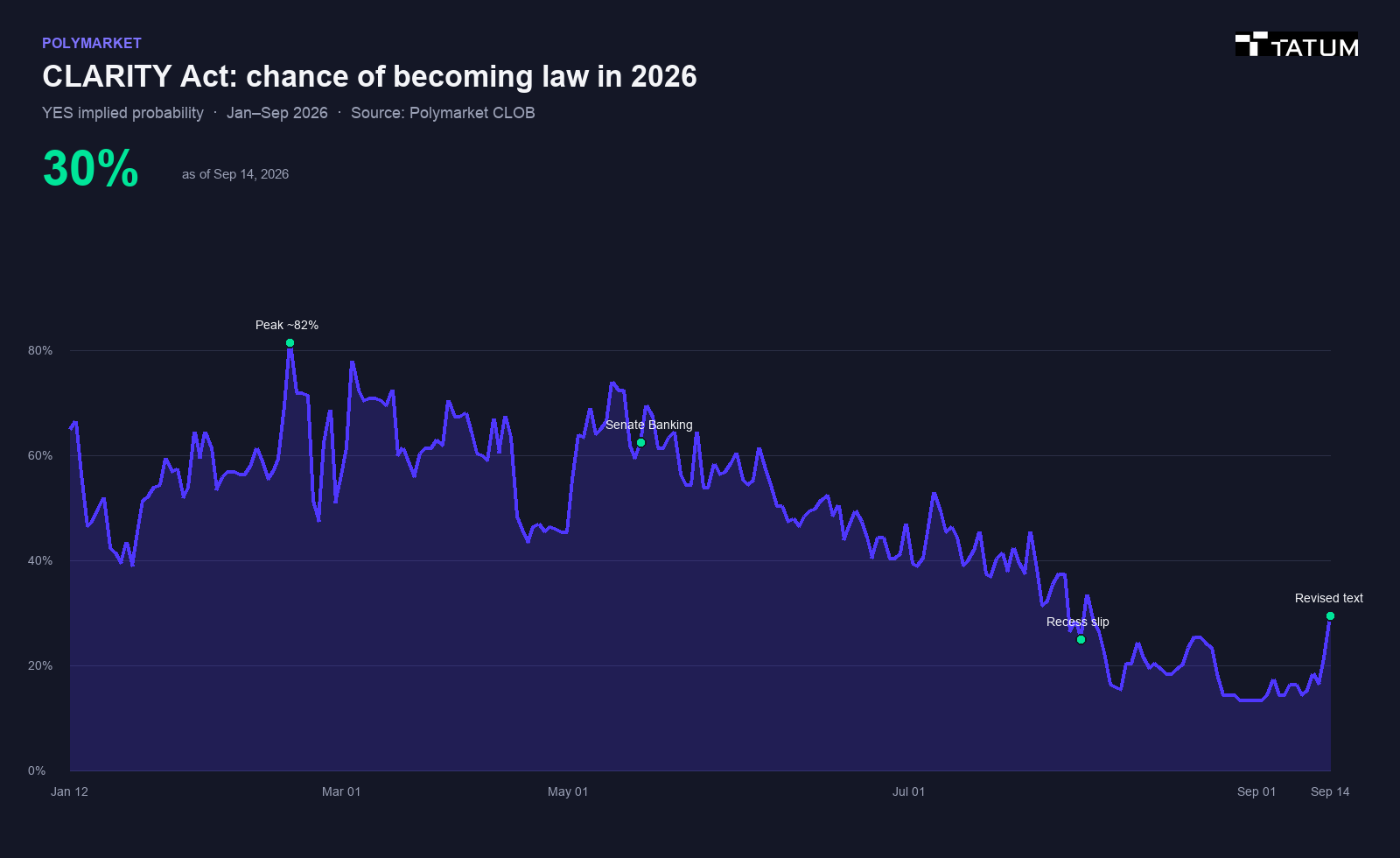
Polymarket · H.R. 3633
Will the CLARITY Act become law in 2026?
YES implied probability from Polymarket CLOB daily closes
Brian Armstrong’s take is worth hearing even if you are not a Coinbase fan: if the bill stalls, the SEC and CFTC say they are ready to publish rules anyway. Zach Pandl at Grayscale said roughly the same on CNBC’s ETF Edge. Regulatory clarity is already arriving through agencies. For builders, that means prep still compounds if cloture fails. You can even pipe those Polymarket moves into an internal Slack with the same price history endpoint you would use for any other market.
Timeline so far
294 to 134. Market-structure bill heads to the Senate with real bipartisan support.
15 to 9. Floor calendar still messy. Ethics and vertical-integration talks keep going.
Leadership says a vote before August recess is unlikely. Polymarket odds slide from the 30s into the teens.
Ethics framework, DOJ + state AG enforcement, BRCA limits, yield circuit breaker, tighter affiliate rules. Odds bounce toward ~30%.
Needs 60. Miss it and 2026 odds probably reprice hard. Clear it and you still need reconciliation and a signature.
What actually changes for builders
If you only accept or send stablecoin payments, tomorrow morning probably looks the same. The sharper shifts hit venues, custody, classification UX, and anything that has to look institution-ready. Tap your lane:
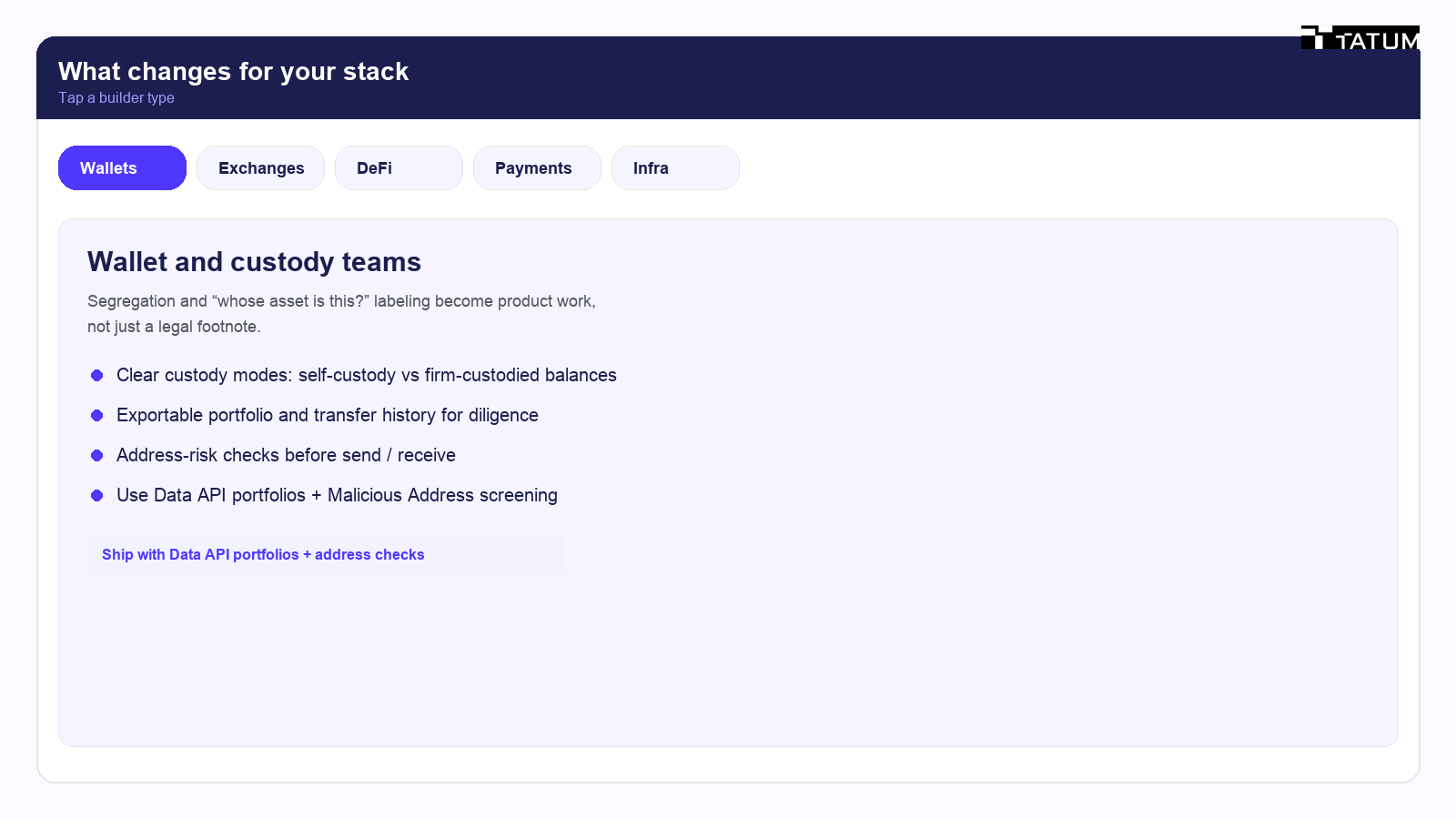
Two knock-on effects matter as much as the statute text.
- More institutional product supply. Banks and big payment companies that sat out waiting for a federal rulebook get more comfortable shipping. That means more partners for you to integrate, often through the same compliance and accounting patterns enterprises already ask for.
- Closer global alignment. The EU, UK, UAE, and Singapore already license a lot of the venue activity CLARITY would cover. When U.S. rules move toward those regimes, multi-market products spend less time rewriting the same compliance story for each region.
GENIUS already showed the movie: clear federal guardrails, then faster large-company adoption of stablecoin payments. CLARITY is aimed at the other ~85% of crypto market value that still lacks a matching U.S. federal rulebook for venues and networks. If you are building on chains those institutions actually use, it helps to already be on solid Ethereum, Polygon, or BNB endpoints instead of a fragile single-node setup.
Wire the odds into something real
The chart above is the same kind of signal risk dashboards and treasury bots should consume in code. With Tatum’s prediction market price history endpoint you can chart implied probability over any window without babysitting a Polymarket scraper:
Want a fuller explorer pattern with live markets and platform filters? We walked through that in Building with Prediction Market Data. Same Dashboard key also unlocks Custom RPC Gateways if you need Bring Your Own RPC or weighted routing for production.
What to do this week
- Write down which of your flows look like brokerage, custody, or plain software, and keep that split somewhere your team can find
- Add portfolio export and transfer history paths. Diligence questionnaires love those. The Data API is the easy route
- Subscribe to transfer and failed-tx Notifications on treasury and hot wallets
- Pipe CLARITY (and related) markets from the Prediction API into an internal risk channel
- Keep payment stablecoin work on licensed rails. GENIUS already set that bar
Midterms can slow crypto-specific bills further. Agency chairs still matter a lot for rulemaking. The demand for scarce digital assets and for production infra does not need a signed CLARITY PDF to keep compounding. If you want a deeper cut on how enterprises pressure-test providers while this plays out, read our notes on enterprise-grade infrastructure.
FAQ
Click a question to open the answer.
A U.S. federal market-structure bill that would set rules for digital-asset classification, exchanges, brokers, dealers, and custody, with oversight split between the SEC and CFTC.
GENIUS (enacted July 2025) regulates payment stablecoin issuers: reserves, disclosures, AML. CLARITY targets the venues and rails around digital assets. It does not replace GENIUS.
Nobody knows. Polymarket implied roughly a 30% chance as of September 14, 2026, after revised Senate text and ahead of cloture. A slip into 2027 is still on the table.
Ship clearer custody UX, exportable portfolio history, transfer monitoring, address-risk checks, and a feed of regulatory-risk markets. Those help whether Congress signs a bill or agencies rulemake instead.
Not right away for most accept/send flows. Stay on licensed rails under GENIUS. CLARITY mainly raises the bar for the venues and networks those payments settle through.
Use Tatum’s Prediction API to list markets, read prices and orderbooks, and pull OHLC history for Polymarket and Kalshi without running your own indexer.