

%20(18).jpg)
Enterprise blockchain infrastructure is not just about uptime or speed. It’s about trust.
Before a single API call hits production, enterprise teams ask harder questions:
Will this pass our security review?
Is the provider SOC 2 compliant?
Are they ISO/IEC 27001:2022 certified?
What happens during a cloud outage?
Who responds when something breaks?
At Tatum, we built our enterprise blockchain infrastructure to answer those questions clearly, and confidently.
Security That Clears Enterprise Reviews
Security reviews are where most infrastructure deals slow down. Procurement teams don’t care about marketing claims. They care about controls, documentation, and accountability.
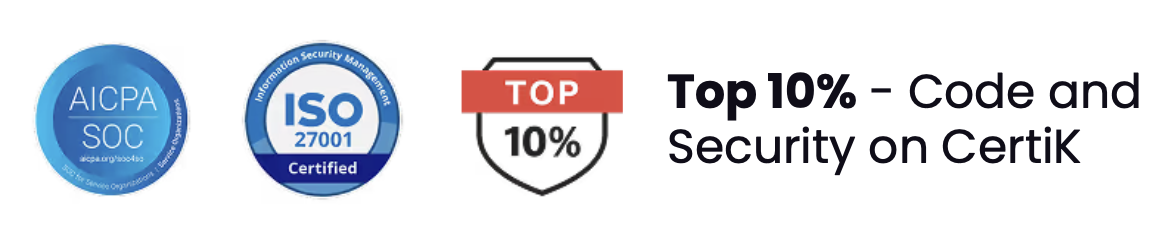
Tatum is SOC 2 compliant and ISO/IEC 27001:2022 certified. That certification covers how we operate our blockchain infrastructure, internal processes, and risk management systems.
For enterprise teams, that means:
-Documented security controls
-Formal incident response procedures
-Defined access management policies
-Continuous risk assessments
-Audit-ready documentation
-Clearly assigned ownership across systems
When your compliance team asks for evidence, we provide it.
This isn’t compliance as a badge. It’s compliance as an operating model.
And because ISO/IEC 27001:2022 requires continuous improvement, our security framework evolves alongside emerging threats and regulatory expectations.
Built for Production, Not Just Performance
There’s a difference between a fast demo and production-ready blockchain infrastructure.
We design for:
-High availability architecture
-Intelligent traffic routing
-Multi-region redundancy
-Real-time monitoring
-Defined Service Level Agreement (SLA) commitments
Reliability isn’t a slide in a pitch deck. It’s operational discipline backed by process.
When you choose an enterprise blockchain infrastructure provider, you’re choosing who carries operational risk with you.
Also, if speed is what you're after. Well, let's just say there is fast and Tatum fast. Check out our RPC latencies independently benchmarked by Compared Nodes.
Build on Enterprise-Ready Blockchain Infrastructure
SOC 2 compliant and ISO 27001 certified infrastructure designed for teams that need security, reliability, and production-grade performance.
Start Building SecurelyEnterprise-Grade Service Level Agreements
Security and infrastructure mean little without operational accountability.
That’s why Tatum’s Service Level Agreement (SLA) clearly defines support scope, response targets, and escalation paths across all plans — from free users to enterprise customers.
Structured Incident Response
We categorize issues by priority to ensure production-critical incidents are addressed first:
- P1 (Critical): Initial response within 2 hours
- P2 (Major): Initial response within 8 hours
- P3 (Low Priority): Response within 24 business hours
Support That Scales With You
- Free Plan: Community support during business hours
- Self-Service Plans: Standard 8/5 support with defined response targets
- Business Plan: 24/7 prioritized support, dedicated communication channels, and real-time updates
Our teams continuously monitor supported networks and proactively mitigate incidents, coordinating with ecosystem partners when needed to maintain service continuity.
Security isn’t theoretical. It’s about how systems behave when something goes wrong.
Here are the kinds of situations we design for.
When a Major Provider Goes Down
Cloud providers and core internet services sometimes fail. If your architecture depends on a single provider, you inherit that risk.
We architect for resilience and failover so external instability doesn’t automatically become your outage. Redundancy and monitoring are not optional add-ons, they’re part of how we operate.
When Someone Tries to Abuse the System
Blockchain infrastructure attracts abuse, spam traffic, and coordinated attempts to overload systems.
In those moments, response speed matters:
-We declare incidents quickly.
-We analyze traffic patterns.
-We rate-limit and block malicious actors.
-We protect legitimate users.
The goal is simple, keep builders online while containing abuse.
When Credentials or Devices Are Compromised
Every organization needs to assume that at some point, a laptop gets lost or a credential leaks. That’s why access is role-based and scoped. Activity is logged. Sessions can be revoked. Keys can be rotated. Processes are documented.
Preparation reduces impact. It turns a potential disaster into a contained event.
When Phishing and Social Engineering Happens
Not all attacks target infrastructure. Many target people. In fact phishing accounts for 34.5% of all malicious activities based on our State of Crypto Q1 2026 report backed by Tatum data and analyzed by Blockchain Bureau.
We invest in access controls, centralized identity management, and ongoing security awareness. No single layer is enough. Security is about stacking defenses.
Enterprise teams don’t choose infrastructure based on promises. They choose it based on risk.
Risk of downtime.
Risk of audit failure.
Risk of operational chaos when something breaks.
At Tatum, our job is to reduce that risk to a level your organization can comfortably build on.
Security is not a feature we market. It is a discipline we operate under, every day. If you have any questions, talk to an expert.
If you’re building something that matters, build it on infrastructure that’s ready for production.
%20(4).jpg)