



Walk into almost any blockchain conference in Singapore, Hong Kong, Tokyo, or Seoul and the agenda is predictable. Banking panels. Payment corridors. Stablecoins.
Not NFT drops. Not meme-coin speculation. The rooms that fill up are talking about dollar settlement, remittances, treasury mobility, and whether a regulated digital dollar can sit next to UPI, PayNow, and Project Ensemble without breaking compliance.
Yes: stablecoins are huge in Asia-Pacific. Let’s dig into why the region leads, what the numbers actually say, and how builders should ship against that reality.
The short version
Stablecoins crossed a new all-time high of $321B in market capitalization in May 2026. In the first half of 2026 alone, adjusted transaction volumes hit $37.2T, already past the full-year 2025 total. More than 80% of that activity happens outside North America.
Asia-Pacific is the center of gravity for real payment utility. Per CoinDesk Research’s Definitive Stablecoin Landscape Series: Asia Pacific, the region accounts for 51.2% of identified stablecoin payment volume. Liquidity is still USDT-heavy, but that share is slipping as institutions push for compliance, custody, and clearer reserves.
If you are wiring wallets, payouts, or treasury flows across APAC chains, start from Tatum’s stablecoin infrastructure. The rest of this guide shows where each piece of the stack fits.
Global market: dollars still rule, usage is everywhere
The market remains almost entirely dollar-denominated. USD-backed stablecoins hold about 99% of total market cap. Usage, though, is global. Exchanges, wallets, payment firms, DeFi protocols, and corporate treasuries all treat stablecoins as settlement rails, not just trading pairs.
That split matters for product design. North America is where a lot of regulated issuance and institutional digital-dollar infrastructure is getting written into law. Europe leans regulation-first under MiCA, with a public-money bias via the digital euro. APAC sits in between: more experimental than Europe, less centered on a single private-stablecoin playbook than the U.S., and more open to a multi-rail future where stablecoins, tokenized deposits, CBDCs, and real-time payment systems run side by side.
Builders accepting those rails across many networks usually want one RPC Gateway, not a homemade node farm per corridor.
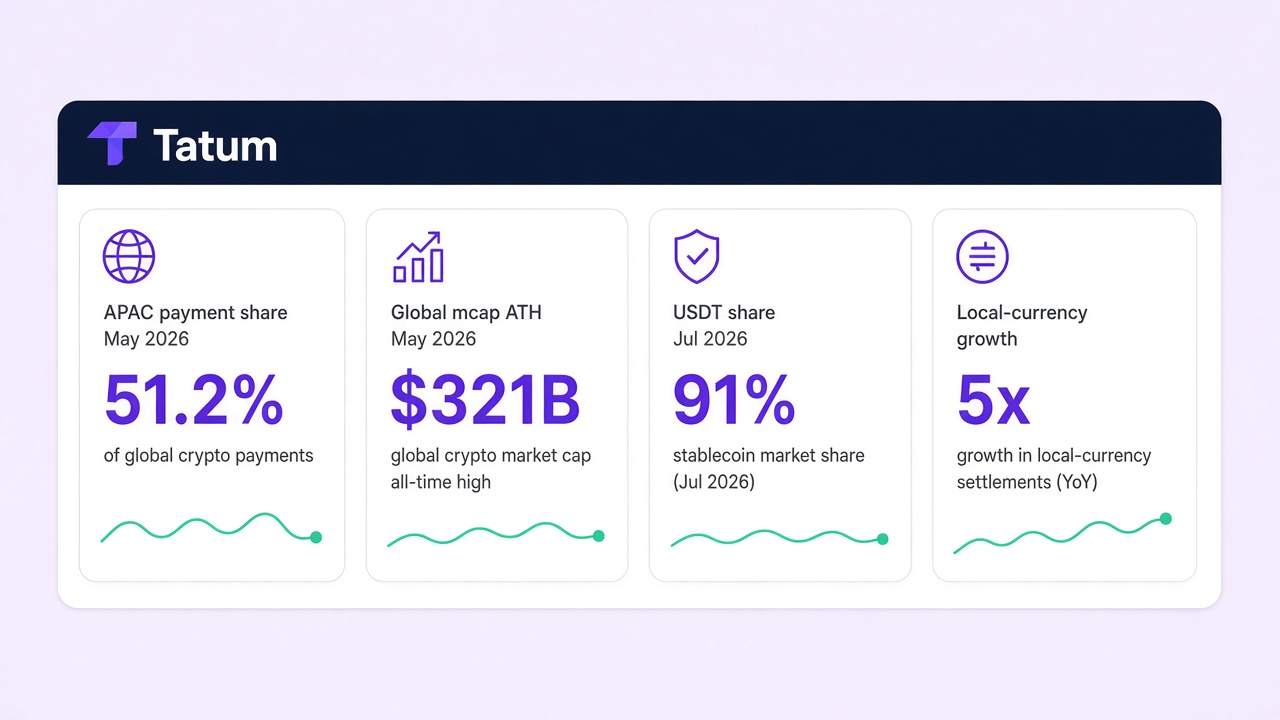
Market snapshot
The numbers that set the APAC story

51.2%
APAC share of identified stablecoin payment volume
$321B
Global stablecoin market cap ATH (May 2026)
91%
USDT share of APAC payment volume (Jul 2026, down from 98%)
5×
Non-USD stablecoin mcap growth since start of 2025
Source: CoinDesk Research, Definitive Stablecoin Landscape Series: Asia Pacific (2026).
Why Asia-Pacific is the proving ground
APAC did not win on issuance alone. It won on friction.
The region combines fragmented currency corridors, huge cross-border trade, high fintech penetration, and advanced real-time payment systems. India’s UPI set a global benchmark. Singapore, Thailand, Hong Kong, Australia, and South Korea already treat mobile-first and instant settlement as normal. Stablecoins scale here because consumers, businesses, and regulators already know digital money.
Domestic rails got fast. Cross-border still often means correspondent banks, pre-funded balances, FX intermediaries, and banking-hour cut-offs. That gap is where stablecoins earn their keep: a 24/7 settlement layer while local fiat rails handle the first and last mile.
CoinDesk Research’s corridor dataset (filtered for at least one APAC country) captured 426 APAC-linked payment corridors across 28 countries, representing $30.9B in stablecoin payment volume and 14.2M transactions. Activity concentrates around Taiwan, South Korea, Indonesia, India, and Australia, with major bilateral flows such as Taiwan→Indonesia, Taiwan→South Korea, and Taiwan→Australia.
Stablecoins here are connective tissue. They do not replace PayNow or UPI. They bridge markets, currencies, and counterparties when the banking stack is too slow or too capital-intensive. Ops teams running those corridors usually wire Notifications for deposits and transfers instead of refreshing explorers.
Use cases that actually move volume
APAC adoption is driven by institutional needs more than crypto-native trading. Tap a card for the short version of each workflow. For B2B and treasury flows, portfolio truth still comes from indexed data via the Data API.
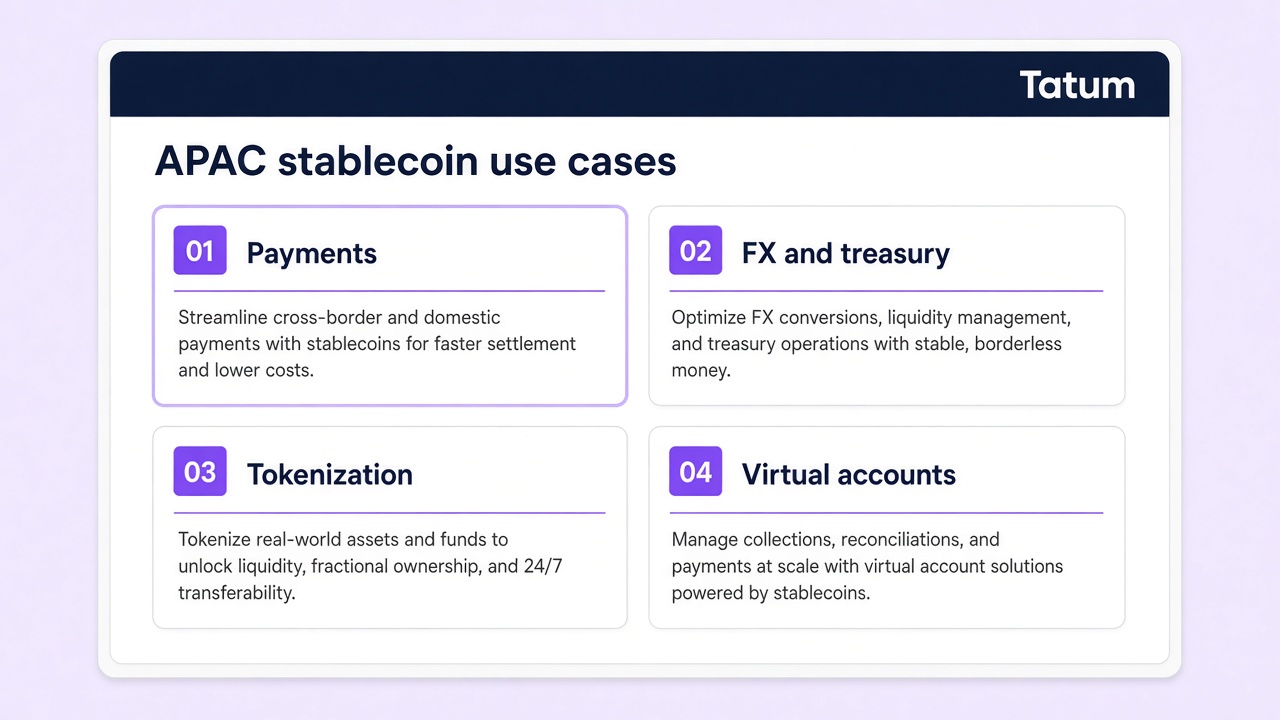
Use cases
Tap a card for the short version of each workflow
Consumer and enterprise products are catching up too. Crypto-linked card volume across major providers reached $3.16B in H1 2026, with a record $624M month in June. In most products the stablecoin stays in the background while the user sees a familiar wallet, card, or merchant UI. Apps that hide the chain from end users usually need MPC signing; that is where Smart Wallets fit.
Regulatory map: filter by model
Regulation is both brake and accelerator. Clear rules on reserves, redemption, custody, and distribution unlock bank and corporate buyers. Ambiguity keeps them on the sidelines.
APAC is not one regime. Filter the table by model type.
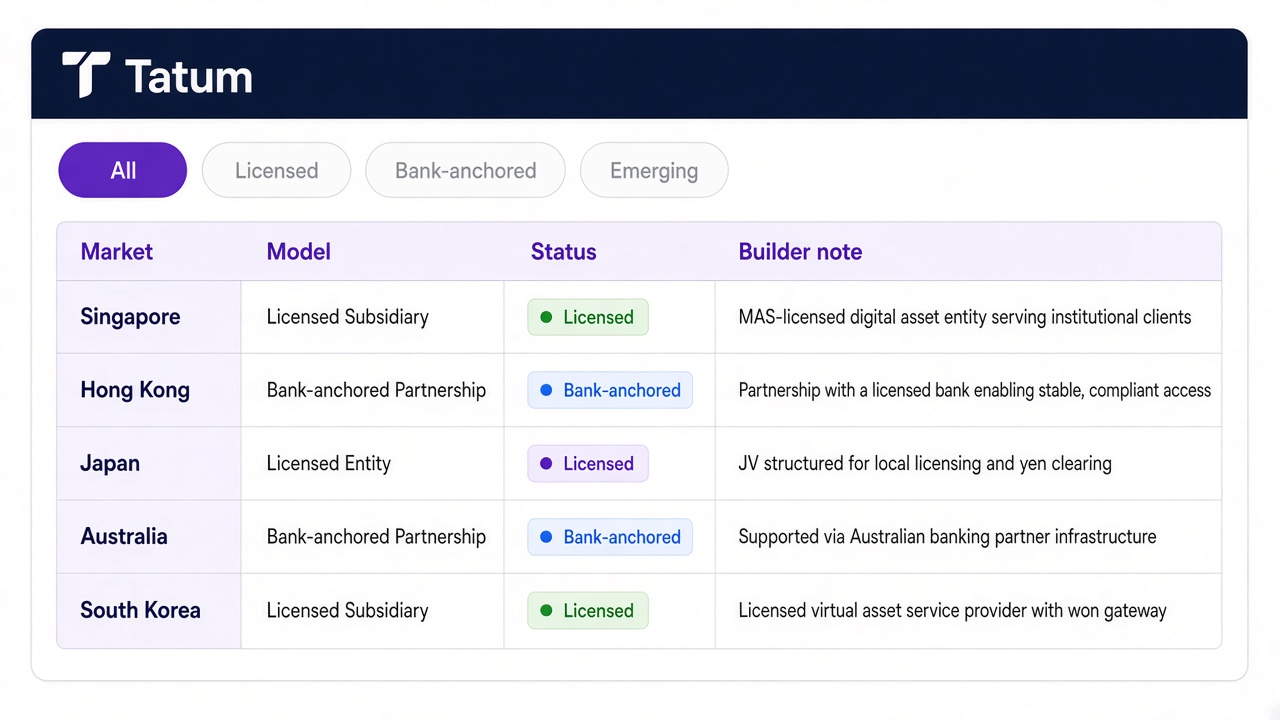
Regulation
APAC models at a glance
| Market | Model | Status | Builder note |
|---|---|---|---|
| Singapore | Payments + SSCF | Single-Currency Stablecoin Framework for qualifying SGD and G10-pegged coins; MAS consulting on legislation (100% reserves, limits on issuer yield) | Strong hub for regulated settlement and tokenization (BLOOM, bank pilots) |
| Hong Kong | Issuer licence | Stablecoins Ordinance live Aug 2025; first HKMA licences Apr 2026 (Anchorpoint, HSBC) | No equivalence path; plan market-by-market permissions |
| Japan | Bank / trust only | Issuance limited to banks, trusts, and registered fund-transfer providers; foreign trust-type coins gain limited recognition via intermediaries | Slower retail path, deeper bank integration |
| Australia | AFSL + platforms | Digital Assets Framework Act 2026; ASIC “exempt foreign issuer” relief; dedicated payment-stablecoin regime still pending | Useful recognition experiments for foreign issuers |
| South Korea | In definition | Issuer eligibility and domestic regime still being set | Huge fiat CEX liquidity (KRW); watch policy drafts closely |
| Thailand | Usage-led | Selected stablecoins allowed for regulated digital-asset activities, not open retail payments | Trading-pair and investment use ahead of payments |
| Vietnam | Restricted payments | Crypto trading is active; using crypto (including stablecoins) as a means of payment remains restricted under existing rules | High retail engagement; treat payments and remittance products carefully |
| Taiwan | VAS Act | Virtual Asset Service Act passed; FSC / Central Bank approval path forming | Corridor activity is already large; issuance catching up |
| India | CBDC-first | No dedicated private stablecoin framework; policy preference for the digital rupee | Domestic rails are world-class; private stables stay constrained |
| Indonesia | OJK + BI | Digital financial assets under OJK; BI’s legal-tender rules constrain payment use of crypto | Treat as custody / investment first, payments second |
Recognition and equivalence are becoming the access question for global USD stablecoins. The U.S. GENIUS Act, Australia’s exempt-foreign-issuer relief, Japan’s intermediary pathway, and Singapore’s consultation on limited foreign recognition all point the same way: home-jurisdiction supervision only travels if the host market says so. Hong Kong’s licensing regime has no equivalence shortcut, so even a well-regulated coin can need local permissions before regulated institutions will touch it.
When diligence asks for holdings and transfer history across chains, map that activity into compliance and accounting workflows with readable portfolios.
Liquidity leaders vs compliance-first coins
USDT still dominates APAC crypto-native liquidity. Deep exchange pairs, broad on-chain distribution, and early-mover network effects made it the default offshore dollar for traders and remittance users. That map should not be mistaken for the institutional end state.
USDT’s share of identified APAC stablecoin payment volume fell from 98% at the start of 2025 to 91% in July 2026. Banks, payment firms, and custodians care about reserve transparency, licensing coverage, AML/KYC, and whether the coin can be held without a punitive capital charge.
Local-currency experiments are small in absolute terms but growing fast. Non-USD stablecoin market cap rose from $12.8M at the start of 2025 to $64.4M by July 2026, led by APAC-linked coins in JPY, AUD, SGD, PHP, and CNY. Examples include StraitsX’s XSGD / XUSD / XIDR, Japan’s JPYC and JPYSC, Australia’s AUDD, and Hong Kong dollar initiatives under the new licensing regime.
Expect a segmented market: liquidity-led coins for trading and offshore dollar flows, compliance-first USD coins for regulated payments and treasury, and local-currency coins for selected domestic workflows. Issuance alone will not decide winners. Distribution, custody, and integration will. Fiat display on top of those rails is easier with live exchange rates.
Market split
How the APAC market is splitting
| Segment | What wins today | What wins next |
|---|---|---|
| Crypto-native liquidity | Deep CEX pairs, low transfer cost, ubiquity (still USDT-led) | Same, plus cleaner on/off-ramps in licensed markets |
| Institutional payments | Corridor partners and last-mile payout coverage | Licensed issuance, attestations, bank-grade custody |
| Tokenized markets | Pilots in Singapore and Hong Kong | Permitted cash legs that clear capital and custody rules |
| Local-currency rails | Small absolute size, fast growth from a low base | Bank-anchored or licensed issuers in SGD, JPY, AUD, HKD |
What builders should ship on Tatum
Institutional buyers will ask the same questions in every APAC diligence call: which chains, who holds the keys, can we get portfolio truth, and do we get alerted when funds move?
You do not need a homemade node farm to answer them. The products linked above already cover the default path: Gateway for chain access, Data API for portfolios, Notifications for deposits, and Smart Wallets when end users should never see a seed phrase.
For the basics of how pegs and reserve models work, start with our stablecoins explained guide and the multi-chain view in stablecoins across blockchains. U.S. issuer rules sit under the GENIUS Act; market-structure context is in our CLARITY Act builder guide.
Ship next
Build APAC stablecoin flows without owning the node stack
Get an API key, hit the Gateway, and wire balances plus deposit alerts for the corridors you care about.
Outlook: selective, corridor-first, infrastructure-led
Over the next few quarters, APAC stablecoin growth will track three things: regulatory implementation, tokenized capital-market expansion, and commercially viable cross-border corridors. Aggregate volume already looks impressive. The harder test is whether stablecoins become embedded in regulated finance.
Singapore and Hong Kong remain the near-term hubs: clearer rules plus payments and tokenization infrastructure. Japan’s bank-anchored model will move slower but sit closer to core banking. Australia is pulling activity into its financial-services perimeter. Korea, Thailand, Vietnam, and India will each take their own path, which means products must tolerate fragmentation.
The constructive case holds. Fragmented currencies, large trade corridors, uneven dollar access, and pre-funded accounts still create demand for faster settlement. The winners will combine credible issuance with the operating layer institutions already use to move, safeguard, convert, and settle value. Treat chain access as product infrastructure, not a side project, and keep the stablecoin use case as your map of what to ship next. APAC stays the proving ground for that shift from exchange liquidity into financial infrastructure.
FAQ
APAC holds 51.2% of identified stablecoin payment volume. Fragmented currencies, large trade and remittance corridors, and mature digital-payment habits create demand for 24/7 cross-border settlement that domestic rails alone do not solve.
Yes for crypto-native liquidity, but less than before. Its share of identified APAC payment volume fell from 98% at the start of 2025 to 91% in July 2026 as compliance-first and local-currency options gained ground.
Singapore and Hong Kong are furthest along for regulated issuance and institutional use. Japan is bank-anchored. Australia is folding digital-asset platforms into its financial-services perimeter. Elsewhere, regimes are still forming.
Cross-border payments and settlement, FX and liquidity consolidation, treasury sweeps via virtual accounts, and the cash leg for tokenized funds and RWAs. B2B already leads payment-volume mix at 37.1% in H1 2026.
Start from the stablecoin use case. From there, wire the Gateway for chain access, the Data API for balances, and Notifications for deposit alerts. Add Smart Wallets if you need MPC UX for end users.
Headline APAC figures in this guide draw on CoinDesk Research’s Definitive Stablecoin Landscape Series: Asia Pacific (2026), plus Tatum product context for builders.