


The short version
Three things are driving Zcash privacy hype in 2026. Not vibes alone. A capital narrative, regulated packaging, and a real protocol speedup for shielded payments.
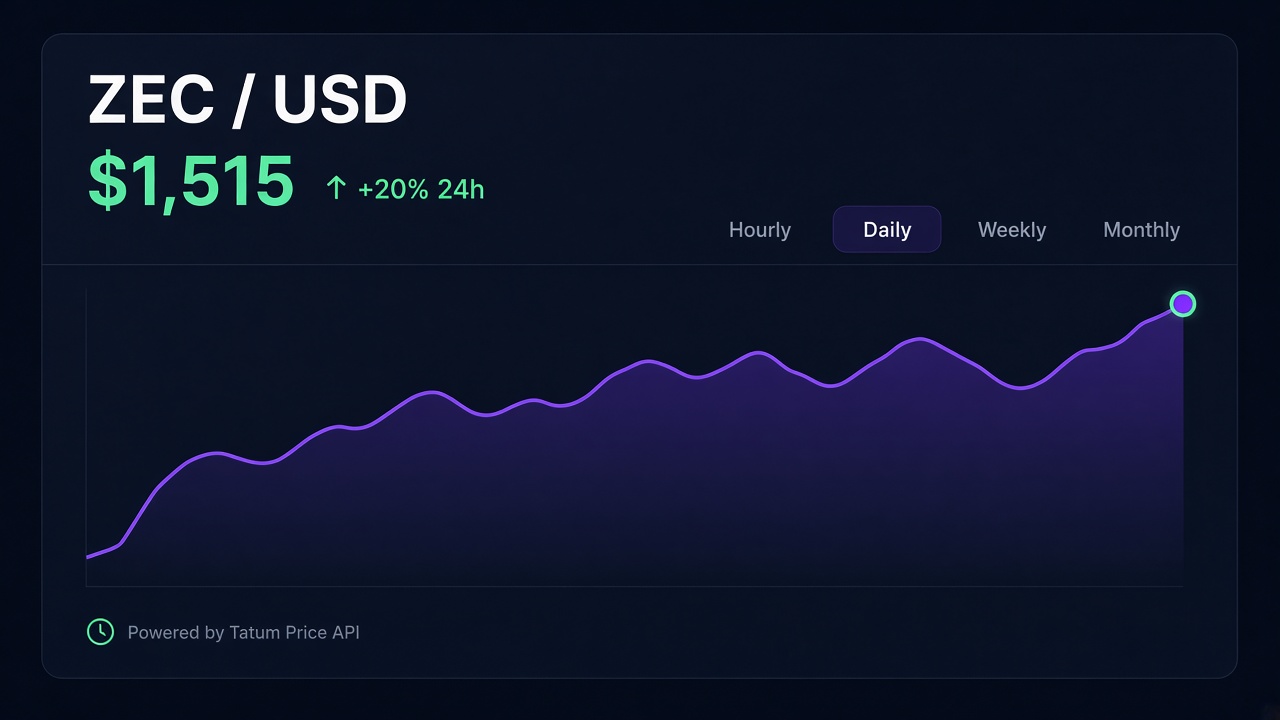
- Capital: Paradigm’s Matt Huang called Zcash a “private complement to Bitcoin.” ZEC jumped ~20% in a day and printed near $1,521
- Packaging: Grayscale’s ZCSH ETF filed a 3-for-1 share split after a ~2,800% trailing run
- Protocol: NU7 targets November 5, 2026 and aims to cut block time from 75s to 25s for faster private confirmations
Underneath the tape, shielded ZEC still hides sender, recipient, and amount with zero-knowledge proofs. New to that model? Start with What Is Zcash?. This piece answers what is driving the hype, then what you can ship on top.
Why privacy is the fuel
Transparent chains are excellent for auditability. They are a liability for salaries, supplier payouts, remittances, or a treasury rotation you would rather not announce on an explorer.
That product gap is why the September signals landed. When serious capital frames Zcash as Bitcoin’s private complement, and the network is about to make shielded payments less laggy, teams start asking for reliable RPC, fee estimates, and ZEC pricing without scraping five exchanges.
The price move behind the narrative
Switch Hourly, Daily, Weekly, or Monthly. Live path uses Tatum OHLCV; if the key is offline, a snapshot keeps the UI usable. The same stack powers exchange-rate lookups for fiat display in wallets and checkout.
Tatum Price API · ZEC/USDT
Zcash (ZEC) price
Loading candles…
Under the hood, the live path hits Tatum’s OHLCV batch endpoint (GET /v4/data/rate/symbol/OHLCV/batch) with intervals 1h, 1d, 1w, and 1M. That is the same Price API you would use in a wallet or portfolio screen.
How Zcash privacy works
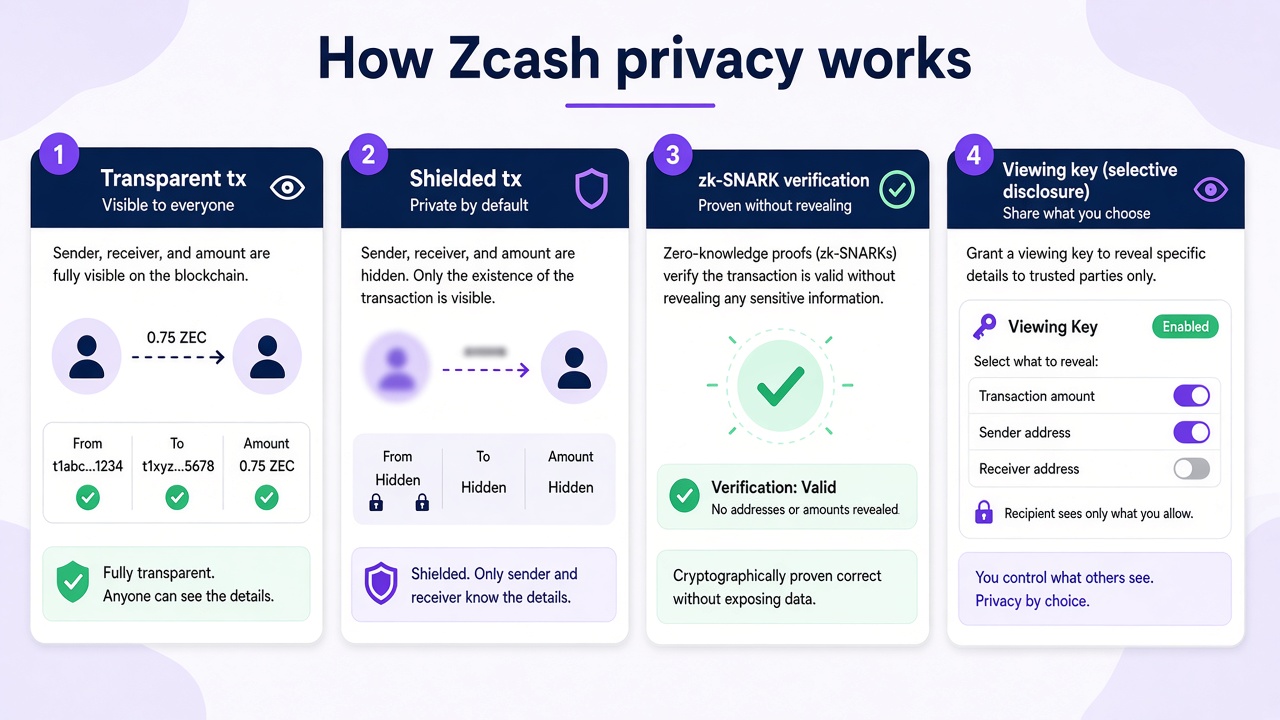
Hype without a product dies. Zcash’s product is optional privacy at the protocol layer. Transparent addresses behave like Bitcoin. Shielded addresses (mostly Orchard now) encrypt sender, recipient, and amount. Tap a lane:
Capital and the Bitcoin-complement story
Privacy coins usually fade after a narrative week. This run started with a capital story that product teams could repeat.
Paradigm’s framing
In mid-September 2026, Paradigm co-founder Matt Huang disclosed that the firm had bought ZEC. He called Zcash a private complement to Bitcoin, and backed longer funding for the development stack as AI-driven cyber capability and quantum computing raise the stakes for privacy tooling.
Markets moved fast. Reports put ZEC up roughly 20% in 24 hours, with prints near $1,521, a new effective all-time high before a mild pullback. That is narrative plus liquidity, not a whitepaper alone.
Huang did not pitch Zcash as a Bitcoin killer. He pitched it as the private rail next to Bitcoin’s transparent store of value. Remittance, payroll, and treasury teams already feel that gap when a public explorer leaks too much.
Grayscale packaging and the 3-for-1 split
Grayscale’s Zcash product on NYSE Arca (ticker ZCSH) filed with the U.S. SEC for a 3-for-1 forward share split. At the close on September 28, shareholders receive two additional shares for each share held.
Economics stay flat. If you held 10 shares at $300 each ($3,000 total), you hold 30 shares at $100 each after the split. Same value, lower unit price. After a roughly 2,800% trailing run, Grayscale said the per-share price had become a barrier for smaller allocators. A forward split is the classic accessibility move.
For builders, the signal beats the math. Regulated wrappers are packaging ZEC the way they packaged BTC and ETH. That usually precedes more wallet, custody, pricing, and RPC demand.
A noisy side signal: coverage around the same window noted Zcash mining revenue per megawatt near 4× Bitcoin. Not a product roadmap. Still another reason the network stopped being easy to ignore.
NU7 makes private payments faster
Capital and ETFs move the tape. NU7 is what makes the privacy story more usable. Core engineering groups including the Zcash Foundation, Project Tachyon, Valar, ZODL, and Shielded Labs aligned on scope after community and token-holder polling.
Headline change: target block time moves from 75 seconds to 25 seconds (ZIP 218). Anything that waits N confirmations (exchange deposits, bridges, merchant settlement) can unlock in about one third of the time.
About 2.4 million ZEC voted (~66% of the eligible shielded pool at snapshot). Support for 25-second blocks was effectively unanimous on a ZEC-weighted basis (~99.9%). That is stake weight, not a headcount of users.
Throughput, not just latency
Tripling block frequency does not automatically triple TPS. ZIP authors estimate Orchard peak capacity for certain two-action operations rising from roughly 2.9 to 6.6 TPS, with per-block caps (for example up to 330 Orchard actions) so wallet sync does not explode. Counterintuitively, worst-case shielded sync bandwidth was modeled to fall ~37% despite more blocks, because of those tighter caps.
Emission stays on the Bitcoin-like path
More blocks would mint more ZEC if rewards were left unchanged. NU7 divides the per-block reward by three and stretches the halving interval from 1.68M to 5.04M blocks so daily issuance stays roughly the same. Token holders rejected a smoothed emission curve: ~98.9% of voting ZEC kept the current halving schedule.
Network Sustainability Mechanism
Under ZIP-235 thinking, about 60% of transaction fees would be temporarily removed from circulation, then re-emitted via block rewards later to support miner revenue as halvings shrink issuance, still under the 21M ZEC cap. Voters preferred starting that re-emission in February 2031 (~97% of expressed weight), not immediately.
NU7 timeline
Tap a milestone, or let it auto-advance. Dates are targets until activation height is set.
Major consensus changes expect Zebra (Zcash Foundation node) rather than legacy zcashd. Wallets should need limited changes; full nodes, indexers, and explorers may need updates. NU7 also disables legacy Sprout/v4 transaction formats.
What the hype means for builders
Privacy wins when it sits in flows users already hate leaking. That is why capital’s story and NU7’s latency cut matter together.
- Remittances and merchant pay: wallet-to-wallet or wallet-to-merchant without a public balance graph
- Payroll: pay contributors without broadcasting salaries
- Treasury: move reserves without telegraphing size and timing; pair chain reads with the Data API on your other networks
- Auditable privacy: hand finance a viewing key; keep spending keys separate
- Exchanges and bridges: treat confirmation policy as a product knob once 25s blocks land, and use Notifications for deposit and failed-tx webhooks where you already monitor transparent rails
Keep transparent rails where venues demand them. Default to shielded when confidentiality is the feature. Do not reinvent mixers on a transparent L1 if Zcash already owns the primitive.
Build on the hype with Tatum
You do not need to run Zebrad to start. Tatum’s RPC Gateway exposes Zcash Mainnet and Testnet with JSON-RPC and Zebrad endpoints (Zcash sits alongside the rest of the supported blockchains catalog), plus the Price API for live ZEC rates and OHLCV charts like the one above.
| Capability | What you get |
|---|---|
| Zcash Mainnet RPC | zcash-mainnet.gateway.tatum.io JSON-RPC plus zcash-mainnet-zebrad.gateway.tatum.io |
| Zcash Testnet RPC | Matching testnet JSON-RPC and Zebrad endpoints for staging |
| Core methods | Blocks, chain info, mempool, raw tx decode/submit, fee estimation, address validation |
| Price API | Live ZEC rates, price change, and OHLCV for wallets and dashboards |
| Explorer tooling | Postman collection and RPC Zcash docs |
Try a call on Zcash
Hit the network from the browser, or import the Zcash Postman collection if you prefer a desktop client. The widget below runs a live RPC call against Tatum’s Zcash gateway so you can confirm connectivity before wiring your own key from the Dashboard.
Reuse the same Dashboard key you already use for other chains. Add Zcash as another gateway target when you need fiat display, PnL, or alerts beside RPC. For agent workflows, point coding agents at the Tatum MCP and gateway /llms.txt instead of pasting OpenAPI by hand.
Ship on Zcash without running nodes
Mainnet + Testnet RPC, Zebrad access, and ZEC pricing from one API key.
Get your free API keyFAQ
Click a question to open the answer.
Three stacked signals: Paradigm’s “private complement to Bitcoin” framing and ZEC buying, Grayscale’s ZCSH 3-for-1 share split after a huge trailing run, and NU7 aiming to cut block time from 75s to 25s for faster shielded payments.
No. Transparent transactions stay available. Shielded is optional. Viewing keys add selective disclosure for audits without publishing every payment.
No. Faster blocks adjust per-block rewards so issuance timing stays aligned. NSM fee recycling is designed to stay inside the existing cap.
November 5, 2026 is the working mainnet target after testnet and an October 20 height decision. Treat it as a schedule until height is set.
Use Tatum’s Price API: exchange rate by symbol, price-change intervals, and OHLCV batch candles for ZEC at 1h, 1d, 1w, and 1M.
Read What Is Zcash?, open the Zcash RPC docs, import the Postman collection, and hit Mainnet or Testnet through the gateway with a Dashboard API key.
Bottom line
Zcash privacy hype in 2026 is not one tweet. It is capital repeating a usable story, ETF packaging lowering the unit-price barrier, and NU7 making shielded payments less laggy. Shielded ZEC remains one of the few L1-native ways to move value without a public balance graph, and without trusting a mixer. Hook Mainnet or Testnet through the Zcash RPC surface on Tatum when you are ready to ship.

%20(84).jpg)
%20(77).jpg)