

.jpg)
Every blockchain infrastructure provider claims to have a great free tier. The reality is that "free" means very different things depending on where you look.
Some platforms provide a standard RPC endpoint that works well for basic reads, but leave you completely on your own when you need wallets, event listeners, or transaction handling. Others offer a high sticker number for credits, only to consume those credits rapidly through weighted compute unit pricing or strict per second limits. A few even package a 30 day trial as a free tier, deactivating your setup just as your prototype begins to take shape.
When you are shipping a modern decentralized application, an isolated RPC URL is rarely enough. A functioning dApp typically requires reading blockchain state, streaming live events, creating user wallets, dispatching transactions, handling multi chain routing, and increasingly, exposing on chain capabilities to autonomous AI agents. If every piece of that architecture requires a separate provider, your setup quickly becomes fragmented and difficult to maintain.
Tatum takes a full stack approach. Instead of providing bare node access alone, Tatum bundles essential application layer tooling directly into its free tier.
Tatum Free Plan
Full developer toolkit to explore, prototype, and build production ready architectures.
The architectural gap in conventional free tiers
A basic JSON RPC endpoint answers queries such as eth_getBalance, eth_call, or eth_sendRawTransaction. It is fundamentally a direct connection to a blockchain node.
The issue arises when you begin constructing the actual user experience. Your application needs a way to create and manage non-custodial or smart contract wallets, listen for on chain events such as token deposits or contract state changes, stream live updates without burning bandwidth on polling, and switch effortlessly between networks.
If your provider gives you only an RPC URL, you have to write, host, and maintain all of those middle tier services yourself. You end up running custom indexing scripts, maintaining cron jobs for balance polling, and manually wrangling distinct endpoints for every testnet and mainnet.
Tatum eliminates this fragmentation by combining low level node access with higher level infrastructure primitives. You can test your entire application lifecycle, from smart wallet instantiation to real time notification dispatch and AI agent interaction, without leaving the ecosystem or paying upfront infrastructure fees.
1. End to End Blockchain Data API
Querying raw node data directly across multiple chains quickly becomes an engineering bottleneck. Standard RPC calls require you to manually parse logs, index historical events, and assemble complex database architectures just to retrieve basic portfolio balances or token metadata.
Tatum eliminates indexer operations by delivering a comprehensive, unified Blockchain Data API across 60+ networks. You get a single integration surface for EVM, UTXO, and Solana architectures with typed REST responses that simplify development and minimize parsing errors.
The Data API provides specialized endpoints organized by product family:
-Price Api: Instantly get prices for 1000+ crypto currencies, or fetch any token price by contract address.
-Token API: Fetch collection data, popular tokens, newest tokens, and trending tokens with transparent credit costs starting at 20 credits.
-Wallet API: Retrieve wallet portfolios, historical balances by address, and address reputation analytics without custom scrapers.
-Staking API: Inspect active staked assets, validator positions, reward distributions, and staking transaction histories across networks like Ethereum and Solana.
-NFT API: Access metadata, enumerate collection tokens, inspect owners, and verify specific token holders.
-Transactions & DeFi API: Pull complete transaction histories, examine transaction DNA, resolve block by time queries, and track custom smart contract events.
-Blockchains & Web3 Name Service: Query block heights, hashes, UTXO indices, and resolve domains across ENS, Solana Name Service, and supported networks.
Every endpoint follows predictable credit metering defined directly in the documentation, making usage easy to forecast as your application grows.
2. On chain notifications without custom indexing backends
Keeping your application state synchronized with on chain events is notoriously cumbersome. The simplest method is HTTP polling, where a backend script repeatedly queries the node for new blocks or address changes.
Polling creates significant request overhead, introduces artificial latency, and regularly fails to handle deep chain reorganizations cleanly.
Tatum replaces this with a native notification engine. You can configure webhooks for smart contract events, specific address balance shifts, or confirmed asset transfers. By reacting instantly to on chain events rather than continuously querying nodes, your backend stays lean and your application updates the moment an on chain state change occurs.
.png)
3. Persistent WebSockets for live data streams
While webhooks are ideal for backend event processing, client facing interfaces demand bidirectional, real time connectivity.
Tatum provides native WebSocket support across its supported networks. Rather than forcing your frontend to poll an endpoint to display pending transactions, mempool actions, or contract events, you can open a single persistent connection to stream state updates directly to the client.
This capability is essential for live trading dashboards, real time block explorers, multiplayer Web3 gaming, and instant payment confirmations. Developers can architect reactive user interfaces using modern event driven designs right from day one, with real time streams consuming credits and request quotas smoothly.
4. Multi chain RPC Router
Modern decentralized applications are rarely confined to a single blockchain. Managing distinct infrastructure endpoints, bespoke authentication headers, and network specific failover systems for each chain adds needless complexity to your codebase.
Tatum’s RPC Router acts as a unified gateway across supported blockchain environments.
Instead of hardcoding separate URLs and credentials across your development, staging, and production environments, your application directs requests through a single routing layer. This architecture simplifies switching between networks, centralizes key security, and keeps your codebase clean as you expand across multiple Layer 1 and Layer 2 ecosystems.
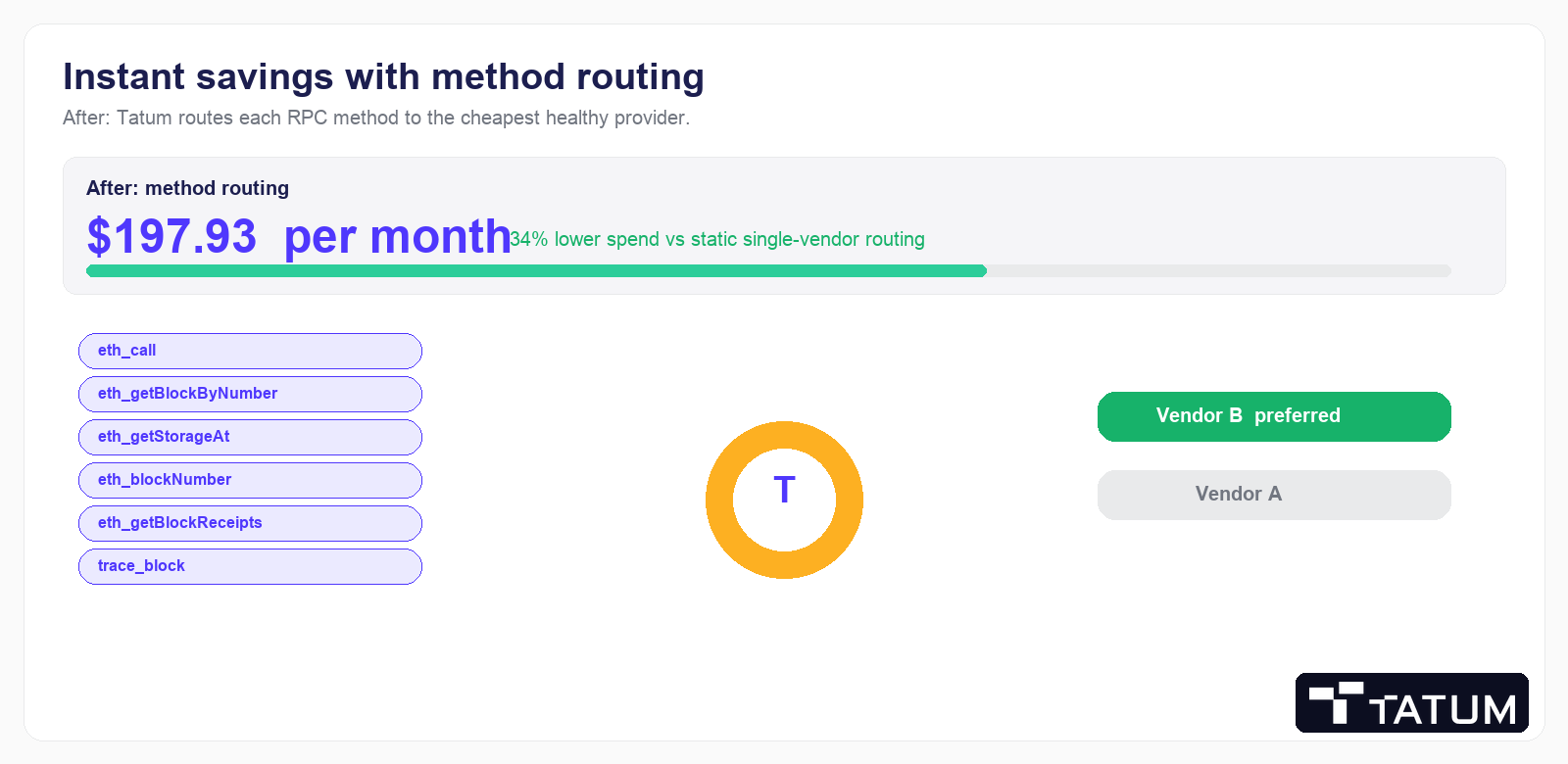
Instant savings with method routing
One RPC bill, two states: static routing vs Tatum routing to the cheapest healthy provider.
If you are at the very earliest stage of building and need to test a quick smart contract call or verify a script without touching a dashboard, Tatum also powers FreeRPC.com. FreeRPC provides instant public endpoints across 50+ blockchains and more than 180 network interfaces with zero signup, zero API keys, and no configuration barriers. You can grab an active RPC URL for ecosystems like Base, Solana, Ethereum, Monad, or Sui directly in your browser, validate your logic immediately, and then transition seamlessly to Tatum's managed RPC Router and full platform features when your project is ready.
5. Model Context Protocol (MCP) for autonomous AI agents
The integration of generative AI and blockchain infrastructure is transforming developer workflows. However, large language models cannot interact with blockchains reliably if they are restricted to static documentation or generic web scraping.
Tatum provides native Model Context Protocol (MCP) integration, exposing structured, type safe tools directly to AI systems such as Claude Code, Cursor, and custom agentic frameworks.
Through Tatum’s MCP server, an autonomous agent can inspect balances, verify transaction statuses, construct compliant payloads, test API routes, and debug failing smart contract invocations directly inside your development environment. This turns your AI assistant from a simple code generator into an active development partner capable of safely interacting with live chain data.
6. Rapid prototyping with the Tatum AI Builder
To accelerate the path from initial concept to working software, Tatum offers the AI Builder.
The AI Builder allows developers to define application requirements in natural language and automatically generate structured, production aligned blockchain integration code. Whether you need an escrow contract interface, a token indexing pipeline, or a multi chain wallet dashboard, the tool provisions the initial architecture rapidly.
While all AI generated code should undergo careful testing for business logic, signing parameters, and access controls, utilizing the AI Builder dramatically reduces initial boilerplate setup. Combined with the MCP server, it forms a cohesive environment for rapid prototyping and iterative development.
7. Node debugging tools and enterprise grade reliability
Diagnosing failed blockchain transactions is notoriously frustrating. A reverted transaction might stem from incorrect calldata, execution gas limits, out of order nonces, or subtle contract state reverts.
Tatum's free tier provides access to full nodes alongside dedicated debugging tools and comprehensive error logs. Instead of receiving generic error strings from an unmanaged public node, developers can inspect execution traces, review comprehensive logs, and systematically diagnose why an interaction failed.
Having access to clear debugging capabilities on a free tier prevents costly development bottlenecks and ensures teams build reliable transaction flows before scaling their user base.
8. Grow your project with the Tatum Affiliates Program
Earn 15% from every referral
Turn your audience, content, or network into a source of recurring income. With the Tatum Affiliates Program, you earn 15% commission on every plan and purchase made by customers you refer.
There are no maximum limits on how much you can earn. As your referrals continue using Tatum, your commissions can continue growing. Payments are processed monthly through PayPal, with referrals and earnings tracked through PromoteKit.
Share Tatum through your blog, newsletter, social channels, videos, or other authentic content, and earn passive income from the developers and teams you send our way.
Free tier comparison at a glance in 2026
To see how Tatum compares with other prominent providers in the ecosystem, look at the feature availability across essential development primitives:
| Feature / Capability | Tatum | Alchemy | Infura | QuickNode |
|---|---|---|---|---|
| Supported chains | 130+ blockchains across EVM and non EVM networks | 100+ chains across EVM, Layer 2s, and Solana | 30+ networks focused on EVM L1, L2s, and Starknet | 80+ chains across 135+ networks (EVM and non EVM) |
| Average global latency | Sub 50 ms latency with global edge routing | Sub 50 ms latency via Cortex routing engine | Network and region dependent | Low latency with global edge accelerator |
| MCP support | Native MCP server for 130+ chains and RPC gateway | Native MCP server for data and wallet tools | Community-maintained MCP integrations | Native MCP server for endpoint management |
| Smart Wallets | Included | Included | Integrated via MetaMask SDK and ecosystem | Available via Marketplace add-ons |
| AI Builder | Included via ai.tatum.io | No direct equivalent | No direct equivalent | No direct equivalent |
| Number of faucets | Multiple built-in faucets across supported testnets | Network-specific testnet faucets | Network-specific testnet faucets | Network-specific testnet faucets |
| Self hosted / custom endpoints | Yes, supports private nodes and gateway routing | No | No | No |
| Pay in crypto | Yes | Yes, via USDC and crypto payment flows | Fiat / credit card focused | Yes, via crypto checkouts and enterprise |
When should you choose Tatum's free plan?
Tatum’s free plan is built specifically for builders who need to develop, iterate, and validate real decentralized applications rather than just execute raw read queries against a node.
It is ideal if you are:
- Prototyping a complete Web3 application that requires wallets, transactions, and event handling.
- Building a real time tracking interface or live trading tool using WebSockets.
- Implementing event driven backend workflows using webhook notifications.
- Architecting multi chain platforms that benefit from a centralized RPC Router.
- Integrating autonomous AI agents and automated coding pipelines using standard MCP tooling.
- Preparing hackathon submissions, proofs of concept, or early stage startup MVPs.
When your application outgrows the initial exploration limits, scaling up is straightforward. The Starter plan provides 4,000,000 credits per month with a 200 requests per second throughput limit, , giving your project plenty of headroom to support growing user traffic smoothly.
The Infrastructure Verdict
Raw RPC providers give you a pipe to the node. Tatum gives you the application layer: smart wallets, event triggers, WebSockets, multi chain routing, debugging tools, and AI integrations on a permanent $0 starting tier.
Getting started
Great developer infrastructure should remove friction, not add to it. By bringing wallets, notifications, real time streams, multi chain routing, and AI developer tools into a single platform, Tatum provides everything you need to take an idea from initial design to functional deployment.
Create your free account, access your API key, and begin building your next Web3 project on Tatum today.