

%20(44).jpg)
Staking has been a core primitive in proof of stake networks for years now, but the way developers need to think about it has changed significantly. What started as a relatively simple concept, locking tokens to earn yield and help secure a network, has evolved into a multi layered ecosystem with its own derivative assets, DeFi integrations, and increasingly complex data requirements.
If you're building a wallet, a portfolio tracker, a DeFi analytics platform, or any application that touches user assets on Ethereum or Solana, you can no longer treat staking as an afterthought. A substantial chunk of assets on both networks are staked in one form or another. Miss that data, and your product is showing users an incomplete picture of their own finances.
This guide breaks down how native staking and liquid staking actually work, how they compare from a developer perspective, and how Staking APIs are making it significantly easier to build applications that surface this data correctly.
How Proof of Stake Staking Actually Works
Before getting into the API side of things, it's worth being precise about the mechanics, because native staking and liquid staking behave very differently at the protocol level, and that difference matters a lot when you're designing an application.
In a proof of stake network, validators are responsible for proposing and attesting to new blocks. To participate, validators lock up a certain amount of the native token as economic collateral. This is what gives the system its security guarantees: validators who behave dishonestly risk losing that collateral through a mechanism called slashing.
Most users don't run validators themselves. Instead they delegate their tokens to an existing validator. On Solana, this delegation happens directly through the network's native staking mechanism. On Ethereum, solo staking requires 32 ETH and your own validator setup, which is why most retail participants end up going through staking pools or liquid staking protocols instead.
Either way, when tokens are natively staked, they're locked. The wallet balance doesn't move. The tokens can't be transferred, used as collateral, or deployed anywhere else. The user earns rewards periodically, and when they want their tokens back, they go through an unstaking period that can range from a couple of days on Solana to potentially longer on Ethereum depending on validator exit queue conditions.
That constraint, the illiquidity of staked tokens, is what liquid staking was built to solve.
What Liquid Staking Actually Does Differently
Liquid staking protocols accept your tokens, stake them on your behalf across a managed set of validators, and give you back a derivative token that represents your staked position. That derivative is a normal on chain token. It lives in your wallet like any other asset. You can transfer it, trade it, use it as collateral in a lending protocol, provide liquidity with it, or hold it and let it appreciate.
On Ethereum, the biggest liquid staking protocols are Lido, which issues stETH, and Rocket Pool, which issues rETH. On Solana, Marinade issues mSOL and Jito issues jitoSOL, among others. Each of these tokens represents a claim on underlying staked assets plus the accumulated rewards those assets have earned.
The mechanics of how yield gets reflected differ between protocols. stETH uses a rebasing model where the number of tokens in your wallet increases over time to reflect earned rewards. rETH and mSOL use an exchange rate model where the number of tokens stays constant but the token itself becomes worth progressively more of the underlying asset as rewards accumulate. This is why, if you stake 1 SOL into Marinade today, you might receive something like 0.89 mSOL rather than 1:1, because mSOL has been appreciating since the protocol launched.
Both approaches achieve the same economic outcome, but they have real implications for how you handle these assets in your application. Rebasing tokens require special accounting logic. Exchange rate appreciation needs to be factored into portfolio valuations. Neither is particularly complex once you understand what's happening, but both require that you actually fetch the right data in the first place.
Top Liquid Staking Protocols by TVL
| Name | TVL | Fees 7d | Revenue 7d |
|---|---|---|---|
|
1
|
$21.665b | $11.37m | $1.14m |
|
2
|
$8.479b | $4.68m | $468,039 |
|
3
|
$1.303b | $1.31m | $0 |
|
4
|
$1.141b | $1.65m | $48,619 |
|
5
|
$928.17m | $1.18m | $47,032 |
|
6
|
$901.5m | $182,439 | $9,122 |
|
7
|
$881.02m | $1.17m | $192,647 |
Native Staking vs Liquid Staking: What Developers Need to Understand
The comparison between native and liquid staking is usually framed around user tradeoffs: yield, liquidity, risk. That framing is useful for end users but it doesn't capture the full picture for developers building applications on top of these systems.
From a data perspective, native staked assets and liquid staking positions are completely different things. Native stake accounts are protocol level constructs associated with a wallet address. To get a complete picture of what someone has staked natively, you need to query the network's staking layer, retrieve active stake accounts, match them to validator addresses, and pull reward history. On Ethereum specifically, this involves dealing with the consensus layer separately from the execution layer, which adds architectural complexity.
Liquid staking positions, by contrast, show up as token balances. But they're scattered across multiple protocols, each with its own contract addresses and token mechanics. Without a consolidated data source, building an application that accurately shows a user all of their liquid staking positions means maintaining a registry of every active liquid staking protocol and token on every network you support. That registry goes out of date every time a new protocol launches or an existing one changes its structure.
This is the infrastructure problem that purpose built Staking APIs are designed to address.
Native Staking Vs Liquid Staking
Native Staking
Recommended For Beginners
Liquid Staking
Liquid Staking Protocols Offer Flexibility
Yield, Risk, and Composability: The Real Tradeoffs
On the user side, the choice between native and liquid staking comes down to a few practical dimensions that are worth understanding if you're going to surface this information clearly in your product.
Yield is fairly comparable between the two models on a base level. Ethereum liquid staking protocols typically offer slightly lower yields than raw validator rewards because they charge protocol fees, but the difference is often small. What changes the yield calculation significantly is that liquid staking tokens can be deployed further into DeFi: lent, used as liquidity, or staked in governance protocols. A user who holds mSOL and then deposits it into a lending protocol to earn additional yield on top of base staking rewards can end up significantly outperforming a user who is natively staked and waiting passively.
Risk is additive with liquid staking. Native staking carries validator risk and, on Ethereum, slashing risk. Liquid staking adds smart contract risk from the protocol itself. It's also worth noting that liquid staking tokens can temporarily depeg from their theoretical backing value in secondary markets during periods of stress, which creates real losses for anyone who needs to sell during those windows. These risks are manageable and don't mean liquid staking is a bad choice, but they're worth being transparent about in any application that presents staking options to users.
Composability is where liquid staking genuinely wins by a large margin. The ability to maintain a productive staking position while simultaneously having full access to that capital is a fundamentally different proposition from native staking. On Solana particularly, the DeFi ecosystem around liquid staking tokens like mSOL and jitoSOL is mature enough that users can layer multiple yield sources on top of their base staking rewards with relative ease.
Building with Staking APIs: What's Now Possible
Access to clean, structured staking data has historically been one of the more annoying parts of building in this space. Running your own indexers, maintaining protocol registries, and handling the architectural differences between Ethereum's consensus layer and execution layer is real engineering work that takes time away from building the actual product.
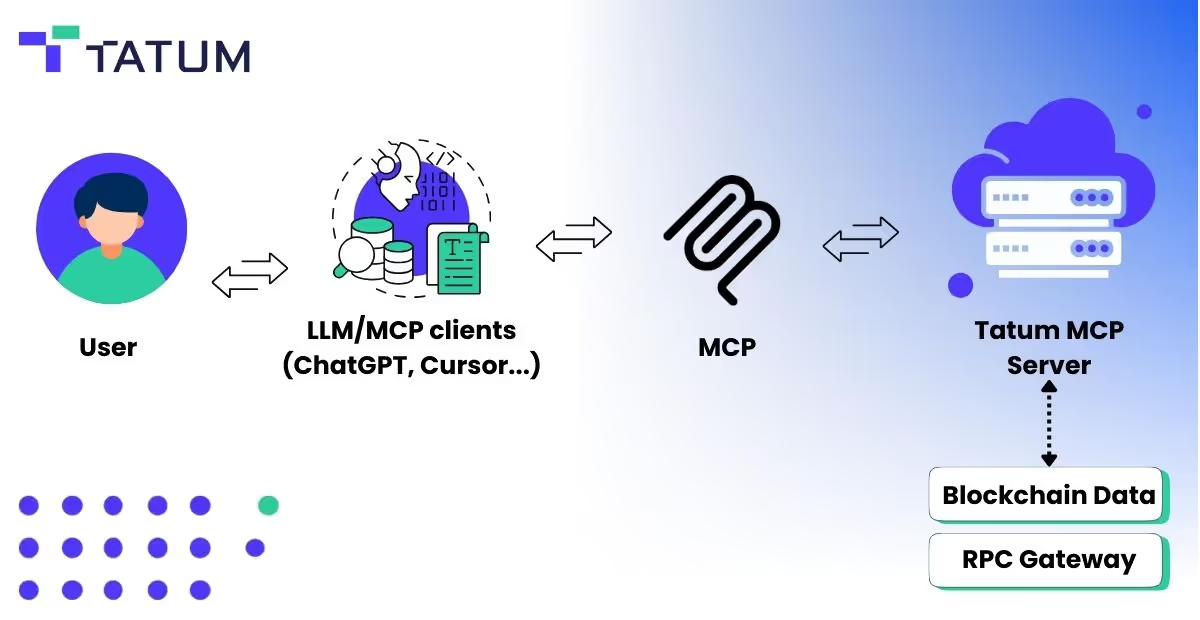
Tatum has recently expanded its Data API to include both native staking support for Ethereum and a dedicated Liquid Staking API covering Ethereum and Solana. Together these endpoints give developers a unified interface for querying staking data without having to build or maintain any of that underlying infrastructure.
Ethereum Staking API
The Ethereum Staking API exposes four endpoints that cover the key data points any staking focused application needs.
GET /v4/data/staking/native/current-assets returns all current staked assets for a given Ethereum address, with full detail on active stake positions. This is typically your entry point when building any kind of staking overview for a user.
GET /v4/data/staking/native/current-assets-by-validator returns the same staking data but grouped by validator, including delegated amounts and validator specific details. If you're building anything that tracks validator performance or lets users monitor which validators hold their stake, this is the endpoint that matters.
GET /v4/data/staking/native/rewards returns historical staking reward data for Ethereum accounts. For portfolio trackers, tax tools, or any product that needs to show users how their staking position has performed over time, reward history is essential and notoriously difficult to reconstruct from raw chain data.
GET /v4/data/staking/native/transactions returns staking related transaction history including stake deposits, withdrawals, and validator interactions. This gives you the activity feed layer, useful for showing users a timeline of what their staking account has done.
You can also test any of these endpoints directly in the Tatum Dashboard by searching a wallet address, which is a convenient way to explore the data structure before you start writing integration code.
Liquid Staking API
The Liquid Staking API introduces two endpoints that address the protocol fragmentation problem.
GET /v4/data/staking/liquid/current-assets retrieves all liquid staking token balances held by a wallet address, across all supported liquid staking protocols. Rather than querying Lido, Rocket Pool, Marinade, and Jito separately and aggregating the results yourself, you get a consolidated response covering the full picture of a user's liquid staking positions.
GET /v4/data/staking/liquid/pools returns the full list of supported liquid staking pools and tokens for a given blockchain, covering major protocols like Lido, Rocket Pool, Marinade, and Jito. This endpoint is useful for both discovery and for keeping your application current as new protocols emerge or existing ones update their token structures.
Current support covers Ethereum and Solana, which together represent the vast majority of liquid staking activity across the market today. The Solana Liquid Staking API support is particularly useful given how active the Solana DeFi ecosystem is around LSTs, and the Ethereum Liquid Staking API coverage addresses what is still the largest liquid staking market by total value locked.
What You Can Actually Build
With both native and liquid staking data accessible through a consistent API interface, the range of practical applications is fairly broad.
Staking dashboards are the most direct use case. Combining native staking data with liquid staking positions gives users a single screen view of everything they have staked, including validator details, reward history, and LST balances, without needing to navigate to separate protocol interfaces.
Portfolio trackers gain a major accuracy improvement. Staked assets have historically been one of the more common sources of incorrect portfolio valuations because they require separate data pipelines from regular token balances. A portfolio tracker that pulls from both the native staking endpoints and the liquid staking current assets endpoint can show users their actual net worth rather than a number that ignores a potentially significant portion of their holdings.
Validator analytics tools can use the validator grouped endpoints to build performance tracking, reward rate comparisons, and delegator distribution views across the Ethereum validator set.
Wallets can surface contextual staking information directly in the asset view. Rather than directing users offsite to check their staking positions, a wallet integration can pull current stakes, pending rewards, and recent staking transactions inline.
DeFi analytics platforms can build more accurate yield decomposition views by distinguishing between base staking yield from the protocol level and additional yield from LST deployments in DeFi applications.
 Solana Staking Pool Demo
See validator APY in action
Same class of data as Get staking pools: search, sort, and compare. Wire it into your product with one REST call.
Best Solana staking pools
Explore native staking pools on Solana. Compare APY, commission, and performance.
Want the full validator list with production-grade limits? Use the Staking API with your Tatum key.
Get API keyPractical Considerations When Building Staking Features
A few things worth keeping in mind as you start building against staking data.
Exchange rates matter more than raw token amounts for liquid staking positions. Showing a user their mSOL balance without converting it to a SOL equivalent at the current exchange rate gives them a meaningless number. Make sure your application fetches and applies the current exchange rate when displaying LST positions.
Reward history requires careful handling for tax purposes. In many jurisdictions, staking rewards are treated as income at the time they're received. The rewards endpoint gives you the historical data, but your application needs to think about how to present that information in a way that's useful rather than confusing.
Unstaking delays are a user experience issue worth surfacing explicitly. Native staking has an exit queue. Liquid staking protocols often have an immediate swap path at a small cost alongside a delayed unstaking path at no cost. If your application lets users initiate unstaking, make sure you're communicating clearly what the timeline and cost implications are.
Protocol risk is real and worth acknowledging in your UI. Liquid staking positions carry smart contract risk that native staked assets don't. Depending on your application's context, it may be worth surfacing this distinction to users rather than treating all staking positions as equivalent.
Where This Is All Heading
The staking landscape in 2025 is meaningfully more complex than it was even two years ago, and that complexity is only growing. Restaking protocols like EigenLayer on Ethereum are adding another layer on top of existing staking infrastructure. New liquid staking protocols continue to launch on Solana, Ethereum, and other chains. The boundaries between staking, lending, and liquidity provision are increasingly blurry as DeFi protocols find more ways to use LSTs as productive collateral.
For developers, this means the demand for clean staking data APIs is going to keep increasing. Applications that can accurately surface a user's complete staking picture, across native positions, liquid staking protocols, and the DeFi deployments built on top of those, are going to be meaningfully more useful than those that can only see regular token balances.
The Ethereum Staking API and Liquid Staking API additions from Tatum are a practical response to that demand. If you're building anything in this space, the documentation is worth exploring to understand what the endpoints return and how they fit into your application architecture. The Tatum Dashboard also lets you run live queries against real wallet addresses, which is a useful starting point before you commit to an integration approach.
Staking data is not a niche requirement anymore. For any application that wants to give users an accurate picture of their on chain assets, it's table stakes.
%20(70).jpg)