

%20(50).jpg)
Real-world asset tokenization has moved from whitepaper concept to institutional reality faster than most people expected. And right at the center of that shift, quietly but decisively, sits the XRP Ledger.
For years, Ripple's narrative was almost entirely about cross-border payments. Fast settlements, low fees, correspondent banking disruption. That story was compelling enough on its own. But in 2025 and into 2026, something bigger started happening. The XRP Ledger began attracting serious institutional attention not just as a payments rail, but as a foundation for tokenizing real-world financial assets at scale.
This article breaks down what's actually happening in the Ripple RWA space, why it matters for developers, and how you can start building on it today using Tatum's infrastructure.
What Is Real-World Asset Tokenization?
Real-world asset tokenization is the process of representing ownership of a traditional financial asset, such as treasury bonds, real estate, or credit instruments, as a digital token on a blockchain.
The token inherits the blockchain's properties: programmable transfer, instant settlement, 24/7 availability, and composability with other on-chain systems. Traditional financial infrastructure still runs on processes that haven't fundamentally changed in decades. Settling a cross-border bond redemption takes one to three business days. That represents billions in trapped liquidity and unnecessary counterparty risk. Tokenization collapses that.
When ownership lives on-chain, settlement becomes atomic, transfers become programmable, and compliance logic can be embedded directly into the asset itself. XRPL is particularly well suited for this because it was designed from the ground up for financial transactions. Native support for asset issuance, an on-chain DEX, escrow, and built-in compliance metadata make it a more natural fit for regulated tokenization than general-purpose smart contract platforms.
The Transaction That Changed the Conversation
On May 6, 2026, something happened that the financial world should have paid more attention to. Ondo Finance, JPMorgan, Mastercard, and Ripple completed the first cross-border, cross-institution redemption of a tokenized US Treasury fund in under five seconds. The asset in question was OUSG, Ondo Finance's tokenized fund backed by short-term US Treasury bills and available to accredited investors.
.png)
Here's what the transaction actually looked like in practice.
Ripple redeemed a portion of its OUSG holdings directly on the XRP Ledger. Ondo processed the redemption and sent the payment instruction via Mastercard's Multi-Token Network. That instruction was routed to Kinexys, JPMorgan's blockchain-based settlement platform, which then delivered the dollar-denominated funds to Ripple's account in Singapore through its correspondent banking network. The whole process took less than five seconds. Outside normal banking hours.
To put that in context, this exact operation would normally require one to three business days through traditional rails, multiple manual reconciliation steps, and exposure to settlement risk throughout the entire window.
The transaction didn't just demonstrate speed. It demonstrated that public blockchain infrastructure and regulated institutional banking networks can interoperate in a way that actually works at the level of compliance, custody, and cross-border settlement that institutions require. Ian De Bode, president of Ondo Finance, framed it clearly: by connecting public blockchain infrastructure to interbank settlement rails, the four companies involved are laying the groundwork for global markets that operate twenty-four hours a day.
Kinexys, the JPMorgan platform that handled the banking side, has now processed over three trillion dollars in cumulative transactions.
That's not a pilot program. That's infrastructure.
The Broader RWA Picture
This isn't isolated. The RWA tokenization market has grown to over $20 billion in on-chain value across major blockchains, with tokenized US treasuries leading the charge. Institutions including BlackRock, Franklin Templeton, and Ondo Finance have all moved real assets on-chain.
Ripple has positioned XRPL directly within this wave, partnering with asset managers and custody providers to build compliant tokenization infrastructure on the ledger. The RLUSD stablecoin, Ripple's USD-pegged token issued on XRPL, adds another layer. A native, regulated stablecoin on the same ledger where RWAs are being issued means settlement, payment, and asset transfer can all happen in one place without bridging to another chain.
What This Means If You're Building
If you're a developer looking at the RWA space, the opportunity is real but it's also specific. You're not building DeFi speculation tools on XRPL. You're building infrastructure for compliant asset transfers, settlement automation, payment routing, and on-chain financial operations that need to interact with real-world counterparties.
That means your technical stack needs to be solid. You need reliable access to the XRPL network, clean RPC methods, and ideally a gateway that handles node infrastructure so you're not managing your own full node just to get started.
That's where Tatum comes in for the infrastructure layer.
Start Building on XRP Today
Access Ripple Mainnet and Testnet instantly with Tatum's reliable RPC gateway. Skip the node setup and start building RWA infrastructure on XRPL in minutes.
Get Your Free API Key ASAP!Connecting to XRPL Through Tatum's RPC Gateway
Tatum provides a fully managed RPC gateway for the XRP Ledger, covering both mainnet and testnet environments. Getting started is straightforward.
Sign up at the Tatum Dashboard and you get two API keys out of the box, one for mainnet and one for testnet, with no node setup required.
Your mainnet endpoint is ripple-mainnet.gateway.tatum.io
And testnet is ripple-testnet.gateway.tatum.io.
For teams running production workloads, Tatum also offers Dedicated API Keys.
.png)
These give you isolated capacity for a specific chain and throughput tier, meaning your XRPL integration isn't sharing rate limits with anything else in your stack. There's no credit consumption from your base plan, no shared rate caps, and no surprise billing at the end of the month.
If you're building something that handles real institutional volume, whether that's tokenized bond redemptions or high-frequency on-chain settlement, that kind of predictable infrastructure matters. You can provision a dedicated key directly from the dashboard and size it to the RPS your application actually needs.
Making Your First RPC Call to XRP
Understanding RPC Pricing and Credits
Tatum prices RPC calls on a credit system based on the computational complexity of the method being called. For most standard XRPL operations, including methods like ledger, account_info, account_tx, tx, fee, and submit, the cost is two credits per call. These cover the vast majority of what you'll need for day-to-day application functionality.
More resource-intensive operations consume more credits. The eth_call equivalent on EVM chains costs five credits. Debug and trace methods cost fifty credits, which reflects the significantly heavier infrastructure requirements they impose.
For RWA-focused applications, you'll primarily be working within the two credit tier. Fetching account state, reading ledger entries, submitting transactions, querying transaction history, and checking trust lines all fall into the standard category.
The Full Suite of XRPL Methods Available Through Tatum
The gateway exposes the complete XRPL JSON-RPC interface alongside Tatum's own higher-level API methods. On the raw RPC side, you have access to everything you need to build a production application:
For account operations: account_info, account_lines, account_channels, account_currencies, account_objects, account_offers, account_nfts, and account_tx give you full visibility into any account's state, balances, trust lines, active channels, and transaction history.
For ledger interaction: ledger, ledger_closed, ledger_entry, and ledger_data let you query the current and historical ledger state at whatever granularity you need.
For transactions: tx, transaction_entry, submit, and submit_multisigned cover both reading and writing. Multi-signed transaction submission is particularly relevant for institutional setups where multiple parties need to authorize an operation.
For payment routing: ripple_path_find and book_offers are essential if you're building any kind of payment or exchange functionality on top of XRPL's native DEX.
For channels and trust lines: channel_authorize, channel_verify, and noripple_check support payment channel workflows and compliance-oriented trust line management.
On the Tatum API level, you also get purpose-built endpoints that abstract some of the lower-level complexity: generating XRP accounts, querying blockchain information, getting the current fee schedule, sending XRP between addresses, creating and managing trust lines, modifying account settings, and broadcasting signed transactions. These are useful when you want to move quickly without hand-rolling every call from scratch.
On-Chain Notifications for XRP
One of the more under appreciated capabilities in the Tatum stack for XRP is the notifications system. For RWA applications specifically, this matters more than it might seem at first.
Tatum supports six notification types on XRP mainnet: native XRP transfers, paid fees, and fungible token transfers, each with both inbound and outbound variants. This covers the core event types you'd need to monitor in a tokenized asset application.
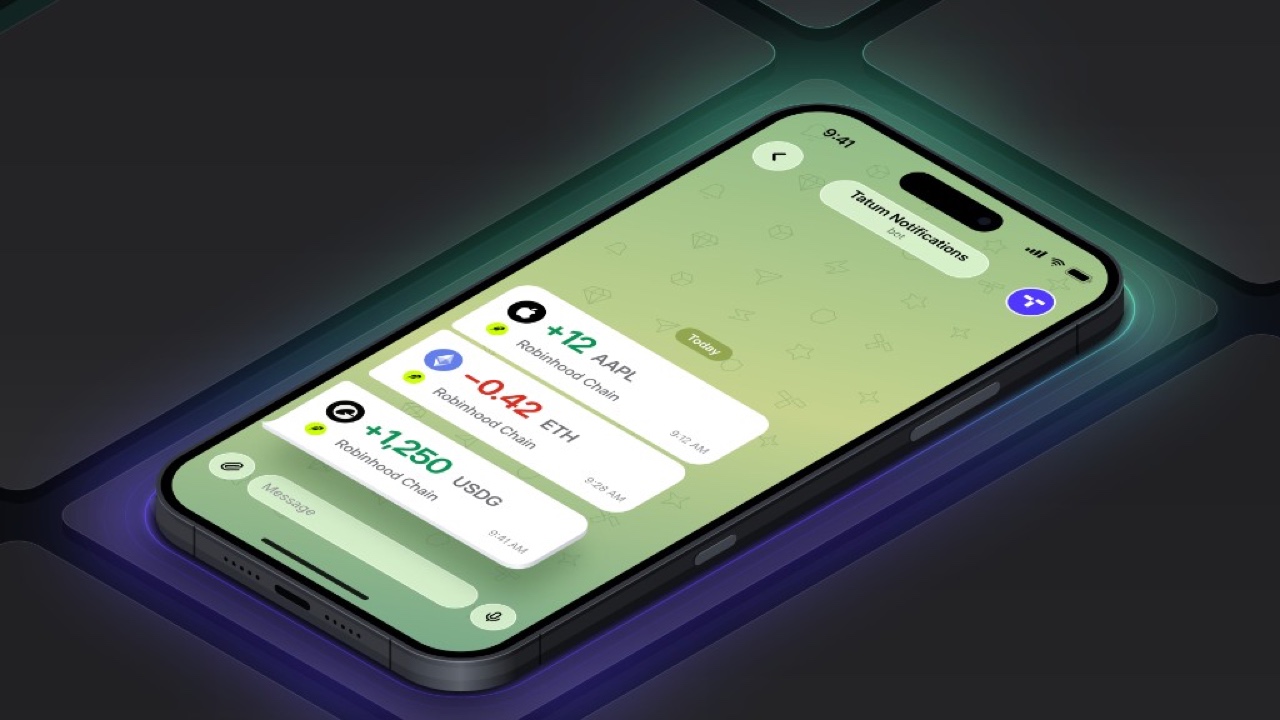
Rather than polling the chain on an interval and parsing raw ledger data yourself, which is both inefficient and error-prone, you subscribe to webhook notifications for specific addresses or event types and receive real-time alerts the moment something happens on-chain. For an application that needs to react to token transfers, redemption events, or settlement confirmations, this is the right architecture.
The practical difference matters at scale. Parsing every block manually to detect relevant events introduces latency, consumes unnecessary resources, and creates maintenance overhead. A notification-driven architecture inverts that model. You get pushed the relevant event the moment it occurs, and your application logic fires in response.
For settlement confirmation workflows, custody monitoring, or any kind of event-driven automation in a tokenized asset system, the notification layer is worth integrating from the start rather than bolting on later.
Try it out with our Notifications builder within your dashboard.
%20(750%20x%20500%20px)%20(716%20x%20480%20px).png)
Testing With Postman Before You Build
If you want to explore XRP methods before committing to a full integration, Tatum maintains a pre-configured Postman collection for the XRP Ledger. The workflow is simple: get your API key from the Tatum Dashboard, import the collection using the Run in Postman button from the Tatum docs, set your gateway-api-key variable in the environment, and start firing methods.
This is a genuinely useful starting point, especially if you're unfamiliar with XRP's JSON-RPC interface or want to validate response formats before writing parsing logic in your application. Being able to see real responses from methods like account_info, ledger_entry, or ripple_path_find in Postman before integrating them into production code saves a significant amount of time.
Why This Moment Matters for Builders
The XRP Ledger isn't a newcomer trying to attract developers with theoretical use cases. It's a twelve-year-old network with a proven settlement record, institutional adoption from JPMorgan, Mastercard, and Ondo Finance, a native stablecoin, and growing on-chain RWA activity that's measurable in real-time.
The five-second treasury redemption in May 2026 wasn't just a press release. It was a proof point that the infrastructure stack, public blockchain plus institutional payment rails plus compliant asset issuance, actually works end to end. That's the kind of validation that tends to accelerate developer interest significantly.
If you're building in the tokenization space, whether that's settlement tooling, asset management interfaces, compliance infrastructure, or payment automation, XRPL is worth taking seriously right now. The technical foundation is solid, the institutional momentum is real, and the developer tooling through gateways like Tatum means you don't need to provision your own node infrastructure just to start building.
Get your API key from the Tatum Dashboard, connect to the XRPL gateway, and start exploring what's possible. The tokenization wave is already here. The question is whether you're building on top of it.