

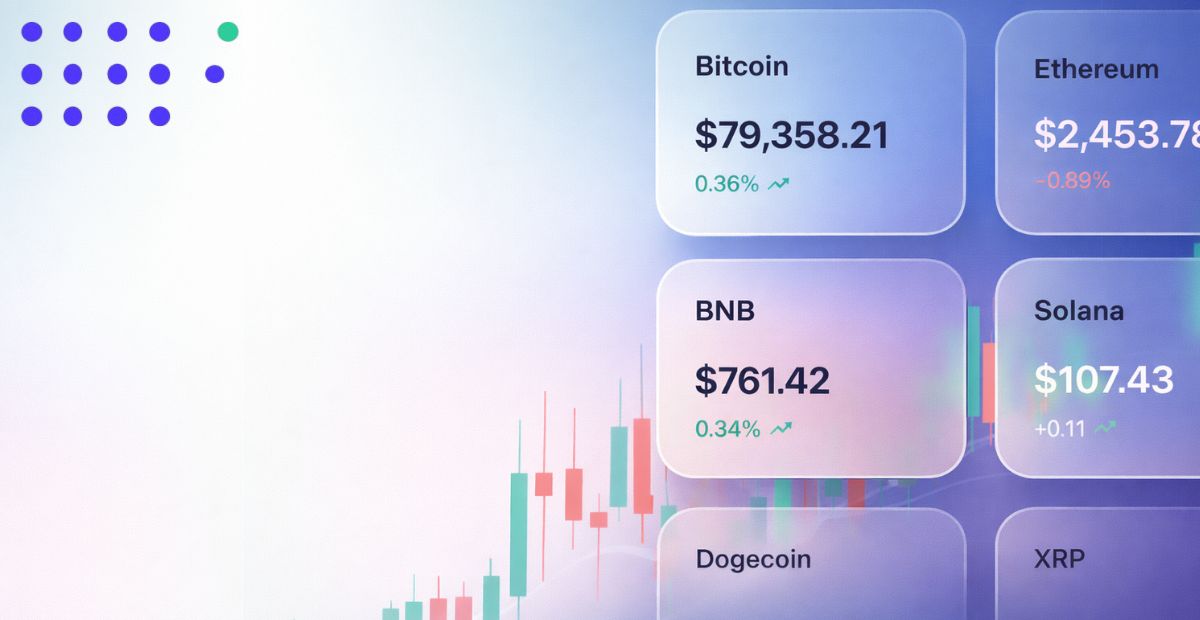
If you are building anything in Web3, sooner or later you will need a crypto price API.
Whether it is a wallet showing balances, a dashboard tracking portfolios, a trading interface, or a payment flow that converts crypto to fiat, accurate price data is foundational. Without reliable prices, fees are wrong, balances are misleading, and user trust disappears quickly.
This article explains what a crypto price API actually does, why many teams struggle when they try to build one themselves, and how Tatum’s Crypto Price API helps developers fetch real time and historical crypto prices through a single, production ready API.
What Is a Crypto Price API
A crypto price API allows applications to programmatically query the exchange rate of cryptocurrencies against fiat currencies or other crypto assets.
In practice, this means answering questions like how much is 1 ETH worth in USD right now, what was the price of BTC yesterday at a specific time, or how much a token has moved over the last 24 hours.
An API for crypto prices removes the need to manually scrape exchanges, integrate multiple data providers, or maintain custom pricing logic. Instead, developers send a request and receive a normalized price response that can be used directly inside an application.
Why Crypto Price APIs Are Harder Than They Look
At first glance, crypto prices seem simple. You look at an exchange, read a number, and display it.
In reality, production grade pricing is much more complex.
Tokens trade on multiple centralized and decentralized exchanges, often with different liquidity and pricing. The same asset can exist on several blockchains. DeFi prices can change rapidly, and some assets only have meaningful liquidity on specific venues. On top of that, applications often need prices in dozens or even hundreds of fiat currencies.
Many teams start by pulling prices from a single exchange API. That approach usually breaks as soon as the product gains users or supports more assets. Prices drift, coverage is incomplete, and maintaining reliability becomes an operational burden.
A proper crypto price API needs aggregation, normalization, and consistent availability, not just raw numbers.
The Tatum Crypto Price API Solution
Tatum’s Crypto Price API is designed for developers who want reliable crypto prices without building and maintaining their own pricing infrastructure.
It lets you fetch real time and historical exchange rates for cryptocurrencies, stablecoins, and contract based tokens against more than 165 fiat currencies. Prices are aggregated from a large set of centralized and decentralized exchanges and normalized into a single response format.
Instead of worrying about where prices come from or how often sources update, you interact with one API that works across chains and assets.
Real Time Crypto Prices for Applications
The most common use case for an API crypto prices solution is fetching the current value of an asset.
With Tatum, you can request the exchange rate of a cryptocurrency by its symbol, such as BTC, ETH, or SOL, or by its contract address for smart contract tokens. This is especially useful for ERC 20, BEP 20, and other tokens where symbols may overlap or be ambiguous.
By default, prices are returned against a base fiat currency, such as USD or EUR, but you can choose from a wide range of supported fiat currencies depending on your application’s audience.
These real time prices are suitable for wallets, dashboards, trading tools, and payment flows where up to date valuation is critical.
Fetching Multiple Crypto Prices in One Request
Most applications do not display just one asset.
Portfolio views, analytics dashboards, and wallet screens often need prices for multiple tokens at the same time. Fetching each price individually increases latency and API usage.
Tatum’s batch endpoints allow you to request multiple crypto prices in a single call. This approach improves performance and simplifies application logic, especially when dealing with portfolios or market overviews.
Historical Prices and OHLCV Data
Real time prices are only part of the picture.
Many products require historical crypto price data to display charts, calculate performance, or analyze trends. For these use cases, Tatum provides access to historical exchange rates and OHLCV data at one minute intervals.
You can query prices at a specific point in time or retrieve the closest available record when an exact timestamp is not available. This makes it possible to build price charts, track historical portfolio value, or support reporting and analytics features.

Tracking Crypto Price Changes Over Time
Sometimes applications do not need full historical datasets, just a clear view of how prices have moved.
The price change endpoint calculates both the absolute and percentage change for a given asset over a defined time range or interval. This is commonly used for daily or weekly change indicators, market summaries, and alerting systems.
By default, price changes are quoted against USDT, with the option to specify other base pairs if needed.
Where Tatum’s Crypto Price Data Comes From
Accuracy and coverage depend heavily on data sources.
Tatum aggregates crypto price data from more than 10 centralized exchanges and over 100 decentralized exchanges. This includes major platforms such as Binance, Coinbase, Kraken, and OKX on the centralized side, as well as leading DEXs like Uniswap, Curve, PancakeSwap, Raydium, and others.
By combining multiple sources, Tatum delivers normalized crypto prices that are more resilient to individual exchange issues and liquidity gaps.
Best Practices When Using a Crypto Price API
When integrating any crypto price API, including Tatum’s, it is important to match your usage patterns to your product requirements.
Frequently requested assets such as BTC, ETH, and major stablecoins should be cached to reduce latency and API usage. Volatile DeFi tokens may require more frequent refreshes, depending on how sensitive your application is to price changes.
For applications that track long term performance, storing historical prices can significantly simplify calculations and improve reliability.
It is also worth remembering that aggregated prices are not instantaneous on chain prices. They are designed for application level pricing, not for executing arbitrage or high frequency trading strategies.
Available Crypto Price API Endpoints
Tatum’s Crypto Price API is split into clear, purpose built endpoints so you can fetch exactly the pricing data your application needs.
If you want the most common crypto price queries, these endpoints cover the majority of use cases.
| Endpoint | What it does | Use cases |
|---|---|---|
| Get Exchange Rate by Symbol | Returns the current exchange rate for a crypto or fiat asset using its symbol, such as BTC, ETH, or EUR. | Live prices in wallets, dashboards, checkout and payment flows. |
| Get Exchange Rate by Symbol, Batch | Fetch exchange rates for multiple crypto or fiat symbols in a single request. | Portfolio views, analytics pages, market overviews. |
| Get Exchange Rate by Contract | Returns the exchange rate for a token using blockchain and contract address, avoiding symbol collisions. | ERC 20, BEP 20, and other smart contract based tokens. |
| Get OHLCV by Symbol | Provides historical price data in OHLCV format at one minute intervals. | Price charts, historical analysis, performance tracking. |
| Get Price Change by Symbol | Calculates absolute and percentage price changes over a defined time range or interval. | Daily change indicators, market summaries, alerts. |
Supported Fiat & Cryptocurrencies
The Crypto Price API supports thousands of crypto assets and a broad set of fiat currencies. You can fetch exchange rates against more than 165 fiat currencies worldwide. All major global ones are supported and can be used as base pairs when querying crypto prices.
Tatum supports the top tokens by market capitalization as well as long tail assets, with new tokens becoming available as soon as they are listed on major centralized or decentralized exchanges.
Getting Started With an API for Crypto Prices
Getting started with the Tatum Crypto Price API is straightforward.
After creating a free API key in the Tatum Dashboard, you can immediately fetch real time crypto prices, query historical exchange rates, and build price powered features without managing custom infrastructure.
If you are searching for a crypto price API that balances accuracy, coverage, and ease of integration, Tatum provides a practical solution for production Web3 applications.