

.jpg)
Monad represents one of the most anticipated architectural evolutions in the Ethereum ecosystem. While traditional Layer 1 networks and Layer 2 rollups have spent years experimenting with off chain scaling, zero knowledge proofs, and application specific appchains, Monad approaches scaling from a different angle: rebuilding the execution, consensus, and state storage engine from the ground up while keeping bytecode level EVM equivalence.
For developers, this means you can take your existing Solidity smart contracts, Hardhat scripts, and Web3 tooling and deploy them directly onto a network targeting 10,000 transactions per second with 400 millisecond block times and single slot finality.
The demand for high performance EVM execution is visible across the industry. Monad Labs secured over $244 million in funding led by prominent investment firms such as Paradigm and Dragonfly Capital. During its public testnet phase, the network processed over 2.4 billion transactions across more than 80 million wallet addresses and millions of smart contract deployments. Following its mainnet launch, hundreds of decentralized finance, NFT, and gaming applications migrated to leverage its low latency execution environment.
Deploying smart contracts to a network that generates blocks multiple times per second is only part of the development process. The real work begins when your backend needs to read account balances, monitor transactions, and serve thousands of concurrent users without experiencing performance bottlenecks.
In this guide, we will walk through the complete backend infrastructure stack for building applications on Monad. We will cover how to connect to high throughput Monad RPC gateways, configure automated on chain webhooks, extract structured ledger state using the Data API, and integrate non custodial smart wallets directly into your application.
.png)
The Monad Developer Infrastructure Challenge
Building on a chain that processes thousands of transactions per second presents operational challenges that simply do not exist on slower networks. On traditional chains with 12 second block times, basic polling loops or public RPC nodes might be sufficient during early development. On Monad, where blocks are produced every few hundred milliseconds, unmanaged public endpoints quickly hit performance boundaries.
When network activity spikes, public RPC nodes frequently hit rate caps, drop incoming requests, or introduce unacceptable latency. For production applications, relying on unstable nodes creates immediate vulnerabilities. A dropped RPC request can cause stuck user transactions, out of sync user interfaces, and failed backend workflows.
To scale an application effectively on Monad, engineering teams need direct access to managed node infrastructure, automated event notification webhooks, and specialized data indexers that remove the burden of parsing raw blocks manually.
Connecting to Monad Mainnet and Testnet via RPC Gateway
Every interaction on Monad, whether estimating gas, fetching account balances, or broadcasting signed transactions, depends on standard JSON RPC requests.
Tatum provides a fully managed RPC gateway for both Monad Mainnet and Monad Testnet. By handling state synchronization, load balancing, and node maintenance behind the scenes, Tatum allows developers to connect directly to the network through clean, production ready endpoints without operating private node hardware.
Network Endpoints
Monad Mainnet JSON RPC: https://monad-mainnet.gateway.tatum.io
Monad Testnet JSON RPC: https://monad-testnet.gateway.tatum.io
Making Your First Call
You can test network connectivity immediately by querying the current block number on Monad Mainnet using cURL:
High Availability and Global Load Balancing
For early stage prototyping, Tatum offers shared gateway keys with initial credit allowances. However, production applications handling substantial user volume require reliable execution guarantees during traffic spikes.
Tatum routes request traffic through a global load balancer featuring automatic priority failover and smart caching. The router continuously checks node sync state and response times across the network. If an individual node experiences latency or drops offline, your requests automatically reroute to a healthy endpoint without disrupting your application frontend.
On Chain Notifications and Automated Alerts
Polling an RPC node repeatedly every few hundred milliseconds to check for transaction confirmations or deposit events is wildly inefficient. Continuous polling wastes backend server resources, inflates your API credit usage, and adds latency to user interfaces.
Instead of polling, modern Web3 backends use push based notification webhooks.
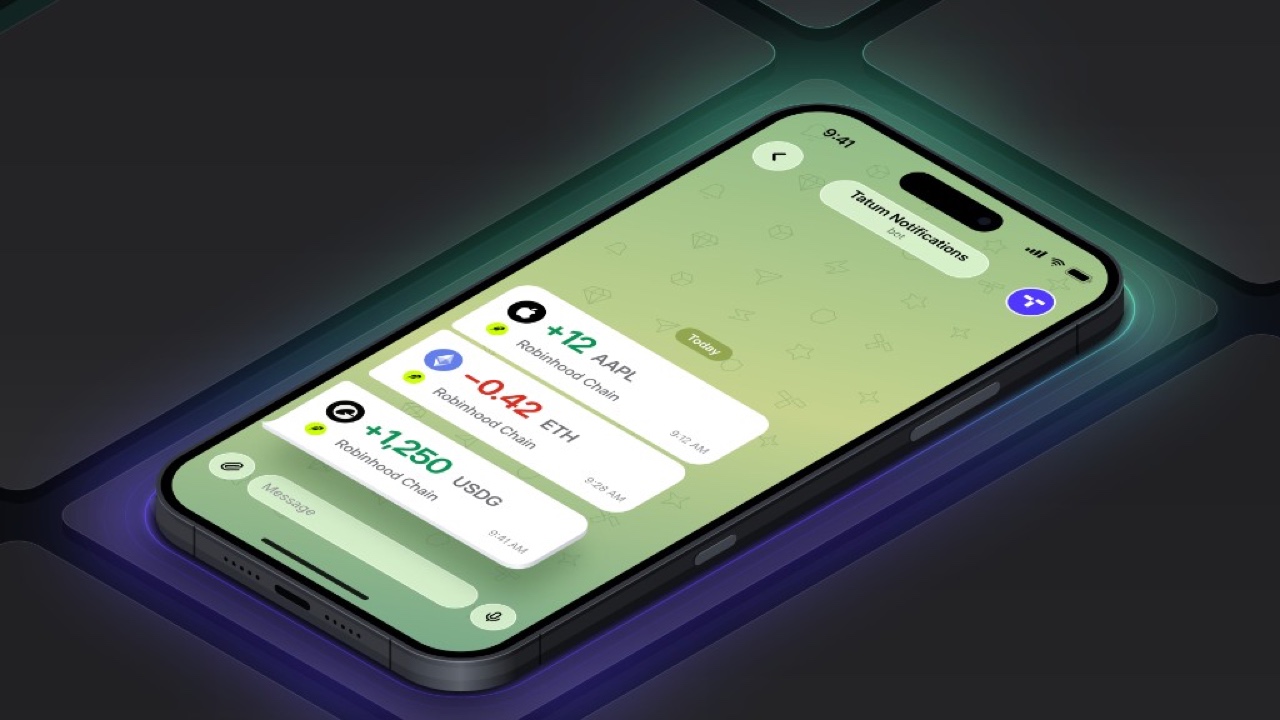
Tatum Webhook Notifications let you set up real time tracking for specific wallet addresses, contract execution logs, or token movements across Monad Mainnet and Testnet. When a monitored event is confirmed on chain, Tatum generates and sends a structured JSON payload directly to your backend endpoint.
Common Notification Workflows
Wallet Balance Tracking: Monitor inbound and outbound transfers of native MON or ERC20 tokens for user deposit addresses, triggering instant push notifications or user balance updates.
Smart Contract Execution Alerts: Receive instant updates when a specific contract emits an event, such as an order match on a decentralized exchange, a vault deposit, or an NFT mint.
Risk and Liquidation Automation: Track reserve changes in decentralized exchange liquidity pools or state updates in lending protocols to fire automated liquidation bots when market parameters change.
Because notification gateways include built in exponential backoff and retry mechanisms, your system will still receive event updates reliably even if your backend server undergoes brief maintenance outages.
.png)
Querying Structured Ledger State with the Data API
Standard JSON RPC methods were engineered primarily for block validation and simple state lookups. They were never designed to handle complex historical data queries efficiently.
If you are building a wallet interface that displays every ERC20 token and NFT held by a user, attempting to gather that information through raw RPC calls requires scanning millions of historical block logs and parsing state manually. On a high throughput chain like Monad, this naive approach requires thousands of RPC queries, consumes enormous bandwidth, and results in slow loading times.
The Tatum Data API solves this problem by maintaining real time indexed models of the Monad ledger. Instead of writing custom indexers or maintaining complex local databases, you can query enriched blockchain state using simple REST calls.
Key Data API Modules
Wallet API: Instantly retrieve complete token holdings, native MON balances, and historical transaction logs for any public address.
Token API: Query metadata, account holdings, and total supply statistics for standard ERC20 smart contracts.
NFT API: Fetch ownership records, collection metadata, and historical transfer logs for non fungible tokens.
Price API: Access live exchange rates for MON and supported tokens against common fiat pairs.
Transactions API: Retrieve decoded transaction histories and contract call details for any wallet address.
Using indexed Data APIs reduces backend boilerplate code significantly, letting your engineering team ship production features in days rather than spending weeks writing custom indexing infrastructure.
Simplifying User Onboarding with Smart Wallets
One of the largest obstacles to acquiring mainstream users in Web3 is account management. Forcing new users to write down seed phrases, install browser extensions, and purchase native MON tokens just to pay gas fees creates heavy friction during onboarding.
Using the Tatum Smart Wallets SDK, developers can embed non custodial Multi Party Computation (MPC) wallets directly into their application interface.
MPC technology splits private key generation and transaction signing across separate mathematical secret shares. Because no single entity holds the full private key in one location, you eliminate single points of failure without taking custody of user funds.
Gas Sponsorship Built In
The Smart Wallets SDK also supports native gas sponsorship. You can configure your backend to pay network transaction fees on behalf of your users behind the scenes. Your users can interact with smart contracts on Monad immediately without needing to hold native MON for gas beforehand, delivering an intuitive user experience comparable to traditional web applications.
┌─────────────────────────────────────────────────────────────────────────┐
  Sign Transaction

  To          0x4c2b...8f01
  Amount      1.284 MON
  Network Fee Paid by App
  Signer      MPC (2 of 3 Shares)
└─────────────────────────────────────────────────────────────────────────┘
Understanding Monad's Architecture: Why It Is Built for Speed
To build durable applications on Monad, it helps to understand the core architectural innovations that allow the network to achieve extreme throughput while remaining fully EVM compatible.
                     ┌──────────────────────────────┐
                     │    Monad Consensus (BFT)     │
                     │  Orders Transactions First   │
                     └──────────────┬───────────────┘
                                    │
                                    ▼
                     ┌──────────────────────────────┐
                     │ Parallel Execution Engine    │
                     │  Processes Inputs Concurrently│
                     └──────────────┬───────────────┘
                                    │
                                    ▼
                     ┌──────────────────────────────┐
                     │          MonadDB             │
                     │ Async SSD State Storage      │
                     └──────────────────────────────┘
MonadBFT Consensus
Monad uses a high performance Byzantine Fault Tolerant consensus mechanism based on Pipeline HotStuff, optimized for low latency peer to peer communication. MonadBFT separates transaction ordering from execution, allowing consensus nodes to reach agreement on block order at network speed without waiting for execution to complete first.
Asynchronous and Deferred Execution
In traditional EVM chains, nodes must fully execute every transaction in a block before proposing or agreeing on the next block. Monad decouples consensus from execution entirely. The consensus layer agrees on transaction ordering first, while execution runs concurrently in a separate pipeline. This decoupling gives the execution engine a significantly larger time budget to process state changes cleanly.
Optimistic Parallel EVM Execution
Standard EVM implementations process transactions sequentially, one after another. Monad implements optimistic parallel execution, running multiple transactions concurrently across multi core CPU hardware. If the execution engine detects a state access conflict between two concurrent transactions, it speculatively re executes the conflicting transaction with updated parameters. Because most transactions in a block do not touch identical storage slots, parallel processing yields massive throughput gains.
Custom MonadDB State Storage
Most EVM clients rely on general purpose key value databases like LevelDB or RocksDB, which are optimized for log structured data rather than the random access patterns required by Merkle Patricia Tries. Monad built a custom database called MonadDB, engineered specifically to store Merkle Patricia Trie structures natively on disk. MonadDB supports asynchronous, multi threaded I/O operations directly on modern SSD hardware, removing disk read bottlenecks during high volume state accesses.
Start Building on Monad Today
Monad offers one of the most powerful execution environments in Web3, combining high throughput, low latency, and total EVM compatibility. By removing the performance constraints that previously limited smart contract development, Monad enables a new generation of high frequency DeFi protocols, real time gaming platforms, and consumer applications.
By abstracting away the operational headaches of node management, real time webhooks, structured indexers, and account setup, Tatum provides the complete developer toolkit to build on Monad. Create a free API key in the Tatum Dashboard, connect to the Monad RPC gateway, and start building scalable Web3 applications today.