
eCash (ECX) is a separate Bitcoin hard fork from LayerTwo Labs, associated with Paul Sztorc. It went live at Bitcoin block 973,728 on October 29, 2026. Addresses that held BTC at that height received the same number of ECX on the new chain. Bitcoin itself did not change, and one ECX is not worth one BTC.
ECX is not eCash (XEC). It is also not a token minted on Ethereum or Solana. A wrapped version, wECX, does trade on Solana. Mixing those three up is how a withdrawal goes to the wrong network.
The interview quotes, the November 5 market snapshot, and the early sidechain list below come from Cointelegraph Magazine’s November 7, 2026 report. Prices and sidechain status dated November 9 were checked on the project site and dashboard.
What is eCash?
Sztorc has argued for years that Bitcoin’s base layer should stay conservative, and that new ideas should ship on sidechains instead of waiting for a mainnet consensus change. BIP300 describes how a sidechain locks and withdraws coins, with miner signalling and a delay. BIP301 describes blind merged mining, so sidechain blocks can be mined without every mainchain miner running the sidechain’s software.
Those proposals are not active on Bitcoin. eCash is the network where LayerTwo Labs turned them on. The node is a fork of Bitcoin Core, with a different network identity, a difficulty reset at the fork, and Drivechain rules. Same style of addresses. Different chain. A Bitcoin node will not peer with it.
The point, in the project’s words, is a place to try payments, privacy, assets, prediction markets, and other designs without editing Bitcoin. Whether that place gets users is a separate question. Sztorc is aiming at builders, not at another store-of-value slogan.
" We need to actively sabotage the degrowth policies killing Bitcoin. We want to find the true Bitcoin builders and give them the tools to actually innovate. We just need the open-minded, risk-taking contrarians to come and build."
- Paul Sztorc, founder of LayerTwo Labs
He is also not moved by the fear that miners could steal sidechain funds. His line: if you believe miners would torch a billion-dollar operation for a short-term theft on a layer 2, you should not trust Bitcoin’s base layer either. That is an incentive claim. It is not a proof that a Drivechain withdrawal is safe, and the project’s own docs say the mechanism has specific security assumptions and a withdrawal delay.
Why Bitcoin holders received ECX
A hard fork copies the ledger, then applies new rules. eCash copied Bitcoin through block 973,727. Block 973,728 is the first block mined under eCash rules.
Every ordinary address with BTC at that height started with the same ECX balance. There was no claim form. Controlling the private keys is what makes the balance spendable.
" If you held the keys to your BTC at that exact block, you now own the exact same amount of ECX. It is that simple, and you can access them right now."
- LayerTwo Labs, on the block 973,728 snapshot
Coins left on an exchange depend on that company. CoinW and GMO Coin have announced distribution programs, and other venues may do nothing.
Alpha and beta were rehearsals, with their own snapshots. Beta started on September 19, 2026, at Bitcoin block 967,680. Alpha is retired. Mainnet is the balance that matters. Practice coins from the test networks are not mainnet ECX.
The project also documents special treatment of some early Bitcoin mining outputs on the ECX chain, separate from ordinary holder balances. That does not change the 1:1 credit for normal outputs. Read it in the official fork FAQ before you assume every historic coin moved the way Bitcoin moved it.
What you can do with it
Three real options. A fourth, “spend it like Bitcoin in any wallet,” is not one of them.
Leave it
Doing nothing is allowed. The fork already credited the balance. You do not have to move BTC, install a new wallet, or talk to anyone offering to “unlock” ECX. Anyone who asks for a seed phrase is not the recovery process.
Holding is also the liquidity decision. If the market is thin, selling later is a valid choice. It is not the same thing as the coins being worthless, or being worth a second bitcoin.
Split it before you spend BTC
BTC and ECX shared transaction history at the fork, and they still share address formats. Replay protection is opt-in. The fork itself does not make the next Bitcoin transaction safe on both chains.
LayerTwo Labs’ warning is the practical one: move ECX, with the project’s replay rules, before you spend BTC. An unprotected Bitcoin spend can be rebroadcast on eCash and can move the ECX as well.
" Never move your BTC first, as an ordinary, unprotected BTC spend can easily be replayed on the ECX network."
- LayerTwo Labs, holder warning
Use software from the project, not a lookalike download. The integration guide is ecash-com/fast-facts, and wallet builds are linked from ecash.com. That guide also says early v1.0.0 nodes diverged at block 974,016, so an operator should run a current release.
This is not a tax opinion. Some countries treat a fork credit as income. Look up the rule where you file before you sell.
Trade it, if you know which asset you are trading
Native ECX and wrapped wECX are not interchangeable transfers. The project’s buy page says the Solana wrapper converts through a bridge at 1:1 before fees, and that the bridge is custodial: you receive the other asset when the operator completes the order.
| Venue | What it lists | What you actually hold |
|---|---|---|
| Neoxa | ECX/USDT spot, on the project’s buy page | Native ECX, if deposits and withdrawals are open |
| CoinW | Launch distribution for eligible BTC holders, announced October 19, 2026 | Whatever that exchange credits. Trading was not listed on the buy page |
| GMO Coin | Launch distribution support, announced October 26, 2026 | A custodian balance, not a key you control |
| Orca | wECX/USDC pool on Solana | A Solana token. Not a native ECX payment |
| SideShift | Swaps into wECX on Solana | The same wrapper. Check the receive address is Solana |
The project page checked on November 9 names Neoxa and shows ECX/USDT. The November 7 report also described a venue spelled NeoxEX with ECX/USDT, ECX/USDC, and ECX/BTC on October 29. Open the book yourself before you rely on a pair that might have changed.
Public market data is still patchy. That same report put a CoinMarketCap quote at $32.63 on November 5, with about $355,000 of 24-hour volume, while CoinGecko had a preview with no price and Kaiko was not tracking ECX. Sztorc’s team described an early range around $40 to $50 and did not publish depth. The Orca series below is one pool, not the whole market.
What the price data shows
Tatum’s Price API does not list ECX. A rate request for the symbol on November 9 returned no ECX currency rates. The chart still uses that API for Bitcoin, which is the asset holders already had, and shows wrapped ECX from the Orca pool as a separate series.
Switch wECX or BTC. wECX is the Solana pool. BTC is Tatum OHLCV (GET /v4/data/rate/symbol/OHLCV/batch), with a cached snapshot if the live route is down.
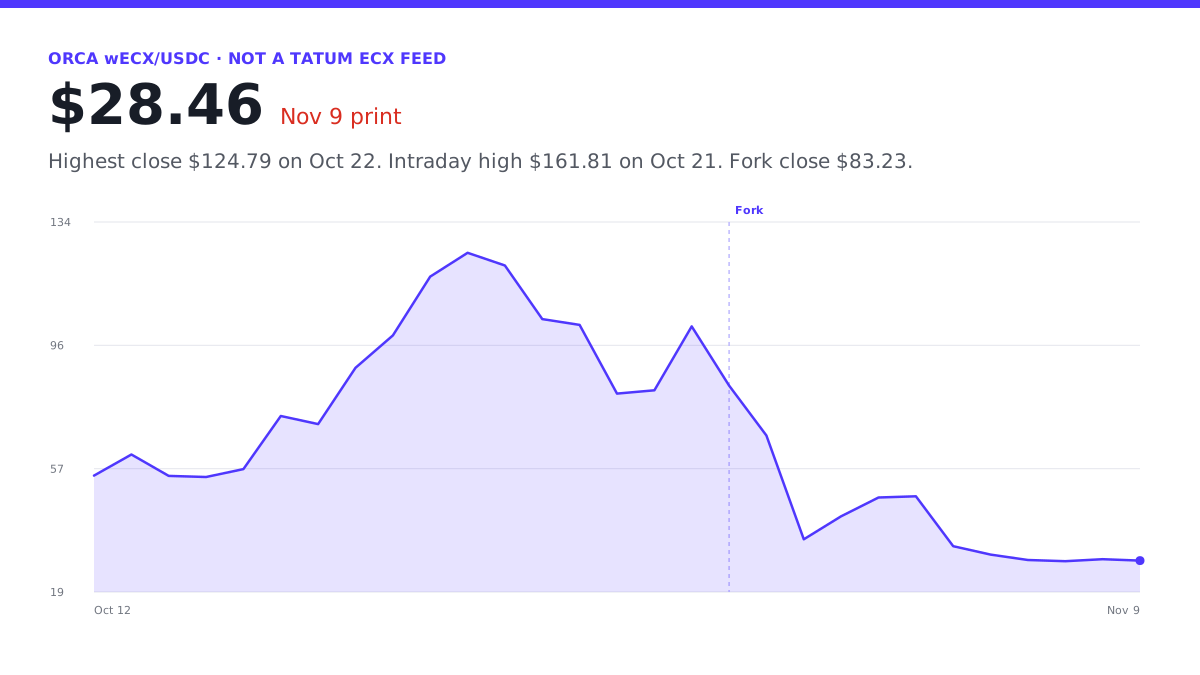
Orca wECX/USDC daily series · pool 7T4xAj1ENEuPckhWqz6nJP9ZkvDnFpVF7nLbUAvSwm43
Read the wECX path against the fork, not against a fantasy of parity with BTC.
The pool was already trading before mainnet. From October 12 the daily closes climb from about $55 to $124.79 on October 22. The pool also printed an intraday high of $161.81 on October 21, which is above any daily close, so it does not appear as a point on the close chart. On October 29 the wECX close was $83.23. Tatum’s BTC close that day was $77,991.89. One ECX, marked on that pool, was about a tenth of one percent of one bitcoin: roughly $83 of wrapped-market value for each bitcoin held at the snapshot.
By November 8 the wECX close was $28.88 and the BTC close was $74,851.44. The November 9 wECX figure, $28.46, is an intraday print, not a finished daily candle. Bitcoin’s daily candle for November 9 was not closed when this page was written. Use the BTC toggle for the latest Tatum bars.
That is a thin market telling you a matching balance can still be a small balance. It does not tell you what native ECX will clear for on Neoxa.
Which sidechains are actually on
The November 7 report listed five sidechains as launched with mainnet: BitNames, BitAssets, Thunder, Truthcoin, and zSide, with Photon and CoinShift still to come. The mainnet dashboard on November 9, 09:20 UTC, is more specific.
Five slots were activated in total. Only one of the seven LayerTwo Labs projects was among them: Thunder, the payments sidechain, at height 978,324, with no node observation reported. The other six project slots were not activated. Four community slots made up the rest. Three proposals were still pending, including one named Solana. That name is a sidechain proposal on eCash. It is not Solana.
Beta is a different network. Several of those projects show as activated there. A beta slot is not a mainnet product.
Payments. Activated at eCash height 978,324. Larger blocks on a sidechain. No node observation on the dashboard.
Names. Names tied to addresses and data commitments. Slot not activated on mainnet.
Assets. Tokens on their own chain. Slot not activated on mainnet.
Markets. Prediction markets. Slot not activated on mainnet. The catalog shows recent developer activity.
Privacy. Private transactions in a Zcash-style model. Slot not activated on mainnet. Its repository sits outside the reviewed LayerTwo Labs set.
Post-quantum. Post-quantum signatures. Slot not activated on mainnet.
Swaps. Peer-to-peer swaps between sidechain and parent-chain assets. Slot not activated on mainnet.
Checked November 9, 2026, 09:20 UTC. Activation means the slot exists. It does not prove a node is reachable, or that anyone is using it. Listing is not an audit or an endorsement.
Slot 24 · activated at 978,708
Slot 46 · activated at 978,331
Slot 130 · activated at 978,341
Slot 131 · activated at 978,342
Activation is the start of the experiment, not evidence of users. The dashboard says so in its own limitations: a slot can exist without a reachable node, transactions, or locked value. If you are choosing somewhere to build, Thunder is the LayerTwo Labs mainnet slot that has cleared activation. Confirm a node before you treat it as a place to send funds.
What builders can use today
eCash is not on Tatum’s RPC gateway. Bitcoin is. If a product needs the parent chain, block data, or a BTC price next to an ECX balance, use the chain you can actually query and label the other number with its source.
For BTC candles, the same route as the chart is the one to call:
GET /v4/data/rate/symbol/OHLCV/batch?symbol=BTC&interval=1d&numberOfCandles=40Send the key in the x-api-key header. Docs: OHLCV batch and the Price API. Do not invent an ECX symbol on that endpoint. Until a feed exists, a wallet that shows an ECX dollar value is showing someone else’s pool, or nothing.
For the fork itself, the useful engineering facts are dull. Addresses look like Bitcoin addresses. The networks do not. Replay protection has to be set on purpose. Sidechain withdrawals wait on miner signalling. And a custodian balance is not the same object as a key you hold.
Sztorc says the first year should be judged by paying users and fee revenue. On November 9 the observable pieces are a live mainnet, one activated project sidechain, four community slots, a thin wrapped market, and a BTC price you can chart. The rest is still a bet that someone builds something people pay for.
Questions people ask
eCash (ECX) is a separate hard fork of Bitcoin from LayerTwo Labs, associated with Paul Sztorc. It runs Drivechains, the sidechain design in BIP300 and BIP301, on its own network. Bitcoin does not activate those rules. ECX is the fork’s asset. The chains share history through Bitcoin block 973,727. eCash blocks begin at 973,728, reached on October 29, 2026.
No. eCash (ECX) at ecash.com is the 2026 Bitcoin fork with Drivechains. eCash (XEC) at e.cash is a different network and a different asset. A wallet, exchange, or address that supports one does not automatically support the other. ECX is also not a token issued on Ethereum or Solana. Wrapped wECX on Solana is a separate asset.
The fork copied Bitcoin’s unspent outputs at block 973,728. An address that held BTC at that height started with the same amount of ECX. Self-custody depends on controlling the keys. If an exchange held the bitcoin, any ECX credit is up to that exchange. The fork does not move BTC, and 1 ECX is not worth 1 BTC.
You can leave it untouched, split it with official eCash software so it can be spent separately from BTC, trade native ECX where a venue actually lists it, or trade wrapped wECX on Solana. Replay protection is opt-in. An ordinary BTC spend can be replayed on ECX, so the project tells holders to move ECX first. Do not give a seed phrase to a site that offers to unlock the coins.
Checked November 9, 2026. The project’s buy page lists Neoxa for a native ECX/USDT market, CoinW and GMO Coin for launch distribution to eligible Bitcoin holders, and Orca plus SideShift for wrapped wECX on Solana. wECX cannot be sent as if it were native ECX. Published quotes around the launch were thin, and several trackers still had no full ECX market.
No. A Tatum exchange-rate request for ECX on November 9, 2026 returned no ECX currency rates, and Tatum’s RPC gateway chain list has no eCash network. The chart on this page loads Bitcoin daily candles from Tatum’s OHLCV endpoint. The ECX line is the Orca wECX/USDC pool, not a Tatum ECX feed.