

The End of Seed Phrases: How Smart Wallets Are Fixing Crypto UX

Written by
Mohit Thakkar
5
min. read
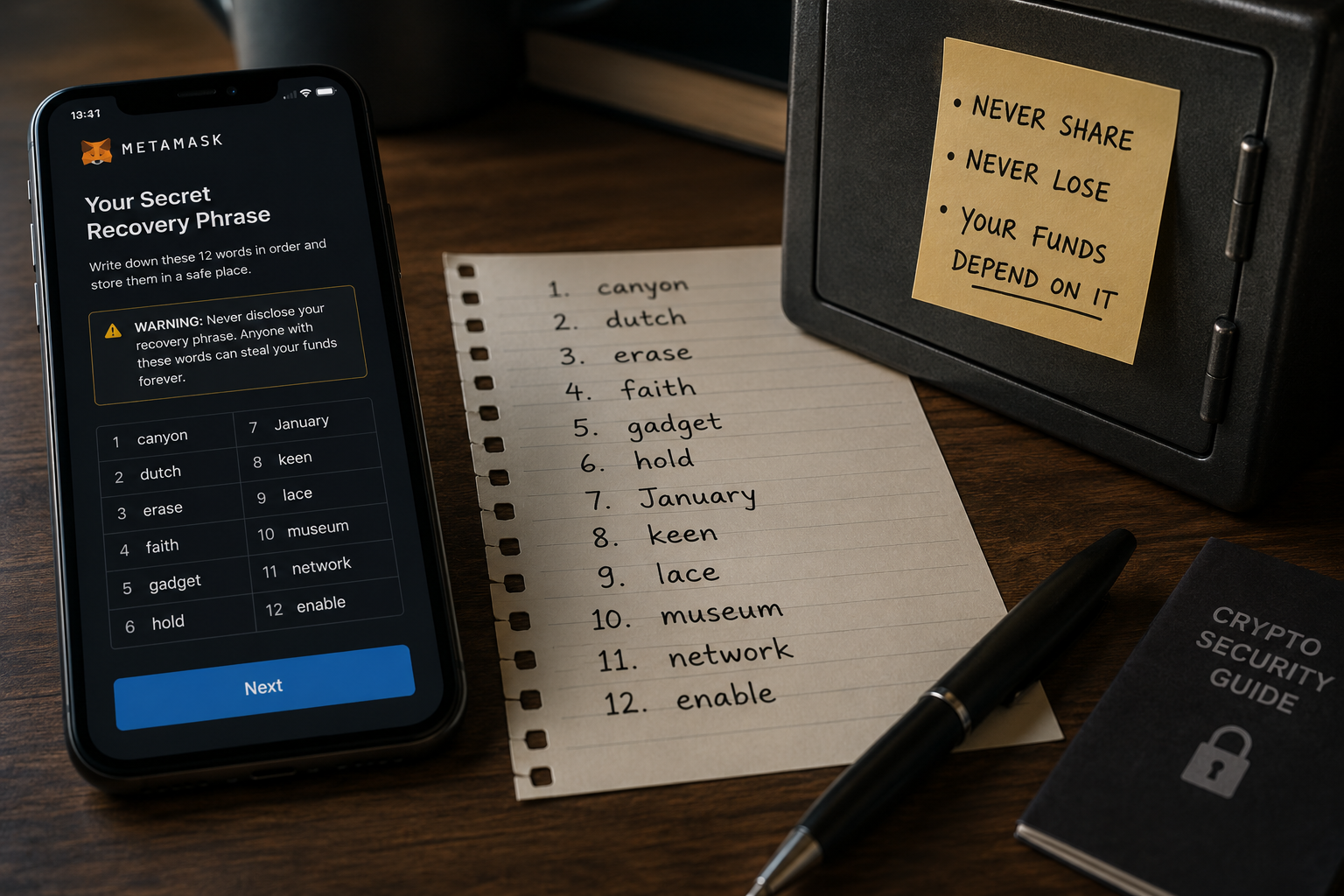
According to research, over 20% of all crypto is estimated to be lost forever due to forgotten passwords and lost seed phrases. Meanwhile, centralized exchanges have repeatedly proven they can't be trusted with custody. FTX. Mt. Gox. Celsius. The list goes on.
For years, crypto has forced users into an impossible choice: convenience (custodial wallets) or security (self-custody with seed phrases). This friction is one of the biggest barriers preventing mainstream adoption. We need a better way.
What if wallets could be both secure AND easy to use?
Smart wallets are a new type of crypto wallet that eliminates seed phrases while remaining truly non-custodial. They deliver bank-like UX with self-custody security no compromise required.
The key innovation? Multi-Party Computation (MPC) a cryptographic technology that splits your private key into multiple shares. No single share can sign transactions alone, and the full key is never reconstructed in one place.
✅ No seed phrases: Login with email, passkey, or biometrics. Recovery is built-in. No writing down random words, no hardware wallets required for everyday use.
✅ True non-custodial security: You control your assets. No single party not even the wallet provider can access your funds without your explicit participation in every transaction.
✅ Familiar user experience: Works like any modern app you already use. Reset password via email. Social login. Biometric authentication. No steep learning curve.
✅ Enterprise-ready features: Programmable policies, multi-user approval flows, spending limits, and compliance-friendly audit trails. Everything traditional finance expects, on-chain.
Unlike traditional wallets (seed phrases required) or custodial solutions (trust required), smart wallets give you both security and convenience. Here's how they work under the hood.
Multi-Party Computation (MPC) is the cryptographic technology that makes smart wallets possible. It splits a private key into multiple "shares" and critically, no single share can sign transactions alone.
Think of it like a safety deposit box that requires two keys to open. You hold one key, the wallet provider holds the other. Neither party can open the box alone both must cooperate.
Here's how the shares are distributed:
Your share: Stored encrypted on your device or in secure cloud storage tied to your identity (iCloud Keychain, Google Drive, passkey). You control access via email, biometrics, or your chosen authentication method.
Provider share: Held by the wallet infrastructure (e.g., Tatum's MPC enclave) in a secure, hardware-isolated environment. This share never leaves the provider's systems.
Signing a transaction: When you want to send crypto, both shares collaborate cryptographically to produce a valid signature. The magic? The full private key is never reconstructed in one place. The signature is computed through a distributed protocol where each party contributes their share without revealing it.
1. No single point of failure: Even if the provider's infrastructure is breached, attackers only get half the key which is cryptographically useless alone. They can't sign transactions or steal funds.
2. You stay in control: The provider can't move your funds without your share actively participating in the signature protocol. Unlike custodial wallets, there's no "admin override" or centralized control.
3. Recovery is built-in: Backup shares can be stored with trusted methods (cloud storage, passkey, hardware security module) without exposing you to seed phrase risks. Lose your device? Recover via email. No 24-word puzzles to memorize.

Neither share alone can authorize a transaction. The private key exists only as a distributed computation, never fully assembled.
Smart wallets aren't just a technical upgrade they unlock entirely new product possibilities that were impractical with traditional wallets.
The scenario: Maria in Texas wants to send money to her family in Mexico. Traditional remittance services (Western Union, banks) take 3-5 days and charge 5-8% in fees.
With smart wallets: Maria sends $100 in USDC using just her family's email address. They receive it in seconds on Polygon (near-zero fees). The recipient can convert to pesos via a local exchange or spend USDC directly at supported merchants. Total cost? Less than $0.50. Total time? Under 30 seconds.
Why it works: MPC wallets enable "wallet-as-a-service" you can embed financial infrastructure into any app without requiring users to understand gas fees, seed phrases, or blockchain networks. The wallet is invisible; the value transfer is instant.
The problem: DeFi has a brutal onboarding curve. Buy crypto on an exchange. Transfer to a self-custody wallet. Manage your seed phrase. Approve smart contract interactions. Pay gas in ETH even though you're swapping USDC. It's a terrible experience for newcomers.
Smart wallets fix this: Sign up with email. Buy crypto with a credit card (fiat on-ramp). Your smart wallet is auto-created in the background. You interact with DeFi protocols like any web service click "Swap," confirm with Face ID, done. Gas fees can be abstracted (paid in stablecoins) or even sponsored by the app.
The old way: Multi-sig wallets (e.g., Gnosis Safe) require manual coordination. "Please sign transaction #47" messages in Discord. Clunky UIs. No built-in policy enforcement.
Smart wallets enable:
Example: A DAO can require 3-of-5 council approval for large treasury transfers, with each council member holding one share via their email-authenticated smart wallet. No browser extension coordination needed.
The problem: Asking gamers to "install MetaMask" is a conversion killer. Players want to play, not learn about gas fees.
Smart wallets enable: Games can create wallets for players automatically on signup. Players own their in-game items as NFTs without ever knowing it's blockchain-based. When they want to sell an item, they approve the transaction with Face ID. The game handles the rest (gas sponsorship, optimal routing, wallet recovery).
Result: Web2 UX with Web3 ownership.
Let's break down how smart wallets stack up against the alternatives you might already know.
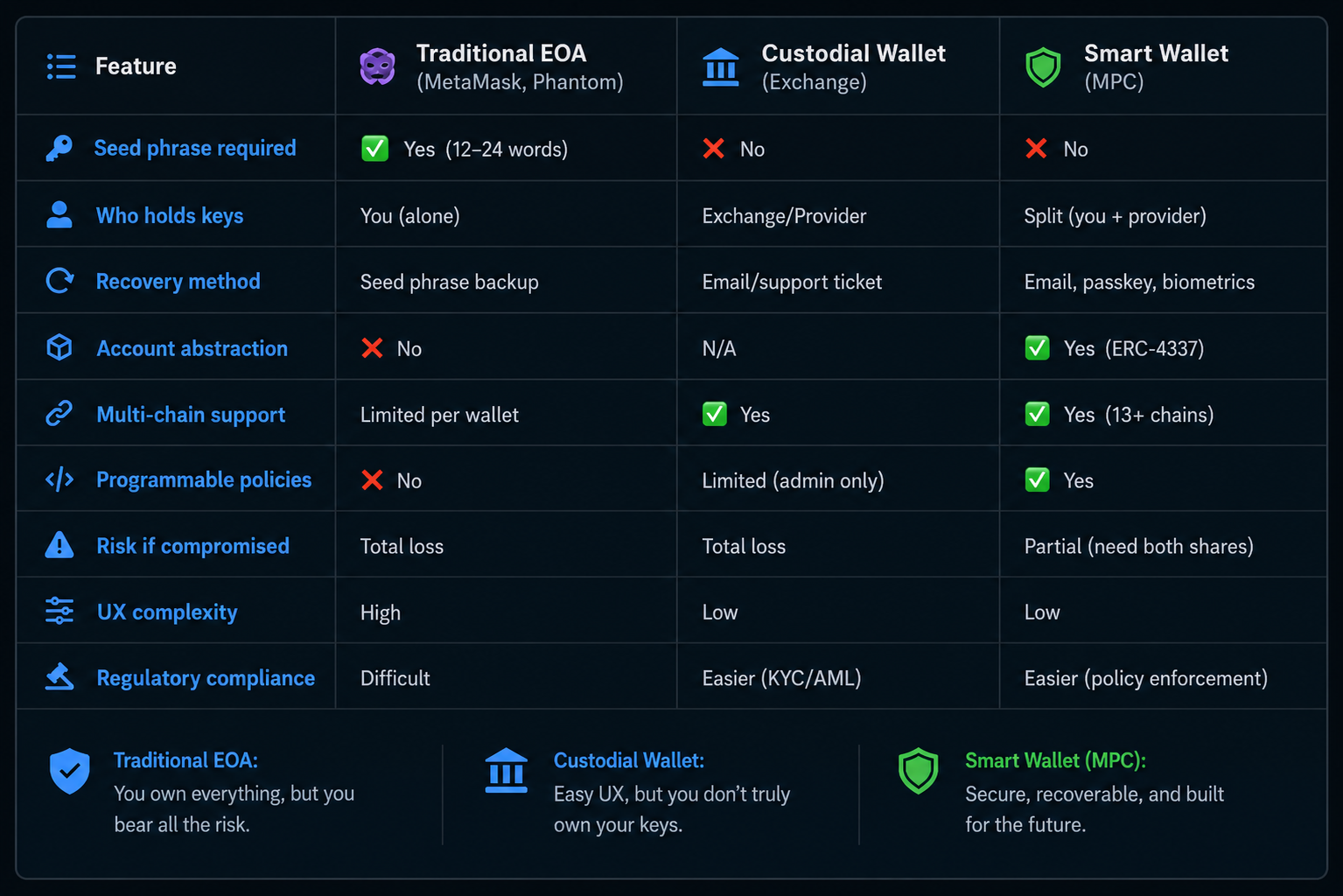
Traditional EOAs (Externally Owned Accounts): Full self-custody, maximum decentralization but terrible UX. One mistake with your seed phrase means permanent loss. Not suitable for mainstream users.
Custodial Wallets (Exchanges, Hosted Solutions): Easy to use, familiar experience but you're trusting a third party with your funds. FTX, Celsius, and Mt. Gox all proved this model's fatal flaw: when the platform fails, your funds are gone.
Smart Wallets (MPC): The best of both worlds. Non-custodial security (no single entity can access your funds) combined with custodial-level UX (no seed phrases, social recovery). This is the model that can finally bring crypto to mainstream audiences.
Ready to add smart wallets to your app? Here's what you need to know.
The Tatum Wallet SDK is an open-source toolkit that handles MPC wallet creation, multi-party signing, and multi-chain support out of the box. It works with 13+ blockchains including Ethereum, Solana, Bitcoin, Tron, Polygon, Arbitrum, and more.
Integration is simple:
1. Create a client (user account)
2. Generate wallet shares via MPC
3. Store your share encrypted in your database
4. Done the SDK handles the cryptographic protocol
What you need to store:
Just three pieces of data per user:
Tatum stores its share server-side in a secure enclave. No full private keys ever touch your infrastructure.
The SDK is built for modern web stacks:
That's it. No complex cryptography to implement. No key management infrastructure to build. The SDK handles MPC coordination, transaction signing, and multi-chain routing.
Smart wallets are the missing piece for mainstream crypto adoption. They remove the UX barriers that have held the industry back seed phrases, hardware wallets, gas fee confusion while preserving the core promise of blockchain: true ownership and control.
For developers, smart wallets unlock new product categories:
For users, smart wallets deliver the experience they expect from modern software:
The technology is ready. The infrastructure is here. All that's missing is builders like you bringing smart wallets to the products people actually use.

%20(73).jpg)
%20(71).jpg)
%20(70).jpg)


