

%20(70).jpg)
If you are building in Web3 in 2026, you are no longer just querying transactions and calling it a day.
Modern crypto applications rely on a layered data stack. Wallet data, pricing, DeFi activity, identity, security signals, and increasingly, predictive insights all play a role in shaping the user experience.
The real challenge today is not access to blockchain data. It is knowing which APIs actually matter when you are designing and scaling your application.
This guide breaks down the top blockchain data APIs developers are using right now, based on real use cases, current trends, and what people are actively searching for. If you are building a wallet, exchange, analytics platform, or any Web3 product, this is the stack you will likely rely on.
1. Wallet API
Wallet APIs are the foundation of most Web3 applications.
At the most basic level, you need to fetch balances and track assets. But in practice, developers expect much more. Multi chain support, token detection, and near real time updates are now standard.
A Wallet API allows you to retrieve balances across different blockchains, track token holdings, and monitor address activity without running your own infrastructure.
If your app shows a portfolio, supports payments, or interacts with user accounts, this is where everything starts.
Here are the supported endpoints for our Wallet API
| Endpoint | Method | URL |
|---|---|---|
| Get balances by time of addresses | GET | https://api.tatum.io/v4/data/wallet/balance/time |
| Get wallet portfolio | GET | https://api.tatum.io/v4/data/wallet/portfolio |
| Get unspent UTXOs for an address | GET | https://api.tatum.io/v4/data/utxos |
| Get wallet reputation | GET | https://api.tatum.io/v4/data/wallet/reputation |
| Get unspent UTXOs for a batch of addresses | POST | https://api.tatum.io/v4/data/utxos/batch |
| Get wallet reputation portfolio | GET | https://api.tatum.io/v4/data/wallet/reputation/portfolio |
| Get wallet reputation by tokens | GET | https://api.tatum.io/v4/data/wallet/reputation/tokens |
2. Transactions API
If wallets are the entry point, transactions are the core data layer.
A Transactions API gives you access to transaction history, internal transfers, smart contract interactions, and event logs. This is critical for building anything that needs to reflect onchain activity in a meaningful way.
Developers use transaction data to power:
-Wallet histories
-Explorer style interfaces
-DeFi dashboards
-Compliance checks
Without reliable transaction indexing, most Web3 apps break down quickly.
3. Token API
Tokens are everywhere, and handling them correctly is harder than it looks.
Different standards, inconsistent metadata, and chain specific quirks make it difficult to build a clean experience. A Token API abstracts that complexity and gives you a normalized way to work with assets.
This typically includes token metadata, balances, transfer history, and contract level details.
If your application deals with ERC20 tokens, stablecoins, or any fungible assets, a Token API is essential.
4. Crypto Price and Exchange Rate API
Raw balances do not mean much without pricing.
A Crypto Price API provides real time exchange rates, historical price data, and market metrics like price changes or OHLCV. This is what allows you to display portfolio value, build trading interfaces, or run analytics.
Accurate pricing data is especially important when dealing with volatile markets or cross chain assets.
Most applications end up calling price endpoints more often than any other data source.
Check token price by contract
5. Fee Estimation API
Fees are one of the biggest pain points in Web3 UX.
A Fee Estimation API helps you predict transaction costs before submission. This is critical for avoiding failed transactions and improving user trust.
Different chains use different fee models, so having a unified way to estimate gas or network fees makes a big difference when building multi chain applications.
Even small improvements in fee estimation can significantly improve conversion rates.
6. Blockchains API
In 2026, multi chain is the default, not a feature.
A Blockchains API provides network level data such as block height, chain status, and protocol specific parameters. It helps you monitor the health of a network and adapt your application logic accordingly.
Instead of hardcoding chain specific logic, developers use these APIs to build more flexible and scalable systems.
If you are supporting more than one chain, this layer becomes important very quickly.
7. DeFi API
DeFi continues to be one of the most active areas in crypto.
A DeFi API gives you structured access to liquidity pools, lending protocols, yield farming opportunities, and other financial primitives.
Instead of indexing every protocol yourself, you can plug into aggregated data and focus on building features.
This is especially useful for:
-Portfolio dashboards
-Yield aggregators
-Trading tools
DeFi data is complex, but APIs make it accessible.
8. Staking API
Staking has become a core part of many ecosystems.
A Staking API allows you to track staking positions, calculate rewards, and monitor validator performance. This is important for both individual users and platforms that offer staking services.
For wallet developers, staking data is now expected as part of the overall portfolio view.
It also plays a role in analytics and long term asset tracking. Here is an app tracking the best Solana Staking pools using this API.
Here are the supported endpoints for our Staking API
| Endpoint | Method | URL |
|---|---|---|
| Get current staked assets | GET | https://api.tatum.io/v4/data/defi/events |
| Get current staked assets by validator | GET | https://api.tatum.io/v4/data/staking/native/current-assets-by-validator |
| Get staked account rewards | GET | https://api.tatum.io/v4/data/staking/native/rewards |
| Get staking transactions | GET | https://api.tatum.io/v4/data/staking/native/transactions |
| Get staking pools | GET | https://api.tatum.io/v4/data/staking/native/pools |
| Get liquid staking current assets | GET | https://api.tatum.io/v4/data/staking/liquid/current-assets |
| Get liquid staking pools | GET | https://api.tatum.io/v4/data/staking/liquid/pools |
| Get staked account rewards - Batch | POST | https://api.tatum.io/v4/data/staking/native/rewards/batch |
9. Web3 Name Service API
Wallet addresses are not designed for humans.
Web3 name services solve this by mapping readable names to blockchain addresses. A Name Service API lets you resolve these names and integrate them into your application.
This improves usability across wallets, marketplaces, and social platforms.
Even though it is a relatively small feature, it has a big impact on user experience and adoption.
10. Marketplace API
Marketplace APIs provide access to trading activity across digital assets. While they started with NFTs, they now cover broader onchain markets, including liquidity pools and token trading.
Beyond basic listings and sales data, newer endpoints like CryptoSlam trade analytics bring deeper insight into market behavior. For example, the Get pair trades DNA endpoint returns liquidity pool trades enriched with WalletDNA metrics, letting you filter by trade size, side, and wallet signals such as IQ, reputation, and flow.
GET /v4/data/marketplace/cryptoslam/pair/trades/dna
This makes it possible to track smart money, analyze trading patterns, and build more advanced analytics or trading features.
If your app depends on market activity, this kind of data gives you a real edge over simple price feeds.
11. Storage API
Storage APIs are becoming increasingly important as Web3 apps move beyond transactions and start handling real user data.
With solutions like Walrus decentralized storage, developers can store files in a way that is verifiable and not tied to a single provider. Instead of relying on centralized infrastructure, data can be persisted and certified onchain.
The Tatum Storage API makes this practical to integrate. You can upload files to Walrus, track certification status, list uploads, and manage automatic renewals without dealing directly with the underlying storage complexity.
Uploads are asynchronous by design. When you send a file, the API returns a jobId and blobId. From there, you poll the status endpoint until the file is fully certified onchain. This pattern is important if you are building apps that depend on data availability guarantees. Here is Agent Pact, built with this API.
12. Malicious Address API
Security has become a core requirement, not an optional feature.
A Malicious Address API helps identify wallets associated with scams, hacks, or suspicious activity. This allows you to flag risky transactions before they happen.
For exchanges, wallets, and compliance focused applications, this is critical.
It helps protect users and reduces exposure to regulatory risks. Here is a small app built using this API.
13. Prediction API
Prediction APIs are one of the newer additions to the Web3 data stack, but they are gaining traction fast. Instead of focusing only on historical data, these APIs provide insight into potential future outcomes, including prediction market data, probability signals, and aggregated sentiment.
This shift is already visible in endpoints like List prediction market events, which aggregates data across platforms such as Polymarket and Kalshi. Rather than querying isolated markets, you can fetch structured events that group multiple outcomes under a single question, along with total volume, liquidity, and even nested market data when needed.
GET /v4/data/prediction/events
This makes it much easier to build applications that reason about probabilities instead of just prices. A trading interface can surface market implied odds. A DeFi dashboard can model expected scenarios. A DAO can explore prediction signals to inform governance decisions.
Detailed docs and MCP server access
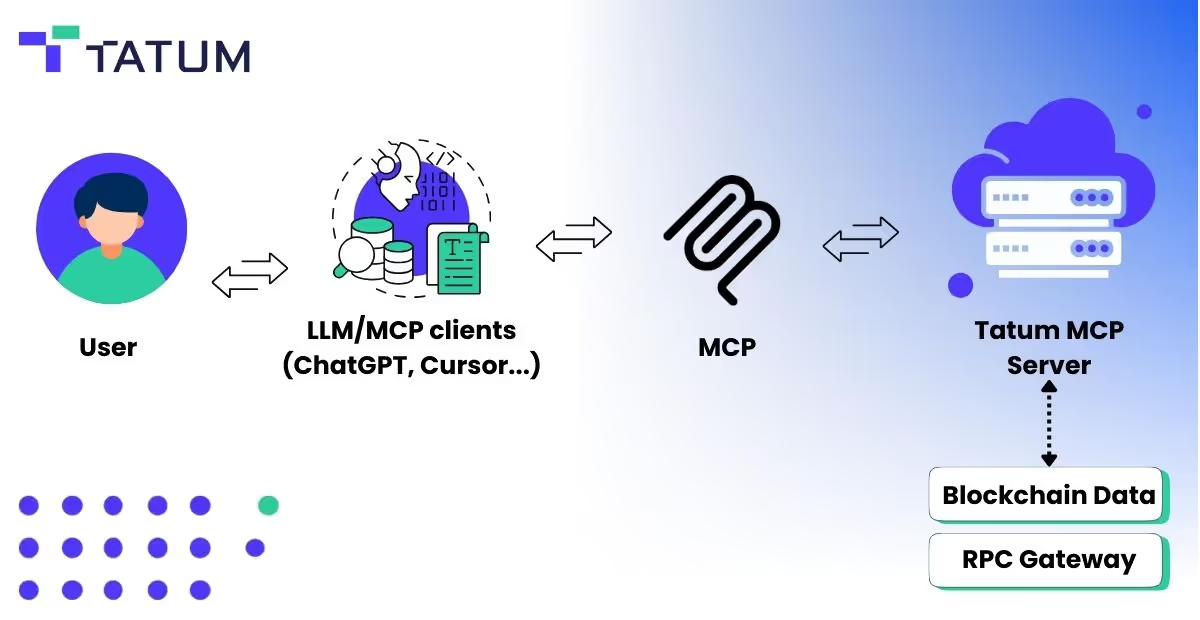
Use the API reference for request schemas, platform filter rules, and error codes — or connect the Tatum docs MCP server to query endpoint details in AI workflows.
Live prediction markets explorer
Add your API key and pull live markets from GET /v4/data/prediction/markets — filter by platform, status, and sort by volume.
| # | Market | Platform | Status | Yes | Volume | Liquidity |
|---|---|---|---|---|---|---|
| 1 | Will BTC reach $150k in 2026? 0xe06a…c61 | polymarket | active | 0.42 | 1.2M | 84k |
| 2 | Fed cuts rates before July? KXRATEJUL-26 | kalshi | open | 0.61 | 420k | — |
Explorer locked
Get your API key and click Unlock & fetch to load live Polymarket and Kalshi markets.
Other Blockchain APIs Worth Knowing
Not every useful API fits into a core stack, but some are still important depending on what you are building.
NFT API
NFT APIs handle metadata, ownership, and transfers for non fungible tokens.
They are essential for NFT marketplaces, gaming platforms, and digital collectibles. However, for general purpose applications, NFT functionality is often just one component rather than a core dependency.
Don't we all love our NFTs?
Mining API
Mining APIs provide data about mining rewards and network activity.
They are mainly relevant for proof of work chains. As more ecosystems move toward proof of stake, their importance has become more limited for most developers.
Final Thoughts
Building in Web3 today is less about accessing blockchain data and more about structuring it in a way that actually makes sense for users.
The gap between raw onchain data and usable application logic is still wide. The developers who close that gap are the ones who win. Not by adding more features, but by choosing the right data layers and combining them effectively.
In practice, most applications do not need everything from day one. A solid foundation usually starts with wallet, transaction, and token data. From there, pricing, DeFi, and identity layers add context. Security and prediction APIs come later, when you are optimizing for trust and decision making.
The important shift in 2026 is this. Web3 apps are no longer just interfaces to the blockchain. They are data driven systems that interpret, filter, and sometimes even anticipate what is happening onchain.
If you think about APIs as building blocks rather than endpoints, it becomes much easier to design systems that scale and evolve with the ecosystem.
That is ultimately the goal. Not just to read blockchain data, but to turn it into something users can actually use.
%20(44).jpg)