

%20(67).jpg)
Polkadot is one of those protocols that rewards you the more you understand it. On the surface, it looks like another layer-1 blockchain competing for developer attention. But spend some time with the architecture and it becomes clear that Polkadot is doing something fundamentally different. It is not trying to be the fastest chain or the cheapest chain. It is trying to be the infrastructure layer that connects and coordinates everything else.
In 2026, and after the transition to Polkadot 2.0 that vision is more concrete than ever. Parachain slot auctions are gone. Agile Coretime has replaced them with a flexible blockspace marketplace. JAM is on the horizon, pointing toward a future where Polkadot functions less like a blockchain and more like a decentralized computing substrate. If you are building in Web3 and have not looked at Polkadot recently, this is a good time to catch up.
What Makes Polkadot a Layer-0 Protocol
Most blockchains operate at layer-1, meaning they are sovereign networks with their own consensus, their own security, and their own rules. Polkadot sits one level below that. It provides the shared security, finality, and communication infrastructure that other blockchains, called parachains, can plug into.
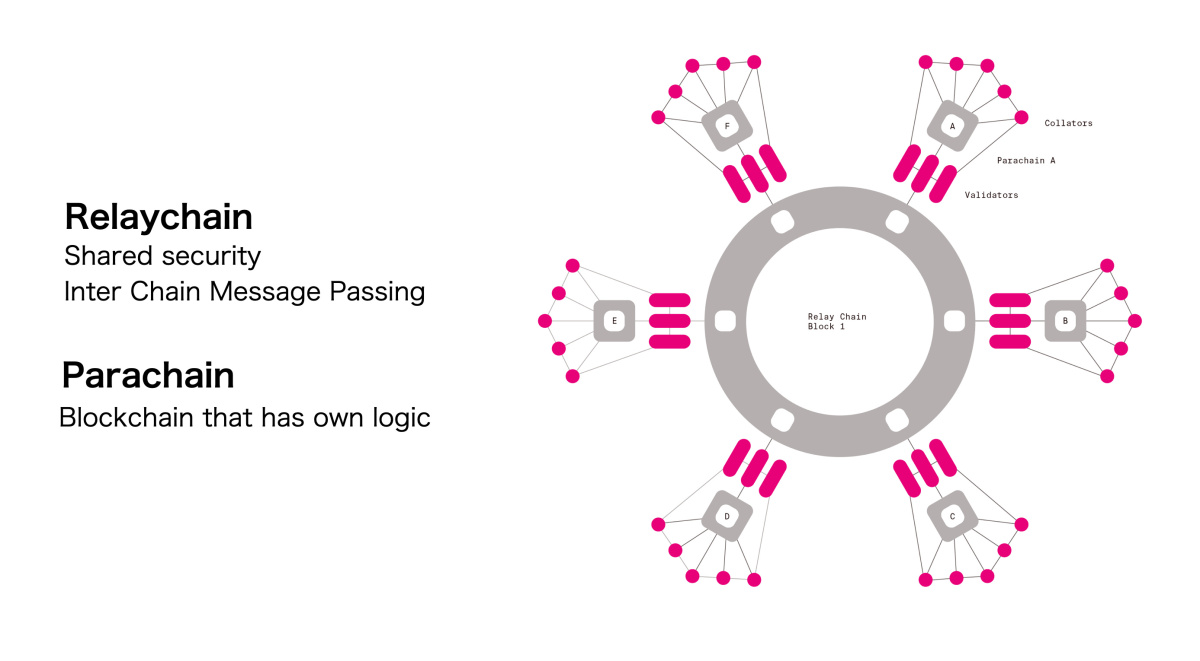
The core of Polkadot is the Relay Chain. This is the root chain responsible for network security and consensus. It does not handle general smart contract execution. Its job is coordination: validating the state transitions of all connected parachains and ensuring they finalize correctly. This separation of concerns is intentional. The Relay Chain stays lean so parachains can specialize.
Polkadot uses a consensus mechanism called BABE for block production and GRANDPA for finality. Together they allow the network to produce blocks quickly while achieving deterministic finality, meaning once a block is finalized, it cannot be reverted. This is a meaningful property for cross-chain applications where you need to trust that state changes on one chain are permanent before acting on another.
How Parachains Work
Parachains are sovereign blockchains that lease blockspace on the Relay Chain.
They maintain their own state, run their own logic, and can support anything from DeFi protocols to identity systems to gaming infrastructure. What they get in return for connecting to Polkadot is pooled security. Rather than bootstrapping their own validator set from scratch, they inherit the economic security of the entire Polkadot network.
Each parachain has a collator node that bundles transactions into blocks and submits them to Relay Chain validators for verification. The validators check the state transition is valid according to the parachain's own rules, then include a proof in the Relay Chain block. This is how Polkadot achieves shared security without requiring every validator to run every chain's full node.
Nominated Proof of Stake (NPoS) Explained
Polkadot secures the network through Nominated Proof of Stake, or NPoS. Validators are responsible for producing and finalizing blocks. Nominators back validators with their DOT stake, sharing in both rewards and the risk of slashing if a validator misbehaves.
What makes NPoS distinct is the election mechanism. Polkadot uses a proportional representation algorithm to select validators in a way that distributes stake as evenly as possible across the active set. This is designed to prevent stake concentration and make it harder for any single actor to dominate validation. In 2026, the active validator set sits in the hundreds, making Polkadot one of the more decentralized proof-of-stake networks by that measure.
XCM: How Polkadot Handles Cross-Chain Communication
Cross-chain messaging in most ecosystems is a bridge problem. You deploy a bridge contract, lock assets on one side, mint representations on the other, and hope nothing goes wrong. Polkadot takes a different approach with XCM, which stands for Cross-Consensus Messaging.
XCM is not a bridge protocol. It is a messaging format, a language that different consensus systems use to express instructions to one another. An XCM message might say "transfer this asset to this account on that chain" or "execute this operation if this condition is met." Because XCM is built into the Polkadot runtime and parachains implement it natively, cross-chain transfers and calls between parachains do not require external bridge infrastructure. They happen through the Relay Chain using the same security guarantees that secure the whole network.
This matters for developers building multi-chain applications. Instead of managing bridge risk and custom integration work for every chain you want to interact with, XCM gives you a standardized way to move assets and trigger logic across the ecosystem. XCM v3 and the subsequent updates have expanded what is expressible in these messages, including conditional execution, fee payment in foreign assets, and more complex multi-hop routing.
Agile Coretime: The End of Parachain Slot Auctions
For most of Polkadot's early history, getting a parachain slot meant winning a candle auction and locking up DOT for a lease period of up to two years. It was an effective mechanism for bootstrapping the network, but it created real friction for smaller teams and projects that did not need a full dedicated slot.
Agile Coretime changes this completely. Instead of auctioning fixed slots, Polkadot now sells blockspace as a commodity called Coretime. Developers can purchase bulk Coretime, which is essentially a continuous allocation of blockspace for a period, or on-demand Coretime, which lets you pay for individual blocks as you need them.
This shift has significant practical implications. A team building a proof of concept no longer needs to commit millions in locked DOT just to test their parachain on a live network. A production parachain with predictable load can buy bulk Coretime efficiently. A chain with spiky or seasonal usage can mix bulk and on-demand allocations. The blockspace market becomes flexible and composable rather than rigid and capital-intensive.
For Web3 builders, Agile Coretime is probably the single most important change to how Polkadot works in recent years. It dramatically lowers the cost and commitment required to deploy parachain-level infrastructure.
Build on Polkadot Without Managing the Infrastructure
Connect to Polkadot and Asset Hub using reliable RPC access, a unified API for wallets and transactions, and built-in failover so you can focus on building, not on keeping nodes online.
Start building on PolkadotJAM: Polkadot's Vision for Decentralized Computation
JAM stands for Join-Accumulate Machine, and it represents the longer-term architectural direction for Polkadot. Where the current Relay Chain is specialized for parachain coordination, JAM is designed as a more general-purpose decentralized computer.
The core idea behind JAM is to separate computation from state. Work is submitted to the network, executed in parallel across validators, and then the results are accumulated into on-chain state. This model is inspired by how cloud computing handles workloads, distributing execution across nodes rather than requiring every node to process everything sequentially.
JAM would allow developers to run arbitrary computational workloads on Polkadot's validator set, not just blockchain state transitions. This opens up use cases that do not fit neatly into the current parachain model, including off-chain data processing, more complex rollup schemes, and application logic that does not need to be a full chain.
JAM is still being developed and is not yet live on mainnet. But it is worth understanding because it signals where the Polkadot core team sees the protocol going. The goal is not just to connect blockchains but to provide a credibly neutral, decentralized substrate for computation at scale.
Polkadot Asset Hub: Managing Assets Across the Ecosystem
Asset Hub is a system parachain on Polkadot that handles asset issuance and management at the protocol level. If you want to create a fungible token, an NFT collection, or manage cross-chain asset transfers across the Polkadot ecosystem, Asset Hub is where that happens.
Because Asset Hub is a system parachain rather than a third-party chain, it benefits from the full security of the Relay Chain and has privileged communication pathways to other parachains via XCM. Stablecoins, bridged assets from other ecosystems, and native Polkadot tokens all flow through Asset Hub as the canonical registry.
For developers, this means there is a well-defined place to anchor asset logic rather than fragmenting it across multiple chains. It also simplifies the mental model for cross-chain asset transfers: assets have a home on Asset Hub, and XCM messages move representations of those assets to wherever they are needed.
Kusama: The Canary Network Developers Actually Use
Kusama is often described as Polkadot's testnet, but that description undersells it. Kusama is a fully independent network with its own validator set, its own token (KSM), and real economic value at stake. The difference from Polkadot is that Kusama runs with faster governance parameters and a higher tolerance for risk, making it the place where new features ship first and where teams can deploy production-grade parachains without the full weight of Polkadot's conservative governance.
In practice, many projects launch on Kusama first as a genuine production deployment, gather data and user activity, then graduate to Polkadot. Others build exclusively on Kusama and Kusama Asset Hub because the faster iteration cycle suits their needs. Kusama also gets Coretime and the same XCM messaging capabilities as Polkadot, so building on Kusama is not a significantly different technical experience.
If you are evaluating Polkadot as a deployment target, it is worth thinking of Kusama and Polkadot as a two-tier system rather than treating Kusama as something to skip.
How to Connect to Polkadot as a Developer
Getting connected to Polkadot for development starts with RPC access. The Polkadot JSON-RPC interface is the standard way to query chain state, submit transactions, and subscribe to events. Most tooling in the ecosystem, including Polkadot.js, SubXT, and the various substrate SDKs, communicates through this interface.
Making your first call on Polkadot
For production applications, depending on public endpoints is a liability. Public Polkadot RPC nodes get rate-limited, go out of sync with the chain tip, and have no guaranteed uptime. When your application is handling real transactions, that kind of instability is not acceptable.
This is where Tatum's RPC Gateway becomes relevant. The Gateway is a middleware layer that sits in front of your node pool and handles routing, failover, and consistency automatically. If one node falls behind the chain tip or goes offline entirely, the Gateway detects it and reroutes traffic to a healthy node instantly. You get 99.9% uptime without managing that complexity yourself.
You can configure the Gateway with your own routing strategy, either priority-based, where you define a preferred node order, or weighted, where traffic is distributed across nodes according to rules you set. The Gateway continuously evaluates node health and applies your strategy on every request. For a network like Polkadot where parachain state and Relay Chain state need to stay in sync, having consistent and reliable RPC access is not just a convenience, it is a correctness requirement.
You can set up your first gateway through the Tatum Dashboard or via the Gateway Management API, and point your existing Polkadot tooling at it without changing anything else in your stack. If you are building on Kusama as well, the same gateway infrastructure covers both networks.
.png)
The v1 REST API and What It Means for Builders
Polkadot's native RPC is powerful but has a learning curve. The substrate JSON-RPC surface is large and the data structures it returns require some familiarity with the ecosystem to work with efficiently. This is one reason higher-level REST API abstractions have become useful for teams that want to integrate Polkadot without becoming substrate experts.
Tatum's v1 API includes Polkadot support, exposing common operations like querying balances, fetching transaction history, and working with assets through a clean REST interface. For teams already working across multiple chains who want consistent tooling, this is a practical way to add Polkadot to your stack without a steep onboarding curve. Combined with the RPC Gateway for reliable node access, you have a solid foundation for building production-grade Polkadot applications without standing up your own infrastructure.
Why Polkadot's Architecture Matters for Web3 Builders
The Web3 landscape in 2026 is increasingly multi-chain by default. Users move assets across ecosystems, applications span multiple chains, and infrastructure decisions made today have long-term implications. In that context, Polkadot's architectural bets start to look prescient.
Shared security means parachain teams are not starting from zero on the hardest problem in crypto: building a secure validator network. XCM means cross-chain communication is a protocol-level feature rather than an afterthought. Coretime means blockspace is accessible to projects at different scales without the old capital requirements. And JAM, if it ships as designed, would make Polkadot something closer to a decentralized cloud than a blockchain network.
None of this means Polkadot is the right choice for every project. Ethereum has deeper liquidity and tooling. Other ecosystems have faster iteration cycles or larger user bases in specific verticals. But if you are building something that benefits from sovereign chain architecture, native cross-chain communication, or flexible blockspace access, Polkadot in 2026 deserves a serious look.
The protocol has matured significantly since its launch, and the shift from parachain auctions to Coretime alone removes one of the biggest practical barriers that kept smaller teams from building on it. Combined with the tooling improvements across the ecosystem and better API access options for developers, the activation energy required to get started is lower than it has ever been.